Are some political party stances due to random chance?, with Michael Macy

Are some political party stances due to random chance?, with Michael Macy

I talk with Michael Macy, whose research on “opinion cascades” show how some political group stances on issues can be rather arbitrary and due to initial conditions. Similar to how in many complex systems, slightly different initial conditions can lead to vastly different results later on, the early conditions in a country, including early opinion-holders and influencers, can influence a political party to be aligned with one or another stance on an issue. These early choices have a cascading effect, meaning that, for some issues, the political parties could hold reversed positions if things had gone a bit differently.

Topics discussed: How was his opinion cascade research set up? What political party stances might be due to fundamental ideological differences versus which ones may be more arbitrary and due to chance? Could Democrat and Republican party stances on abortion, immigration, and other issues actually be reversed in a slightly different world? How does this work relate to problematic political polarization? Is there something inherent in humans that lead them to form contentious us-versus-them groups?

Learn more about the show and get transcripts at ⁠behavior-podcast.com⁠⁠.


Hosted by Simplecast, an AdsWizz company. See pcm.adswizz.com for information about our collection and use of personal data for advertising.

Denne episoden er hentet fra en åpen RSS-feed og er ikke publisert av Podme. Den kan derfor inneholde annonser.

Episoder(219)

Army Psy-Op veteran talks influence, blowback, psy-op myths, and more

Army Psy-Op veteran talks influence, blowback, psy-op myths, and more

A talk with an Army Psychological Operations soldier about what military psy-op work really involves—and how different the reality is from many people's ideas about the nature of that work. We discuss...

28 Aug 1h 28min

Can computers spot lies better than humans?, with Bennett Kleinberg

Can computers spot lies better than humans?, with Bennett Kleinberg

Can machines spot a lie better than we can? I talk with psychology researcher Bennett Kleinberg, whose work brings together psychology, machine learning, natural-language processing, and deception det...

12 Aug 1h

Inside a Scientology e-meter auditing session, with Chris Shelton

Inside a Scientology e-meter auditing session, with Chris Shelton

Former Scientologist Chris Shelton spent thousands of hours using the e-meter to "audit" fellow members of the Church—but what does the device actually measure, and why do Scientologists trust it as a...

2 Aug 1h 23min

How Pete Blair scored 100% in a deception detection study

How Pete Blair scored 100% in a deception detection study

In a 2014 deception detection study, Pete Blair made 33 judgments—and got all 33 right. That paper was titled “Expertise in deception detection involves actively prompting diagnostic information rathe...

24 Jul 1h 3min
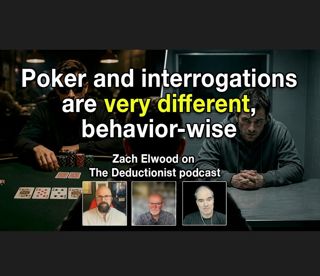
Behaviorally, poker and interrogations are very different

Behaviorally, poker and interrogations are very different

Zach Elwood, author of influential books on poker tells and host of the People Who Read People podcast, joins The Deductionist podcast for a wide-ranging conversation about what we can and can't learn...

10 Jul 49min

Understanding defenses of the polygraph, with David Goldberg

Understanding defenses of the polygraph, with David Goldberg

Polygraphs are a controversial tool in criminal investigations: critics argue they're too unreliable to trust, while proponents say that, even if they’re not perfect, they nonetheless can play a valua...

1 Jul 1h 19min
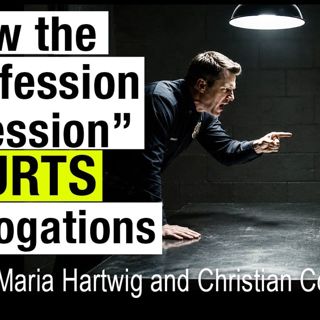
The push for science-based interrogation approaches, with Maria Hartwig and Christian Cory

The push for science-based interrogation approaches, with Maria Hartwig and Christian Cory

In real or fictional criminal interrogation scenes, you've probably seen the approach where police barge in and confront the suspect with the evidence, trying to get them to crack and give a confessio...

20 Jun 53min
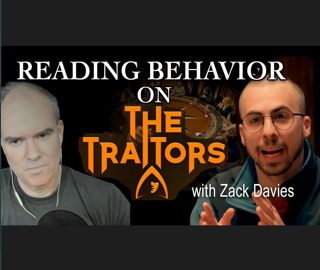
Reading behavior in The Traitors and other social deduction games, with Zack Davies (UK season 2)

Reading behavior in The Traitors and other social deduction games, with Zack Davies (UK season 2)

Zack Davies was a standout contestant on the popular reality TV show The Traitors (UK, season 2). The Traitors is what is called a social deduction game, similar to the games Werewolf and Mafia. In th...

13 Jun 1h

Populært innen Politikk og nyheter

giver-og-gjengen-vg
aftenpodden
bt-dokumentar-2
aftenpodden-usa
popradet
forklart
stopp-verden
fotballpodden-2
det-store-bildet
nokon-ma-ga
rss-espen-lee-usensurert
dine-penger-pengeradet
rss-gukild-johaug
hanna-de-heldige
rss-ness
saken
aftenbla-bla
rss-penger-polser-og-politikk
unitedno
frokostshowet-pa-p5