178. Things get radical

178. Things get radical

1910 was a year of battle between the House of Commons and the House of Lords. Which means a year of battle between the Liberals, with their (initially) huge majority in the Commons, and the Unionists with an equally massive (and entrenched) majority in the Lords.

Two issues needed settling between them.

Firstly, what would happen to Lloyd George’s People’s Budget, which the Lords had already rejected once. That would be the issue decided by the general election of January 1910.

It was won by the Liberals, though only just and without an overall majority. However, with help from the Irish Nationalist MPs and Labour, they could form another government and resubmit the budget. Having seen the Liberals win the election, however narrowly, and faced with the threat of the king creating a load more Liberal peers to give them their own majority, the Lords caved and passed the budget.

Secondly, it was time to settle the relationship between the two Houses of Parliament. Since the Lords couldn’t be expected to vote to reduce their own powers, the government again turned to the king to have him create enough Liberal peers to force a measure through. He argued that it would require another election, so Brits were called to the ballot box again in December 1910, for the second time that year.

Again, and for the last time in their history, the Liberals emerged as the biggest single party in the Commons, though again without a majority. Once more, with support from the Irish MPs and Labour, they could form a government. And, again, faced with the prospect of huge numbers of Liberal peers joining the Lords, the upper house caved, passing the legislation that massively reduced its say in politics.

As their price for the support the Liberals needed, the Irish MPs were looking for renewed moves towards Home Rule, while Labour wanted to see more progressive measures adopted. And both groups had the presence in parliament to get their demands listened to.

Which must have been painful for the women’s movement. It needed influence to win the vote. Without the vote, however, it lacked influence.

A frustrating Catch-22 position to be in.


Illustration: The first page of the Parliament Act of 1911.

Music: Bach Partita #2c by J Bu licensed under an Attribution-NonCommercial-No Derivatives (aka Music Sharing) 3.0 International License.


Episoder(275)

250. Return of the crisis man

250. Return of the crisis man

When Harold Wilson formed his second government, he immediately faced a major crisis inherited from Heath’s administration: the coalminers were on strike, a state of Emergency (Heath’s fifth in four y...

6 Jul 202514min
249. Who governs Britain?

249. Who governs Britain?

How did Heath end up calling an election on the question of who governed the country? Especially as the choice he seemed to be offering was between him and the minders. This episode traces the impact ...

5 Jul 202514min
248. Withered Heath

248. Withered Heath

Ted Heath’s government had to deal with two problems drawn from Britain’s postimperial standing: • adapting to its loss of global status, by negotiating, at the third time of asking and for the first ...

22 Jun 202514min
247. Hopes dashed

247. Hopes dashed

After talking last week about his government’s achievements in the social sphere, this episode looks at the difficulties Wilson faced in economics and foreign affairs.One way Wilson explored to addres...

15 Jun 202514min
246. The sixties, swinging - high and low

246. The sixties, swinging - high and low

According to the English poet Philip Larkin, the sixties saw the invention of sexual intercourse. While that may not be quite the case, it was certainly a time when a lot of people decided that it was...

8 Jun 202514min
245. Pressures preventing progress

245. Pressures preventing progress

The Wilson government got off to a pretty sticky start, with the new Prime Minister learning, more or less as he arrived at Downing Street in October 1964, that the trade deficit for the year was like...

1 Jun 202514min
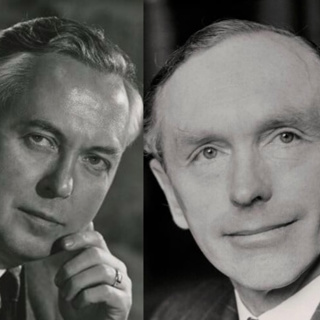
244. Harold gets Home

244. Harold gets Home

Here we’re focusing on the changes that took place in Britain after Supermac (Harold Macmillan) stood down as Prime Minister.A lot of how that went depended on the Opposition formed by the Labour Part...

25 Mai 202514min

243. Sex, spies and a slippery slope

243. Sex, spies and a slippery slope

Last time we looked at the continuing disintegration of the British Empire. In this episode we look at two other key aspects of Macmillan’s foreign policy, Britain’s relations with the US and with pot...

18 Mai 202515min

Populært innen Historie

med-egne-oyne
rss-dette-ma-aldri-skje-igjen
rss-katastrofe
henrettelsespodden
historier-som-endret-norge
rss-benadet
historier-som-endret-verden
sektledere
rss-frontkjemperne
aftenposten-historie
rss-strid-de-norske-borgerkrigene
rss-nadelose-nordmenn-gestapo
historiepodden
rss-bisarr-historie
rss-politisk-preik
liberal-halvtime
vare-historier
undersattene
rss-gamle-greier
rss-historiepodden-ww2