Thomas Friedman on Thriving in the Age of Acceleration

Thomas Friedman on Thriving in the Age of Acceleration

He has been called ‘the most influential columnist in America’, and is read by everyone from small-business owners to President Obama. As a star columnist of The New York Times, Thomas Friedman has won the Pulitzer Prize three times. Although he has been dubbed ‘the high priest of globalisation’, Friedman is well aware that it is the tensions created by globalisation which have paved the way for the election of Donald Trump. Nevertheless, when he comes to the Intelligence Squared stage, Friedman will argue that contrary to Trump’s promises of walls and tariffs, it is openness to trade and ideas that will allow us all to thrive amid the rapid, startling changes sweeping through the world. Given the dizzying whirlwind of technological change which has wiped out jobs and transformed workplaces, it is no wonder that electorates have reached for Trump’s protectionist solutions in the US and nativist retrenchment in the UK. But, as Friedman will argue, the forces of globalisation needn't spell disaster. Instead, it is how we respond to these accelerating changes that will determine whether we falter or flourish. Both the EU referendum and the US presidential election were contests not between left and right, but between what Friedman calls ‘Wall People’ — those who feel their identity threatened by globalisation — and ‘Web People’: those who instinctively embrace the current pace of change and are keen to collaborate in a world without walls. In this major event, Friedman will offer his guide to updating our lives and institutions for the accelerating changes of the 21st century. For example: We need to innovate not just technologically, but politically: moral leadership in a complex world is becoming ever more essential Political leaders should be accelerating local start-ups in both the economic sector and the social sector, to build resilient and prospering citizens The ideal skill set for the jobs of the future is ‘stempathy’: science, technology, maths — and empathy Join us on January 24th, and hear how the new asset class is not information but ‘human capital talent’, and how we can all thrive in the age of acceleration. Support this show http://supporter.acast.com/intelligencesquared. See acast.com/privacy for privacy and opt-out information. Learn more about your ad choices. Visit podcastchoices.com/adchoices

Episoder(1536)

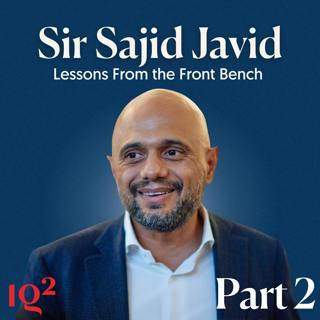
Sir Sajid Javid – Lessons From the Front Bench (Part Two)

Sir Sajid Javid – Lessons From the Front Bench (Part Two)

For more than a decade, Sir Sajid Javid was at the heart of power in Britain. First elected in 2010, he rapidly rose to his first cabinet position as Culture Secretary. The son of a bus driver and com...

8 Feb 36min
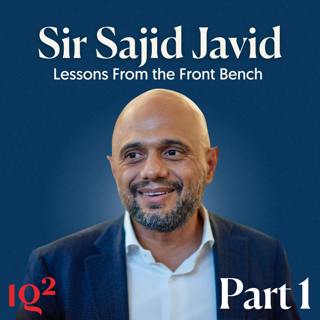
Sir Sajid Javid – Lessons From the Front Bench (Part One)

Sir Sajid Javid – Lessons From the Front Bench (Part One)

For more than a decade, Sir Sajid Javid was at the heart of power in Britain. First elected in 2010, he rapidly rose to his first cabinet position as Culture Secretary. The son of a bus driver and com...

6 Feb 41min
Can Water Shape Our Future?

Can Water Shape Our Future?

In today’s episode, the second in our series in partnership with WaterAid, journalist and author Coco Khan speaks to Helen Rumford, WaterAid’s Lead Policy Analyst for Climate Policy and Campaigns and ...

4 Feb 29min
Julian Barnes in conversation with Ian McEwan (Part Two)

Julian Barnes in conversation with Ian McEwan (Part Two)

Julian Barnes and Ian McEwan are widely celebrated as two of the finest writers of their generation. Along with Salman Rushdie and Kazuo Ishiguro, they were included on Granta’s prescient Best Young B...

3 Feb 43min
Julian Barnes in conversation with Ian McEwan (Part One)

Julian Barnes in conversation with Ian McEwan (Part One)

Julian Barnes and Ian McEwan are widely celebrated as two of the finest writers of their generation. Along with Salman Rushdie and Kazuo Ishiguro, they were included on Granta’s prescient Best Young B...

2 Feb 39min
Why Can’t We Stop Money Laundering? With Oliver Bullough

Why Can’t We Stop Money Laundering? With Oliver Bullough

In an increasingly digital world, hardly anyone relies on cash. $100 bills are essentially absent from global commerce. So how come the US Federal Reserve printed 752 million and 867.2 million of them...

1 Feb 42min
Is the Arctic the World’s Next War Zone? With Kenneth R. Rosen

Is the Arctic the World’s Next War Zone? With Kenneth R. Rosen

Why Is Everyone Suddenly Fighting Over the Arctic? In this episode, Adam McCauley speaks to journalist and author Kenneth R. Rosen about the Arctic’s shifting geopolitical role in the new world order...

30 Jan 51min
Implementing and scaling AI agents in business

Implementing and scaling AI agents in business

Many organisations are experimenting with AI and AI agents. But far fewer are seeing real, measurable impact. The challenge isn’t ambition, it’s readiness. As we explored in the first episode of this ...

29 Jan 35min

Populært innen Politikk og nyheter

giver-og-gjengen-vg
aftenpodden
forklart
popradet
aftenpodden-usa
stopp-verden
lydartikler-fra-aftenposten
rss-gukild-johaug
det-store-bildet
fotballpodden-2
i-retten
dine-penger-pengeradet
rss-ness
nokon-ma-ga
aftenbla-bla
hanna-de-heldige
frokostshowet-pa-p5
rss-penger-polser-og-politikk
bt-dokumentar-2
rss-dannet-uten-piano