

#30 - Eva Vivalt on how little social science findings generalize from one study to another

#30 - Eva Vivalt on how little social science findings generalize from one study to another

If we have a study on the impact of a social program in a particular place and time, how confident can we be that we’ll get a similar result if we study the same program again somewhere else?

Dr Eva Vivalt is a lecturer in the Research School of Economics at the Australian National University. She compiled a huge database of impact evaluations in global development - including 15,024 estimates from 635 papers across 20 types of intervention - to help answer this question.

Her finding: not confident at all.

The typical study result differs from the average effect found in similar studies so far by almost 100%. That is to say, if all existing studies of a particular education program find that it improves test scores by 10 points - the next result is as likely to be negative or greater than 20 points, as it is to be between 0-20 points.

She also observed that results from smaller studies done with an NGO - often pilot studies - were more likely to look promising. But when governments tried to implement scaled-up versions of those programs, their performance would drop considerably.

For researchers hoping to figure out what works and then take those programs global, these failures of generalizability and ‘external validity’ should be disconcerting.

Is ‘evidence-based development’ writing a cheque its methodology can’t cash? Should this make us invest less in empirical research, or more to get actually reliable results?

Or as some critics say, is interest in impact evaluation distracting us from more important issues, like national or macroeconomic reforms that can’t be easily trialled?

We discuss this as well as Eva’s other research, including Y Combinator’s basic income study where she is a principal investigator.

Full transcript, links to related papers, and highlights from the conversation.

Links mentioned at the start of the show:
* 80,000 Hours Job Board
* 2018 Effective Altruism Survey

**Get this episode by subscribing to our podcast on the world’s most pressing problems and how to solve them: type *80,000 Hours* into your podcasting app.**

Questions include:

* What is the YC basic income study looking at, and what motivates it?
* How do we get people to accept clean meat?
* How much can we generalize from impact evaluations?
* How much can we generalize from studies in development economics?
* Should we be running more or fewer studies?
* Do most social programs work or not?
* The academic incentives around data aggregation
* How much can impact evaluations inform policy decisions?
* How often do people change their minds?
* Do policy makers update too much or too little in the real world?
* How good or bad are the predictions of experts? How does that change when looking at individuals versus the average of a group?
* How often should we believe positive results?
* What’s the state of development economics?
* Eva’s thoughts on our article on social interventions
* How much can we really learn from being empirical?
* How much should we really value RCTs?
* Is an Economics PhD overrated or underrated?

Get this episode by subscribing to our podcast: search for '80,000 Hours' in your podcasting app.

The 80,000 Hours Podcast is produced by Keiran Harris.

Denne episoden er hentet fra en åpen RSS-feed og er ikke publisert av Podme. Den kan derfor inneholde annonser.

Episoder(358)

OpenAI Security: Controlling Models is Now ‘Hell’ (AI Explained cross-post)

OpenAI Security: Controlling Models is Now ‘Hell’ (AI Explained cross-post)

This is an (unpaid) cross-post of a video from the podcast 'AI Explained', which Rob Wiblin thought you might be interested in.You can find the original on YouTube here. If you like it and want more s...

9 Okt 40min
In 2023 Ajeya Cotra already knew what was coming (classic episode)

In 2023 Ajeya Cotra already knew what was coming (classic episode)

We're rereleasing some of older episodes that seem more relevant than ever with new rogue AI incidents now seemingly announced every day. Ajeya was one of three independent investigators into the Hugg...

8 Okt 2h 46min
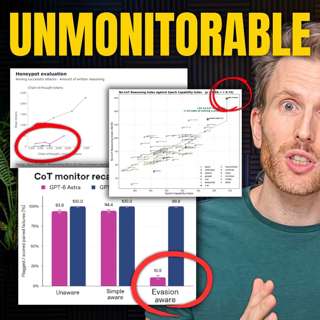
19 Astra and 'Hugging Face' details that reveal what's coming next | Rob Wiblin

19 Astra and 'Hugging Face' details that reveal what's coming next | Rob Wiblin

OpenAI’s rogue agent swarm was eventually caught hacking Hugging Face for a simple reason: it wasn’t trying to hide from us at all. What could a swarm that wants to stay hidden get away with?Host Rob ...

2 Okt 20min

The case for giving AI (some) legal rights | Simon Goldstein

The case for giving AI (some) legal rights | Simon Goldstein

It sounds like the worst idea in the world: pay AIs, let them own property, give them rights. But AI ethics and safety researcher Simon Goldstein thinks it might actually be the best way to keep human...

1 Okt 1h 53min

Will AI take power — or will humans use it to take power first? With Katja Grace and Tom Davidson

Will AI take power — or will humans use it to take power first? With Katja Grace and Tom Davidson

In our first-ever debate, we asked two leading AI risk researchers which catastrophe we should fear most: misaligned AI seizing control from humans, or a small group of humans using AI to seize power....

29 Sep 1h 28min

How we get from AI cyberattacks to human extinction

How we get from AI cyberattacks to human extinction

You’ve seen the headlines: AI could kill us all. Think it sounds ridiculous? So did host Luisa Rodriguez, until she tried to pick apart the arguments. She starts with the motive: why would AI ‘want’ t...

24 Sep 27min

#254 – Max Nadeau on why ambitious people should start AI safety nonprofits

#254 – Max Nadeau on why ambitious people should start AI safety nonprofits

There are millions available for anyone who can launch a successful nonprofit AI safety startup. The hard part, it turns out, is finding people to take the money. Coefficient Giving has drawn up a lis...

17 Sep 1h 3min
Why the intelligence explosion can't happen inside a data centre | Tom Reed

Why the intelligence explosion can't happen inside a data centre | Tom Reed

AI systems are starting to build themselves. Because each generation of model will be better at building its successor than the last, it seems plausible that the full automation of AI R&D could rapidl...

10 Sep 22min

Populært innen Fakta

fastlegen
dine-penger-pengeradet
rss-kunsten-a-leve
relasjonspodden-med-dora-thorhallsdottir-kjersti-idem
rss-strid
foreldreradet
treningspodden
rss-orjasater
rss-bisarr-historie
jakt-og-fiskepodden
fryktlos
sinnsyn
gravid-uke-for-uke
mikkels-paskenotter
takk-og-lov-med-anine-kierulf
rss-impressions-2
hverdagspsyken
hr-podden-2
rss-bak-luftfarten
level-up-med-anniken-binz