#88 – Tristan Harris on the need to change the incentives of social media companies

#88 – Tristan Harris on the need to change the incentives of social media companies

In its first 28 days on Netflix, the documentary The Social Dilemma — about the possible harms being caused by social media and other technology products — was seen by 38 million households in about 190 countries and in 30 languages.

Over the last ten years, the idea that Facebook, Twitter, and YouTube are degrading political discourse and grabbing and monetizing our attention in an alarming way has gone mainstream to such an extent that it's hard to remember how recently it was a fringe view.

It feels intuitively true that our attention spans are shortening, we’re spending more time alone, we’re less productive, there’s more polarization and radicalization, and that we have less trust in our fellow citizens, due to having less of a shared basis of reality.

But while it all feels plausible, how strong is the evidence that it's true? In the past, people have worried about every new technological development — often in ways that seem foolish in retrospect. Socrates famously feared that being able to write things down would ruin our memory.

At the same time, historians think that the printing press probably generated religious wars across Europe, and that the radio helped Hitler and Stalin maintain power by giving them and them alone the ability to spread propaganda across the whole of Germany and the USSR. Fears about new technologies aren't always misguided.

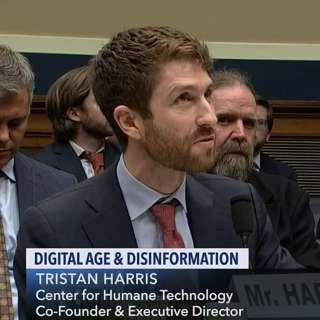
Tristan Harris, leader of the Center for Humane Technology, and co-host of the Your Undivided Attention podcast, is arguably the most prominent person working on reducing the harms of social media, and he was happy to engage with Rob’s good-faith critiques.

Links to learn more, summary and full transcript.
• FYI, the 2020 Effective Altruism Survey is closing soon: https://www.surveymonkey.co.uk/r/EAS80K2

Tristan and Rob provide a thorough exploration of the merits of possible concrete solutions – something The Social Dilemma didn’t really address.

Given that these companies are mostly trying to design their products in the way that makes them the most money, how can we get that incentive to align with what's in our interests as users and citizens?

One way is to encourage a shift to a subscription model.

One claim in The Social Dilemma is that the machine learning algorithms on these sites try to shift what you believe and what you enjoy in order to make it easier to predict what content recommendations will keep you on the site.

But if you paid a yearly fee to Facebook in lieu of seeing ads, their incentive would shift towards making you as satisfied as possible with their service — even if that meant using it for five minutes a day rather than 50.

Despite all the negatives, Tristan doesn’t want us to abandon the technologies he's concerned about. He asks us to imagine a social media environment designed to regularly bring our attention back to what each of us can do to improve our lives and the world.

Just as we can focus on the positives of nuclear power while remaining vigilant about the threat of nuclear weapons, we could embrace social media and recommendation algorithms as the largest mass-coordination engine we've ever had — tools that could educate and organise people better than anything that has come before.

The tricky and open question is how to get there.

Rob and Tristan also discuss:

• Justified concerns vs. moral panics
• The effect of social media on politics in the US and developing countries
• Tips for individuals

Chapters:

  • Rob’s intro (00:00:00)
  • The interview begins (00:01:36)
  • Center for Humane Technology (00:04:53)
  • Critics (00:08:19)
  • The Social Dilemma (00:13:20)
  • Three categories of harm (00:20:31)
  • Justified concerns vs. moral panics (00:30:23)
  • The messy real world vs. an imagined idealised world (00:38:20)
  • The persuasion apocalypse (00:47:46)
  • Revolt of the Public (00:56:48)
  • Global effects (01:02:44)
  • US politics (01:13:32)
  • Potential solutions (01:20:59)
  • Unintended consequences (01:42:57)
  • Win-win changes (01:50:47)
  • Big wins over the last 5 or 10 years (01:59:10)
  • The subscription model (02:02:28)
  • Tips for individuals (02:14:05)
  • The current state of the research (02:22:37)
  • Careers (02:26:36)


Producer: Keiran Harris.
Audio mastering: Ben Cordell.
Transcriptions: Sofia Davis-Fogel.

Episoder(325)

#43 - Daniel Ellsberg on the institutional insanity that maintains nuclear doomsday machines

#43 - Daniel Ellsberg on the institutional insanity that maintains nuclear doomsday machines

In Stanley Kubrick’s iconic film Dr. Strangelove, the American president is informed that the Soviet Union has created a secret deterrence system which will automatically wipe out humanity upon detect...

25 Sep 20182h 44min
#42 - Amanda Askell on moral empathy, the value of information & the ethics of infinity

#42 - Amanda Askell on moral empathy, the value of information & the ethics of infinity

Consider two familiar moments at a family reunion. Our host, Uncle Bill, takes pride in his barbecuing skills. But his niece Becky says that she now refuses to eat meat. A groan goes round the table; ...

11 Sep 20182h 46min

#41 - David Roodman on incarceration, geomagnetic storms, & becoming a world-class researcher

#41 - David Roodman on incarceration, geomagnetic storms, & becoming a world-class researcher

With 698 inmates per 100,000 citizens, the U.S. is by far the leader among large wealthy nations in incarceration. But what effect does imprisonment actually have on crime? According to David Roodman...

28 Aug 20182h 18min

#40 - Katja Grace on forecasting future technology & how much we should trust expert predictions

#40 - Katja Grace on forecasting future technology & how much we should trust expert predictions

Experts believe that artificial intelligence will be better than humans at driving trucks by 2027, working in retail by 2031, writing bestselling books by 2049, and working as surgeons by 2053. But ho...

21 Aug 20182h 11min

#39 - Spencer Greenberg on the scientific approach to solving difficult everyday questions

#39 - Spencer Greenberg on the scientific approach to solving difficult everyday questions

Will Trump be re-elected? Will North Korea give up their nuclear weapons? Will your friend turn up to dinner? Spencer Greenberg, founder of ClearerThinking.org has a process for working out such real...

7 Aug 20182h 17min

#38 - Yew-Kwang Ng on anticipating effective altruism decades ago & how to make a much happier world

#38 - Yew-Kwang Ng on anticipating effective altruism decades ago & how to make a much happier world

Will people who think carefully about how to maximize welfare eventually converge on the same views? The effective altruism community has spent a lot of time over the past 10 years debating how best t...

26 Jul 20181h 59min
#37 - GiveWell picks top charities by estimating the unknowable. James Snowden on how they do it.

#37 - GiveWell picks top charities by estimating the unknowable. James Snowden on how they do it.

What’s the value of preventing the death of a 5-year-old child, compared to a 20-year-old, or an 80-year-old? The global health community has generally regarded the value as proportional to the numbe...

16 Jul 20181h 44min

#36 - Tanya Singh on ending the operations management bottleneck in effective altruism

#36 - Tanya Singh on ending the operations management bottleneck in effective altruism

Almost nobody is able to do groundbreaking physics research themselves, and by the time his brilliance was appreciated, Einstein was hardly limited by funding. But what if you could find a way to unlo...

11 Jul 20182h 4min

Populært innen Fakta

fastlegen
dine-penger-pengeradet
relasjonspodden-med-dora-thorhallsdottir-kjersti-idem
treningspodden
foreldreradet
rss-strid-de-norske-borgerkrigene
rss-sunn-okonomi
jakt-og-fiskepodden
sinnsyn
takk-og-lov-med-anine-kierulf
rss-kunsten-a-leve
gravid-uke-for-uke
merry-quizmas
hverdagspsyken
hagespiren-podcast
smart-forklart
rss-kull
fryktlos
lederskap-nhhs-podkast-om-ledelse
hr-podden-2