
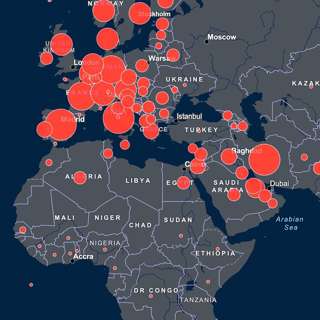
#128 – Chris Blattman on the five reasons wars happen

#128 – Chris Blattman on the five reasons wars happen

In nature, animals roar and bare their teeth to intimidate adversaries — but one side usually backs down, and real fights are rare. The wisdom of evolution is that the risk of violence is just too great.

Which might make one wonder: if war is so destructive, why does it happen? The question may sound naïve, but in fact it represents a deep puzzle. If a war will cost trillions and kill tens of thousands, it should be easy for either side to make a peace offer that both they and their opponents prefer to actually fighting it out.

The conundrum of how humans can engage in incredibly costly and protracted conflicts has occupied academics across the social sciences for years. In today's episode, we speak with economist Chris Blattman about his new book, Why We Fight: The Roots of War and the Paths to Peace, which summarises what they think they've learned.

Links to learn more, summary and full transcript.

Chris's first point is that while organised violence may feel like it's all around us, it's actually very rare in humans, just as it is with other animals. Across the world, hundreds of groups dislike one another — but knowing the cost of war, they prefer to simply loathe one another in peace.

In order to understand what’s wrong with a sick patient, a doctor needs to know what a healthy person looks like. And to understand war, social scientists need to study all the wars that could have happened but didn't — so they can see what a healthy society looks like and what's missing in the places where war does take hold.

Chris argues that social scientists have generated five cogent models of when war can be 'rational' for both sides of a conflict:

1. Unchecked interests — such as national leaders who bear few of the costs of launching a war.
2. Intangible incentives — such as an intrinsic desire for revenge.
3. Uncertainty — such as both sides underestimating each other's resolve to fight.
4. Commitment problems — such as the inability to credibly promise not to use your growing military might to attack others in future.
5. Misperceptions — such as our inability to see the world through other people's eyes.

In today's interview, we walk through how each of the five explanations work and what specific wars or actions they might explain.

In the process, Chris outlines how many of the most popular explanations for interstate war are wildly overused (e.g. leaders who are unhinged or male) or misguided from the outset (e.g. resource scarcity).

The interview also covers:

• What Chris and Rob got wrong about the war in Ukraine
• What causes might not fit into these five categories
• The role of people's choice to escalate or deescalate a conflict
• How great power wars or nuclear wars are different, and what can be done to prevent them
• How much representative government helps to prevent war
• And much more

Chapters:

  • Rob’s intro (00:00:00)
  • The interview begins (00:01:43)
  • What people get wrong about violence (00:04:40)
  • Medellín gangs (00:11:48)
  • Overrated causes of violence (00:23:53)
  • Cause of war #1: Unchecked interests (00:36:40)
  • Cause of war #2: Intangible incentives (00:41:40)
  • Cause of war #3: Uncertainty (00:53:04)
  • Cause of war #4: Commitment problems (01:02:24)
  • Cause of war #5: Misperceptions (01:12:18)
  • Weaknesses of the model (01:26:08)
  • Dancing on the edge of a cliff (01:29:06)
  • Confusion around escalation (01:35:26)
  • Applying the model to the war between Russia and Ukraine (01:42:34)
  • Great power wars (02:01:46)
  • Preventing nuclear war (02:18:57)
  • Why undirected approaches won't work (02:22:51)
  • Democratic peace theory (02:31:10)
  • Exchanging hostages (02:37:21)
  • What you can actually do to help (02:41:25)

Producer: Keiran Harris
Audio mastering: Ben Cordell
Transcriptions: Katy Moore

Episoder(333)

Emergency episode: Rob & Howie on the menace of COVID-19, and what both governments & individuals might do to help

Emergency episode: Rob & Howie on the menace of COVID-19, and what both governments & individuals might do to help

From home isolation Rob and Howie just recorded an episode on: 1. How many could die in the crisis, and the risk to your health personally. 2. What individuals might be able to do help tackle the coro...

19 Mar 20201h 52min

#73 – Phil Trammell on patient philanthropy and waiting to do good

#73 – Phil Trammell on patient philanthropy and waiting to do good

To do good, most of us look to use our time and money to affect the world around us today. But perhaps that's all wrong. If you took $1,000 you were going to donate and instead put it in the stock mar...

17 Mar 20202h 35min
#72 - Toby Ord on the precipice and humanity's potential futures

#72 - Toby Ord on the precipice and humanity's potential futures

This week Oxford academic and 80,000 Hours trustee Dr Toby Ord released his new book The Precipice: Existential Risk and the Future of Humanity. It's about how our long-term future could be better tha...

7 Mar 20203h 14min
#71 - Benjamin Todd on the key ideas of 80,000 Hours

#71 - Benjamin Todd on the key ideas of 80,000 Hours

The 80,000 Hours Podcast is about “the world’s most pressing problems and how you can use your career to solve them”, and in this episode we tackle that question in the most direct way possible. Las...

2 Mar 20202h 57min

Arden & Rob on demandingness, work-life balance & injustice (80k team chat #1)

Arden & Rob on demandingness, work-life balance & injustice (80k team chat #1)

Today's bonus episode of the podcast is a quick conversation between me and my fellow 80,000 Hours researcher Arden Koehler about a few topics, including the demandingness of morality, work-life balan...

25 Feb 202044min

#70 - Dr Cassidy Nelson on the 12 best ways to stop the next pandemic (and limit nCoV)

#70 - Dr Cassidy Nelson on the 12 best ways to stop the next pandemic (and limit nCoV)

nCoV is alarming governments and citizens around the world. It has killed more than 1,000 people, brought the Chinese economy to a standstill, and continues to show up in more and more places. But bad...

13 Feb 20202h 26min

#69 – Jeffrey Ding on China, its AI dream, and what we get wrong about both

#69 – Jeffrey Ding on China, its AI dream, and what we get wrong about both

The State Council of China's 2017 AI plan was the starting point of China’s AI planning; China’s approach to AI is defined by its top-down and monolithic nature; China is winning the AI arms race; and...

6 Feb 20201h 37min
Rob & Howie on what we do and don't know about 2019-nCoV

Rob & Howie on what we do and don't know about 2019-nCoV

Two 80,000 Hours researchers, Robert Wiblin and Howie Lempel, record an experimental bonus episode about the new 2019-nCoV virus.See this list of resources, including many discussed in the episode, to...

3 Feb 20201h 18min

Populært innen Fakta

fastlegen
dine-penger-pengeradet
relasjonspodden-med-dora-thorhallsdottir-kjersti-idem
mikkels-paskenotter
foreldreradet
rss-bisarr-historie
treningspodden
rss-strid-de-norske-borgerkrigene
jakt-og-fiskepodden
rss-sunn-okonomi
ukast
hverdagspsyken
lederskap-nhhs-podkast-om-ledelse
sinnsyn
rss-bak-luftfarten
takk-og-lov-med-anine-kierulf
fryktlos
rss-kunsten-a-leve
rss-kull
gravid-uke-for-uke