

[MINI] Monkeys on Typewriters
Data Skeptic14 Nov 2014

[MINI] Monkeys on Typewriters

What is randomness? How can we determine if some results are randomly generated or not? Why are random numbers important to us in our everyday life? These topics and more are discussed in this mini-episode on random numbers.

Many readers will be vaguely familar with the idea of "X number of monkeys banging on Y number of typewriters for Z number of years" - the idea being that such a setup would produce random sequences of letters. The origin of this idea was the mathemetician Borel who was interested in whether or not 1,000,000 monkeys working for 10 hours per day might eventually reproduce the works of shakespeare.

We explore this topic and provide some further details in the show notes which you can find over at dataskeptic.com

Denne episoden er hentet fra en åpen RSS-feed og er ikke publisert av Podme. Den kan derfor inneholde annonser.

Episoder(601)

Interpretability Practitioners

Interpretability Practitioners

Sungsoo Ray Hong joins us to discuss the paper Human Factors in Model Interpretability: Industry Practices, Challenges, and Needs.

26 Jun 202032min
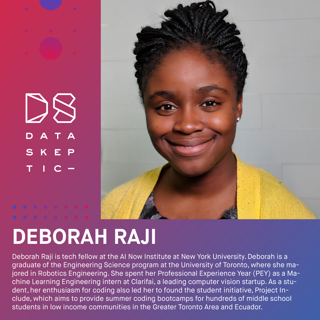
Facial Recognition Auditing

Facial Recognition Auditing

Deb Raji joins us to discuss her recent publication Saving Face: Investigating the Ethical Concerns of Facial Recognition Auditing.

19 Jun 202047min

Robust Fit to Nature

Robust Fit to Nature

Uri Hasson joins us this week to discuss the paper Robust-fit to Nature: An Evolutionary Perspective on Biological (and Artificial) Neural Networks.

12 Jun 202038min
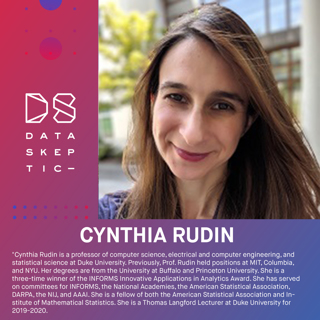
Black Boxes Are Not Required

Black Boxes Are Not Required

Deep neural networks are undeniably effective. They rely on such a high number of parameters, that they are appropriately described as "black boxes". While black boxes lack desirably properties like i...

5 Jun 202032min
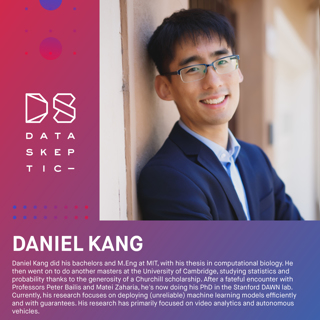
Robustness to Unforeseen Adversarial Attacks

Robustness to Unforeseen Adversarial Attacks

Daniel Kang joins us to discuss the paper Testing Robustness Against Unforeseen Adversaries.

30 Mai 202021min
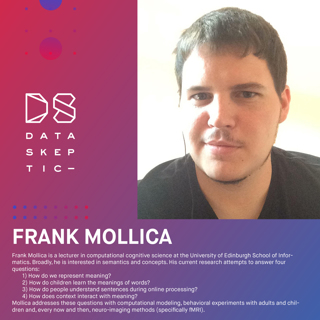
Estimating the Size of Language Acquisition

Estimating the Size of Language Acquisition

Frank Mollica joins us to discuss the paper Humans store about 1.5 megabytes of information during language acquisition

22 Mai 202025min
Interpretable AI in Healthcare

Interpretable AI in Healthcare

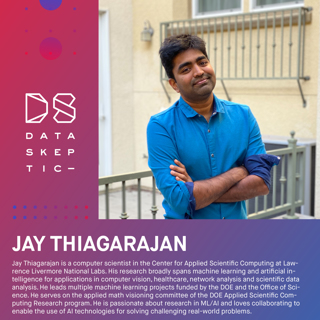
Jayaraman Thiagarajan joins us to discuss the recent paper Calibrating Healthcare AI: Towards Reliable and Interpretable Deep Predictive Models.

15 Mai 202035min

Understanding Neural Networks

Understanding Neural Networks

What does it mean to understand a neural network? That's the question posted on this arXiv paper. Kyle speaks with Tim Lillicrap about this and several other big questions.

8 Mai 202034min

Populært innen Vitenskap

fastlegen
tingenes-tilstand
jss
forskningno
rekommandert
rss-zahid-ali-hjelper-deg
rss-paradigmepodden
sinnsyn
vett-og-vitenskap-med-gaute-einevoll
rss-overskuddsliv
nordnorsk-historie
kvinnehelsepodden
tidlose-historier
villmarksliv
liberal-halvtime
rss-inn-til-kjernen-med-sunniva-rose
fjellsportpodden
grunnstoffene
nevropodden
rss-rekommandert