


100 Days
On Tuesday, the second Trump presidency officially reached the 100-day mark.It’s been a hundred days of transformation, tariffs, retribution, firings and deportation the likes of which America has never seen before.The Times journalists Michael Barbaro, Maggie Haberman, Jonathan Swan and Charlie Savage sit down to assess President Trump’s record.Guest:Maggie Haberman, a White House correspondent for The New York Times.Jonathan Swan, a White House reporter for The New York Times.Charlie Savage, who covers national security and legal policy for The New York Times.Background reading: 100 days into President Trump’s second term: What has changed?Mr. Trump’s 100-day report card.Eight charts that sum up Mr. Trump’s first 100 days.For more information on today’s episode, visit nytimes.com/thedaily. Transcripts of each episode will be made available by the next workday. Photo: Eric Lee/The New York Times Subscribe today at nytimes.com/podcasts or on Apple Podcasts and Spotify. You can also subscribe via your favorite podcast app here https://www.nytimes.com/activate-access/audio?source=podcatcher. For more podcasts and narrated articles, download The New York Times app at nytimes.com/app.
30 Apr 33min

The Housing Market Has New Rules. Realtors Are Evading Them.
Last year, a historic legal settlement resulted in sweeping rule changes that were supposed to lower the price of buying and selling a home across the country.But those changes would cost real-estate agents money, and so those agents, it turns out, have found ways around the new rules.Debra Kamin, who reports on real estate, explains how they did it.Guest: Debra Kamin, a reporter for the real estate section of The New York Times.Background reading: Home sellers and buyers have accused real-estate agents of blocking lower fees.The rule change was the result of a legal settlement last year by the National Association of Realtors.For more information on today’s episode, visit nytimes.com/thedaily. Transcripts of each episode will be made available by the next workday. Photo: Jamie Kelter Davis for The New York Times Subscribe today at nytimes.com/podcasts or on Apple Podcasts and Spotify. You can also subscribe via your favorite podcast app here https://www.nytimes.com/activate-access/audio?source=podcatcher. For more podcasts and narrated articles, download The New York Times app at nytimes.com/app.
29 Apr 30min

Americans to Trump: You’ve Gone Too Far
Warning: This episode contains strong language.One question that has hung over the first 100 days of President Trump’s second term: Is his aggressive approach to everything from deportations to tariffs what most Americans want — or has he simply gone too far?In a major new nationwide poll, voters tell The New York Times exactly how they feel about Trump’s agenda.Nate Cohn, The Times’s chief political analyst, explains the results.Guest: Nate Cohn, the chief political analyst for The New York Times.Background reading: Voters see President Trump’s use of power as overreaching, a Times/Siena poll found.Four perspectives on Mr. Trump’s weak poll numbers.For more information on today’s episode, visit nytimes.com/thedaily. Transcripts of each episode will be made available by the next workday. Photo: Eric Lee/The New York Times Subscribe today at nytimes.com/podcasts or on Apple Podcasts and Spotify. You can also subscribe via your favorite podcast app here https://www.nytimes.com/activate-access/audio?source=podcatcher. For more podcasts and narrated articles, download The New York Times app at nytimes.com/app.
28 Apr 29min

The Sunday Read: ‘The Strange, Post-Partisan Popularity of the Unabomber’
Online, there is a name for the experience of finding sympathy with Ted Kaczynski, the Unabomber: Tedpilling. To be Tedpilled means to read Paragraph 1 of Kaczynski’s manifesto, its assertion that the mad dash of technological advancement since the Industrial Revolution has “made life unfulfilling,” “led to widespread psychological suffering” and “inflicted severe damage on the natural world,” and think, Well, sure.Since Kaczynski’s death by suicide in a federal prison in North Carolina nearly two years ago, the taboo surrounding the figure has been weakening. This is especially true on the right, where pessimism and paranoia about technology — largely the province of the left not long ago — have spread on the heels of the coronavirus pandemic and efforts to police speech on social media platforms. Subscribe today at nytimes.com/podcasts or on Apple Podcasts and Spotify. You can also subscribe via your favorite podcast app here https://www.nytimes.com/activate-access/audio?source=podcatcher. For more podcasts and narrated articles, download The New York Times app at nytimes.com/app.
27 Apr 19min

'The Interview': Isabel Allende Understands How Fear Changes a Society
The beloved author left Chile at a time of great turmoil and has longed for the nation of her youth ever since. Subscribe today at nytimes.com/podcasts or on Apple Podcasts and Spotify. You can also subscribe via your favorite podcast app here https://www.nytimes.com/activate-access/audio?source=podcatcher. For more podcasts and narrated articles, download The New York Times app at nytimes.com/app.
26 Apr 40min
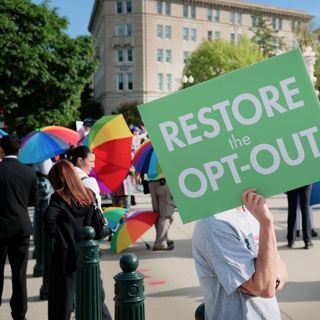
Children’s Books Go Before the Supreme Court
On Tuesday, the Supreme Court heard a case that could hand parents with religious objections a lot more control over what their kids learn in the classroom.Adam Liptak, who covers the Supreme Court, explains how a case about children’s picture books with titles like “Pride Puppy” and “Uncle Bobby’s Wedding” has broad implications for schools across the country.Guest: Adam Liptak, who covers the Supreme Court and writes Sidebar, a column on legal developments, for The New York Times.Background reading: In a lively and sometimes heated argument, the Supreme Court’s conservative majority appeared set to allow opt-outs from L.G.B.T.Q. stories in schools.For more information on today’s episode, visit nytimes.com/thedaily. Transcripts of each episode will be made available by the next workday. Photo: Anna Moneymaker/Getty Images Subscribe today at nytimes.com/podcasts or on Apple Podcasts and Spotify. You can also subscribe via your favorite podcast app here https://www.nytimes.com/activate-access/audio?source=podcatcher. For more podcasts and narrated articles, download The New York Times app at nytimes.com/app.
25 Apr 34min

What an Iowa Farmer Fears About the Trade War
In the increasingly bitter trade war between the United States and China, perhaps nobody has more at stake than America’s soybean farmers, whose crop has become the country’s single biggest export to China.Michael Barbaro speaks to an Iowa farmer who helped build that $13 billion market, and asks her what President Trump’s sky-high tariffs mean for her and for tens of thousands of other American farmers.Guest: April Hemmes, a soybean farmer in Iowa.Background reading: Soybean producers warned that farms could go under after the Trump administration hit China with tariffs of 145 percent.China has long relied on the U.S. for soybeans. But with new steep tariffs, it is likely to look even more to Brazil and Argentina.For more information on today’s episode, visit nytimes.com/thedaily. Transcripts of each episode will be made available by the next workday. Photo: Kathryn Gamble for The New York Times Subscribe today at nytimes.com/podcasts or on Apple Podcasts and Spotify. You can also subscribe via your favorite podcast app here https://www.nytimes.com/activate-access/audio?source=podcatcher. For more podcasts and narrated articles, download The New York Times app at nytimes.com/app.
24 Apr 29min

Trump Says They’re Foreign Gang Members. Are They?
In recent weeks, the Trump administration has deported hundreds of Venezuelan migrants by quickly labeling them as gang members and foreign enemies, and boarding them on planes to El Salvador. It’s sidestepping their rights to a court hearing where anyone might be able to scrutinize the claims against them.As a result, very little has been known about who these men are, or how they were targeted by immigration officials. Until now.Julie Turkewitz, the Andes bureau chief for The New York Times, explains who was actually on those planes, and discusses the secretive process that led to their deportations.Guest: Julie Turkewitz, the Andes bureau chief for The New York Times, based in Bogotá, Colombia.Background reading: Inside President Trump’s rushed effort to deport 238 migrants.The government is relying more on tattoos to identify gang members. Experts say that’s unreliable.For more information on today’s episode, visit nytimes.com/thedaily. Transcripts of each episode will be made available by the next workday. Photo: Alex Peña/Getty Images Subscribe today at nytimes.com/podcasts or on Apple Podcasts and Spotify. You can also subscribe via your favorite podcast app here https://www.nytimes.com/activate-access/audio?source=podcatcher. For more podcasts and narrated articles, download The New York Times app at nytimes.com/app.
23 Apr 29min