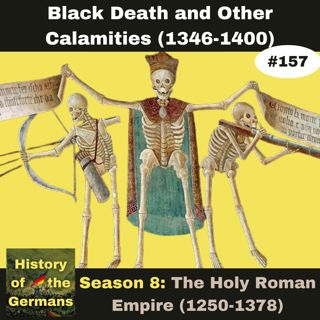
Ep. 157: The Black Death and other Calamities (1346-1400)

Ep. 157: The Black Death and other Calamities (1346-1400)

In around 1320 near the lake Issy-Kul in Kyrgysistan the rats started dying. Shortly after the inhabitants became affected with terrible diseases. Some started coughing up blood and all who did, died within 3 days. Others developed swellings of the lymph nodes, particularly in the groins and armpits. Roughly half of them died within five days. A small number saw their feet and fingertips turn black. All of those died.

Everyone who could still leave sought refuge in towns and villages that had not been affected. The disease travelled with them. By 1330 Chinese chroniclers recorded a plague affecting the Mongol hordes. In 1346 a Mongol army besieging the Genoese trading city of Caffa on Crimea succumbed to the disease. In their final push to cow the defenders they catapulted the diseased corpses of their comrades into the city.

The siege lifted grain transports from Caffa to Italy resumed. The disease reached Messina in Sicily in 1347. In 1348 it had enveloped most of Italy. 1349 it crossed the alps, by 1350 people died in their thousands in Northern Germany and Scandinavia. It took until 1353 before this wave of the plague petered out, leaving between 20 and 60% of the population of Europe dead. The disease returned in 1361-1363, 1369-71, 1374-75, 1390 and 1400. After that intervals became longer but the plague never went away completely and still today a couple of 100 people die worldwide of Plague every year.

Despite having lived through a pandemic only recently, we have all realised that the impact of such an event goes far beyond the gruesome statistics. It is much too recent an event to get a grasp of the impact COVID 19 had on the economy, political system and society in general, but clearly something has changed. Now imagine the plague, which in terms of death toll was between 10 and 30 times worse and crucially affected young and old equally. The fallout was exponentially greater not least because it came on the back ofseveral other calamities. It is these impacts we will mainly focus on in this episode. So let’s dive in..

The music for the show is Flute Sonata in E-flat major, H.545 by Carl Phillip Emmanuel Bach (or some claim it as BWV 1031 Johann Sebastian Bach) performed and arranged by Michel Rondeau under Common Creative Licence 3.0.

As always:

Homepage with maps, photos, transcripts and blog: www.historyofthegermans.com

If you wish to support the show go to: Support • History of the Germans Podcast

For do it yourself merchandise go to: Merchandise • History of the Germans Podcast

Facebook: @HOTGPod

Threads: @history_of_the_germans_podcast

Bluesky: @hotgpod.bsky.social

Instagram: history_of_the_germans

Twitter: @germanshistory

To make it easier for you to share the podcast, I have created separate playlists for some of the seasons that are set up as individual podcasts. they have the exact same episodes as in the History of the Germans, but they may be a helpful device for those who want to concentrate on only one season.

So far I have:

The Ottonians

Salian Emperors and Investiture Controversy

Fredrick Barbarossa and Early Hohenstaufen

Frederick II Stupor Mundi

Saxony and Eastward Expansion

The Hanseatic League

The Teutonic Knights

The Holy Roman Empire 1250-1356

The Reformation before the Reformation

The Empire in the 15th century

The Fall and Rise of the Habsburgs

Episoder(244)

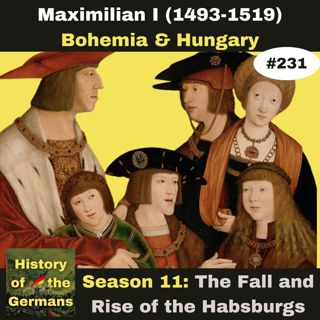
Ep.: 231 – Maximilian I (1493-1519) - Marrying Bohemia and Hungary

Ep.: 231 – Maximilian I (1493-1519) - Marrying Bohemia and Hungary

You have almost certainly seen the image in today’s episode artwork before. It is a family portrait showing Maximilian, his first wife Marie of Burgundy, his son, Philip the Handsome and three childre...

2 Apr 41min
Ep.230: Margaret of Austria (1480-1530) - The League of Cambrai

Ep.230: Margaret of Austria (1480-1530) - The League of Cambrai

Another Thursday and another episode dealing with another epic fail of our hero, Maximilian I. But despite a military campaign that once again failed for all the usual reasons, no money, no strategy, ...

26 Mar 43min
Ep. 229: Joanna the (not?) Mad (1504-1555) - How the Habsburgs gained Spain

Ep. 229: Joanna the (not?) Mad (1504-1555) - How the Habsburgs gained Spain

“Bella gerant alii, tu felix Austria nube" – ‘Let others wage war; thou, happy Austria, marry’ is one of the few terms that almost anyone with a cursory interest in European history knows, only rivall...

19 Mar 48min
Ep. 228 – Maximilian I (1493-1519) - The Princes and the Emperor.

Ep. 228 – Maximilian I (1493-1519) - The Princes and the Emperor.

If there was one group that consistently thwarted Maximilian’s grand plans for world domination, it was the princes of the Holy Roman Empire. He had given in to their demands for Imperial Reform, had ...

12 Mar 26min
Ep. 227: Landsknechte vs. Swiss Mercenaries – The Swabian (Swiss) War of 1499

Ep. 227: Landsknechte vs. Swiss Mercenaries – The Swabian (Swiss) War of 1499

Why are the Swiss called the Swiss? After all, Schwyz in only of 26 cantons, and not one of the largest ones. How did the proud and prosperous citizens of Zurich or Berne, mighty city states in their ...

5 Mar 38min
Ep. 226: Maximilian I (1493-1519) - A Grand Plan for a Great War

Ep. 226: Maximilian I (1493-1519) - A Grand Plan for a Great War

Europe's political landscape is shifting fundamentally. No longer are wars fought between kings and their vassals, and emperors against popes - it is all about the balance of power. and this balaance ...

26 Feb 36min
The Imperial Reform of 1495 with Prof. Duncan Hardy

The Imperial Reform of 1495 with Prof. Duncan Hardy

Prof Duncan Hardy is one of the leading experts in the history of the Holy Roman Empire and one of his main topics is the Imperial reform of 1495, making him the ideal guest for our show.In his first ...

19 Feb 1h 3min
Ep. 225: Imperial Reform 1495 - The Ewige Landfrieden (Public Peace) of 1495

Ep. 225: Imperial Reform 1495 - The Ewige Landfrieden (Public Peace) of 1495

Let me start today’s episode with some outrageous national stereotypes. If an Englishman is disappointed with the way the affairs of state are conducted, he writes a letter to his member of Parliament...

12 Feb 36min

Populært innen Fakta

mikkels-paskenotter
fastlegen
dine-penger-pengeradet
relasjonspodden-med-dora-thorhallsdottir-kjersti-idem
foreldreradet
rss-strid-de-norske-borgerkrigene
treningspodden
jakt-og-fiskepodden
sinnsyn
rss-kunsten-a-leve
rss-bisarr-historie
rss-kull
gravid-uke-for-uke
hverdagspsyken
fryktlos
rss-var-forste-kaffe
level-up-med-anniken-binz
rss-impressions-2
hva-er-greia-med
hagespiren-podcast