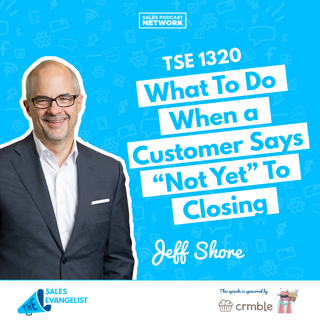
TSE 1320: What To Do When a Customer Says “Not Yet” To Closing

TSE 1320: What To Do When a Customer Says “Not Yet” To Closing

What To Do When a Customer Says “Not Yet” To Closing

We’ve all gotten a “not yet” from a prospect and it can be frustrating having that delay in closing. In this episode we’ll look at how to move from “not yet” to yes.

Jeff Shore is a salesperson at heart and has been in the industry for a number of years. He started his sales career in real estate but for the last 20 years, he’s been at Shore Consulting. Jeff works with companies large and small all around the world. He is also a published author and is getting ready to launch his 10th book. He used to look at sales from the perspective of the salesperson but now, he’s looking at how a buyer buys. Instead of reading sales books, he reads psychology books to know what’s going on in the mind during the sales process that leads to the decisions people make.

Salespeople are sales counselors because they get to the root of the problem before they try to provide any kind of solution. This is the heartbeat of sales. We understand the customers’ problems and we try to offer them the best solution.

On writing his books

As an author, Jeff understands he has to live a book before he writes it. Jeff knows it’s not just about the sale. The follow up is just as important and Jeff is passionate about learning everything he can. He wants us all to know the greatest lessons are in how to serve customers and learning how we can add value after the initial presentation. This is what Jeff’s book is about.

The inability to follow-up

Not following up comes down to two things: I can’t do it or I won’t do it. This is both an ability and a motivation issue. If you don’t know how, find someone to help you or a resource that can teach you. Motivation entails having the right mindset.

The challenges today

The two biggest problems in doing follow-up are that salespeople are often too slow and/or too impersonal. Speed and personalization are the superpowers that salespeople have at their disposal. The faster they serve, the more that they are able to share the message that they care. These days, people equate speed with care. If you can combine speed and personalization, you’re already 98% ahead from other salespeople who just rely on their CRM to kick out a generic email 24-hours after the initial conversation.

Getting back in touch adds value and this is the first step in building a relationship with prospects. The second step is being personal. We all get numerous emails in a week and they come in many forms. If salespeople spent any meaningful time online, they would see there is plenty of accessible information to personalize correspondence and it would make all the difference.

Jeff got an email from a person who just took a photo of himself holding a piece of paper that said, “Hi, Jeff!” He knew then that the email was for him. He got Jeff’s attention and Jeff couldn’t deny him a reply. They didn’t close a deal but it got a response and that is a huge part of the battle.

The need to follow-up

Many salespeople are doing follow-up because of the fear of getting in trouble with their bosses. If the CRM has holes in it, then the sales reps can just blame it on the system. This isn’t enough. A sales rep has to see the importance and value behind the follow-up. Your starting point should be asking yourself how you can add value to the prospect. You need a better motivation to do the follow-up than just your boss.

Don’t get eliminated

There are two types of elimination: active elimination and the passive elimination. Active elimination is when a product or service isn’t a good fit. Passive elimination happens when you fall off from the prospects’ radar and become forgettable. The longer time you wait to do a follow-up, the longer period it will be that you go without having a conversation with them. This lack of communication destroys relationships. This has something to do with a psychological phenomenon called emotional altitude. Human beings are emotional creatures. We make emotion-based decisions but we buy more with our gut. About 85% of the purchasing decisions we have are instinctive or intuitive and only 15% is based on logic and supported by data.

In a sales conversation, a prospect can start hyped up and excited. That feeling of excitement doesn’t last. Time has a way of decreasing that emotional altitude. The role of the follow-up ensures that the emotional attitude stays up. It helps to maintain an emotional engagement.

When to stop

The best time to stop doing a follow-up is when the prospect no longer thinks you’re adding value. Your goal in doing follow-up is to add value and be on their radar to solve future problems. Have structure in your follow-up and you put yourself in a position where you can give what they need over and over again. Be the first person that comes to mind when a need arises.

Your mission isn’t just to follow-up but to follow-up and close. #ClosingADeal

Adding value using a video follow-up

Videos are effective and the amount of value you can build in a 30-second length of time is astounding. One of the barricades to video follow-up is discomfort because some people just don’t like the way they look on camera. If you feel that way, just know that your customers already know what you look like. This is a follow-up video so they’re not expecting to see anyone else. The good thing about this is the ability to do it again and again until you get the perfect personalized video message.

During the pandemic, video conferencing is the best way to talk to other people. We are now forced to use videos and this can help accelerate the video interaction long before you\re able to meet somebody face-to-face for the first time.

Remember your speed

Speed is your sales superpower, so use it. Send a follow-up message as soon as you’re able. You can record a 15-second video telling your prospect how much you enjoyed the conversation and you’re willing to help answer any questions. That’s quick and already a follow-up. The video is much better than a business card that can get thrown away. Your video will be on their phone along with your number.

Steven Pressfield’s book The War of Art talks to artists and writers who are dealing with blocks. Pressfield called this resistance and it keeps them from doing things they need to do. In sales, this is comfort addiction. We like to be in a comfortable place but remember that success doesn't lie in your comfort zone. If you are uncomfortable doing follow-up, you need to deal with the discomfort and breakthrough. If you can do that, then you’ll be able to uncover incredible opportunities.

“What To Do When a Customer Says “Not Yet” To Closing” episode resources

Connect with Jeff Shore via his LinkedIn account or subscribe to his podcast, The Buyer’s Mind and listen to his shows every Saturday.

If you are interested in more sales stories, you can talk to Donald directly. Reach him via these channels: LinkedIn, Instagram, Twitter, and Facebook about any sales concerns.

This episode is brought to you in part by Crmble, the easy-peasy CRM for Trello that helps you manage your contacts and leads without investing in complicated solutions, sync all your data, manage custom fields, and get powerful reporting on your sales. Try Crmble now for free at www.crmble.com/tse. This course is also brought to you in part by TSE Certified Sales Training Program. It’s a course designed to help new and struggling sellers to master the fundamentals of sales and close more deals. It will help them elevate their sales game. Sign up now and get the first two modules for free! You can go and visit www.thesalesevangelist.com/closemoredeals also call us at (561) 570-5077.

We’d love for you to join us for our next episodes so tune in on Apple Podcast, Google Podcast, Stitcher, and Spotify. You can also leave comments, suggestions, and ratings to every episode you listen to.

You can also read more about sales or listen to audiobooks on Audible and explore this huge online library. Register now to get a free book and a 30-day free trial.

Audio provided by Free SFX and Bensound. Other songs used in the episodes are as follows: The Organ Grinder written by Bradley Jay Hill, performed by Bright Seed, and Produced by Brightseed and Hill.

Mentioned in this episode:

HubSpot and bluëmago | STUDIOS

HubSpot and bluëmago | STUDIOS...

Denne episoden er hentet fra en åpen RSS-feed og er ikke publisert av Podme. Den kan derfor inneholde annonser.

Episoder(2000)

Practical Ways Sales and Marketing Can Work to Increase Revenue in 2026 | Mark Kapczynski - 2023

Practical Ways Sales and Marketing Can Work to Increase Revenue in 2026 | Mark Kapczynski - 2023

Sales and marketing are supposed to work together, but in most companies, they don't. Not to the level your revenue actually needs. In this episode, I sat down with Mark Kapczynski, co-founder of Kont...

27 Jul 28min
LinkedIn Response Series - Messages That Generate Responses | Donald C. Kelly - 2022

LinkedIn Response Series - Messages That Generate Responses | Donald C. Kelly - 2022

This wraps up our four part LinkedIn Response Series. Over the last few episodes, I covered your headline, your banner, and how to turn profile views into real conversations. In this final episode, I'...

24 Jul 16min
LinkedIn Response Series - LinkedIn Connection Requests | Donald C. Kelly - 2021

LinkedIn Response Series - LinkedIn Connection Requests | Donald C. Kelly - 2021

show notes

20 Jul 16min
LinkedIn Response Series - LinkedIn Profile Views To Appointments | Donald C. Kelly - 2020

LinkedIn Response Series - LinkedIn Profile Views To Appointments | Donald C. Kelly - 2020

Getting a notification that someone viewed your LinkedIn profile can be exciting, but most sellers don't know what to do next. In this episode of the LinkedIn Response Series, I am sharing how to turn...

17 Jul 16min

LinkedIn Response Series - Your LinkedIn Headline | Donald C. Kelly - 2019

LinkedIn Response Series - Your LinkedIn Headline | Donald C. Kelly - 2019

Your LinkedIn headline is one of the first things prospects see, yet many salespeople waste it by listing their job title and company name. In this first episode of the LinkedIn Response Series, I exp...

13 Jul 25min
How to Ensure That Admin Tasks Don't Overwhelm Your Day | Anthony Iannarino - 2018

How to Ensure That Admin Tasks Don't Overwhelm Your Day | Anthony Iannarino - 2018

Administrative tasks are part of every sales role, but they should never take priority over selling. I'm revisiting a conversation from the archive with Anthony Iannarino to share practical ways to ke...

10 Jul 33min

Bad Mouthing Your Competitor | Donald C. Kelly - 2017

Bad Mouthing Your Competitor | Donald C. Kelly - 2017

How do you handle competitor questions without sounding defensive, desperate, or unprofessional?In this solo episode, Donald C. Kelly shares three practical strategies for talking about competitors wi...

6 Jul 14min

7 Steps to Making 7 Figures in Enterprise SaaS Sales | Brandon Fluharty - 2016

7 Steps to Making 7 Figures in Enterprise SaaS Sales | Brandon Fluharty - 2016

What separates sales professionals who earn six figures from those who consistently earn seven?In this episode, Donald sits down with Brandon Fluharty, enterprise SaaS sales leader, speaker, and autho...

3 Jul 42min

Populært innen Business og økonomi

stopp-verden
rss-penger-polser-og-politikk
dine-penger-pengeradet
e24-podden
lydartikler-fra-aftenposten
rss-pa-konto
pengepodden-2
tid-er-penger-en-podcast-med-peter-warren
morgenkaffen-med-finansavisen
finansredaksjonen
liberal-halvtime
livet-pa-veien-med-jan-erik-larssen
utbytte
lederpodden
pengesnakk
rss-borsmorgen-okonominyhetene
rss-kron-podden
rss-skravla-gar
shifter
okonomiamatorene