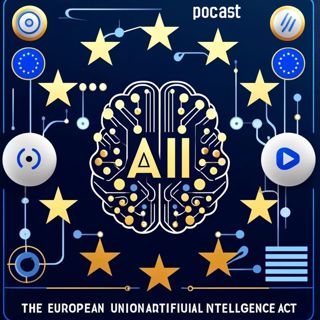
"Rewriting the Future: Europe's Landmark AI Governance Act Poised to Transform the Landscape"

"Rewriting the Future: Europe's Landmark AI Governance Act Poised to Transform the Landscape"

As I sit here, sipping my morning coffee on this chilly January 20th, 2025, I find myself pondering the monumental changes that are about to reshape the landscape of artificial intelligence in Europe. The European Union Artificial Intelligence Act, or the EU AI Act, is set to revolutionize how businesses and organizations approach AI, and it's happening sooner rather than later.

Starting February 2, 2025, just a couple of weeks from now, the EU AI Act will begin to take effect, marking a significant milestone in AI governance. The Act aims to make AI safer and more secure for public and commercial use, mitigate its risks, ensure it remains under human control, reduce any negative impacts on the environment and society, keep our data safe and private, and ensure transparency in almost all forms of AI use[1].

One of the critical aspects of the EU AI Act is its categorization of AI systems into four risk categories: unacceptable-risk, high-risk, limited-risk, and minimal-risk AI systems. Businesses need to be aware of each risk category, how their own AI systems might be categorized, and the regulatory implications on each system. For instance, AI systems that pose unacceptable risks will be banned starting February 2, 2025. This includes AI systems deploying subliminal, manipulative, or deceptive techniques, social scoring systems, and AI systems predicting criminal behavior based solely on profiling or personality traits[2][5].

But it's not just about banning harmful AI systems; the EU AI Act also sets out to regulate General Purpose AI (GPAI) models. These models, such as ChatGPT-4 and Gemini Ultra, are distinguished by their versatility and widespread applications. The Act categorizes GPAI models into two categories: standard GPAI, which is subject to general obligations, and systemic-risk GPAI, which is defined by their use of computing power exceeding 10^25 Floating Point Operations (FLOPS) during training. These models are subject to enhanced oversight due to their potential for significant societal impact[2].

The EU AI Act is not just a European affair; it's expected to have extraterritorial impact, shaping AI governance well beyond EU borders. This means that organizations deploying AI systems incorporating GPAI must also ensure compliance, even if they are not directly developing the models. The Act's phased approach means that different regulatory requirements will be triggered at 6–12-month intervals from when the act entered into force, with full enforcement expected by August 2027[1][4].

As I wrap up my thoughts, I am reminded of the upcoming EU Open Data Days 2025, scheduled for March 19-20, 2025, at the European Convention Centre in Luxembourg. This event will bring together data providers, enthusiasts, and re-users from Europe and beyond to discuss the power of open data and its intersection with AI. It's a timely reminder that the future of AI is not just about regulation but also about harnessing its potential for social impact[3].

In conclusion, the EU AI Act is a groundbreaking piece of legislation that will redefine the AI landscape in Europe and beyond. As we embark on this new era of AI governance, it's crucial for businesses and organizations to stay informed and compliant to ensure a safer and more secure AI future.

This content was created in partnership and with the help of Artificial Intelligence AI

Episoder(298)

EU AI Act 2026: Europe's High-Stakes Reckoning With Regulated Intelligence

EU AI Act 2026: Europe's High-Stakes Reckoning With Regulated Intelligence

Imagine this: it's February 26, 2026, and I'm huddled in my Berlin apartment, staring at my laptop as the EU AI Act's gears grind louder than ever. The Act, formally adopted by the European Council on...

26 Feb 4min

Europe's AI Reckoning: Six Months to Compliance as Brussels Tightens the Screws

Europe's AI Reckoning: Six Months to Compliance as Brussels Tightens the Screws

Imagine this: it's February 23, 2026, and I'm huddled in a Brussels café, steam rising from my espresso as I scroll through the latest dispatches on the EU AI Act. The regulation, formally Regulation ...

23 Feb 3min

EU AI Act Enforcement Looms: August 2026 Deadline Forces Global Compliance Reckoning

EU AI Act Enforcement Looms: August 2026 Deadline Forces Global Compliance Reckoning

Imagine this: it's February 21, 2026, and I'm huddled in my Berlin apartment, laptop glowing as the latest EU AI Act ripples hit my feed. Just ten days ago, on February 11, the European Commission dro...

21 Feb 3min

EU AI Act: A Tectonic Shift Shaping Europe's AI Landscape

EU AI Act: A Tectonic Shift Shaping Europe's AI Landscape

Imagine this: it's February 19, 2026, and I'm huddled in my Berlin startup office, staring at my laptop as the EU AI Act's shadow looms larger than ever. Prohibited practices kicked in last year on Fe...

19 Feb 3min

EU AI Act Deadline Looms: Startups Scramble to Comply

EU AI Act Deadline Looms: Startups Scramble to Comply

Imagine this: it's February 16, 2026, and I'm huddled in my Berlin startup office, staring at my laptop screen as the EU AI Act's countdown clock ticks mercilessly toward August 2. Prohibited practice...

16 Feb 3min

EU AI Act Deadline Looms: Tech Lead Navigates Compliance Challenges

EU AI Act Deadline Looms: Tech Lead Navigates Compliance Challenges

Imagine this: it's early 2026, and I'm huddled in my Berlin apartment, staring at my laptop screen as the EU AI Act's deadlines loom like a digital storm cloud. Regulation (EU) 2024/1689, that beast o...

14 Feb 3min

"Countdown to the EU AI Act: Compliance Chaos Sweeps Across Europe"

"Countdown to the EU AI Act: Compliance Chaos Sweeps Across Europe"

Imagine this: it's early 2026, and I'm huddled in a Berlin café, laptop glowing amid the winter chill, as the EU AI Act's deadlines loom like a digital storm front. Just days ago, on February 2, the E...

12 Feb 3min

Countdown to EU AI Act Compliance: Organizations Face Potential Fines of Up to 7% of Global Turnover

Countdown to EU AI Act Compliance: Organizations Face Potential Fines of Up to 7% of Global Turnover

Six months. That's all that stands between compliance and catastrophe for organizations across Europe right now. On August second of this year, the European Union's Artificial Intelligence Act shifts ...

9 Feb 2min

Populært innen Business og økonomi

stopp-verden
lydartikler-fra-aftenposten
dine-penger-pengeradet
e24-podden
rss-penger-polser-og-politikk
rss-borsmorgen-okonominyhetene
pengepodden-2
pengesnakk
livet-pa-veien-med-jan-erik-larssen
rss-politisk-preik
utbytte
morgenkaffen-med-finansavisen
tid-er-penger-en-podcast-med-peter-warren
finansredaksjonen
lederpodden
stormkast-med-valebrokk-stordalen
rss-markedspuls-2
liberal-halvtime
rss-sunn-okonomi
rss-pa-konto