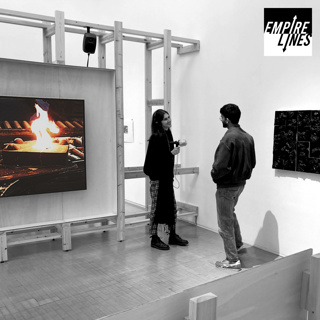
Furnace Fruit, Karanjit Panesar (2024) (EMPIRE LINES x Leeds Art Gallery, British Library)
EMPIRE LINES23 Jan 2025

Furnace Fruit, Karanjit Panesar (2024) (EMPIRE LINES x Leeds Art Gallery, British Library)

Contemporary artist Karanjit Panesar recasts stories of migrant labourers from Punjab working in British industrial foundries, exploring constructs of memory, and national myths in metal, through his film installation, Furnace Fruit (2024). Karanjit Panesar’s practice considers the entanglements of labour, migration, memory, and empire. Furnace Fruit, their new exhibition at Leeds Art Gallery, centres on the stories of the many Punjabi immigrants who, with the end of British colonial rule in South Asia, came to the UK and worked in metal foundries in the 1950s and 1960s - including members of the artist’s own family.

Audio and sound underlie his transdisciplinary practice. Drawing on the South Asian oral history collections at Bradford Industrial Museum and the British Library in London, Karanjit’s exhibition is also an intergenerational conversation, and ongoing process of translation: ‘He’s speaking in our language, I’m listening in mine,’ says one character in the film at the exhibition’s core. Karanjit explains how he ‘embeds’ the archive ‘within the language of the work’, and wider practice of storytelling.

We journey through the steel and automotive foundries across Yorkshire and northern England, as well as Smethwick, Birmingham, in Midlands, central to his research and work. Karanjit explains how railway tracks, and statues of Queen Victoria, were exported from ports like Ormsgill, Barrow-in-Furness around the British Empire, to India, Pakistan, and Australia. We find these parallels in the foundry - a duality, not binary, also reflected in the exhibition’s titular two-channel film - as a place of both imperial and industrial expansion, and artistic production. Karanjit reflects on his own position, navigating the Morris Singer (J.W. Singer & Sons) and John Galizia and Son’s archives at the Henry Moore Institute. He shares his research into sculptors like Bernard Meadows, whose bronze castings of apples, pears, peaches, mangoes informed the artist’s work Double Fruit (2024), a pomegranate figured in both plaster, and black cast iron, as representations of nationhood and Britishness.

From facsimiles by the Boyle Family, artistic explorations of truths and myths, Karanjit explains other processes of translation. He navigates the wooden architectural structure central to this installation, drawing on his work as a technician. We explore technology in his practice - including photogravure prints, or electro-plated sculptural photographs - and ongoing research in deindustrialisation endured by working class communities across the country.

Karanjit Panesar: Furnace Fruit runs at Leeds Art Gallery until 15 June 2025, the second Collections in Dialogue co-commission between Leeds Art Gallery and the British Library in London.

Find more from Bradford Industrial Museum through Bradford 2025, UK City of Culture.


For more about artifice and film, hear Pamela Phatsimo Sunstrum at their exhibition, It Will End in Tears (2024), at the Barbican in London: pod.link/1533637675/episode/6e9a8b8725e8864bc4950f259ea89310

And read my article, in gowithYamo: gowithyamo.com/blog/pamela-phatsimo-sunstrum-barbican


For more about Ibrahim Mahama’s 2024 exhibition at Fruitmarket in Edinburgh, drawing from archives to reconstruct railway lines, and mineral extraction in West Africa, hear the artist’s episode about Sekondi Locomotive Workshop (2024): pod.link/1533637675/episode/ed0be49d016ce665c1663202091ce224


For more about Pakistani and South Asian diasporic communities in Birmingham, and domestic labour in the Midlands and ‘Black Country’, listen to artist Osman Yousefzada on Queer Feet (2023) at Charleston in Firle: pod.link/1533637675/episode/6ca95c67d24936cff9d2d478f4450cf2


And read my article, in gowithYamo: gowithyamo.com/blog/osman-yousefzada-at-charleston-in-firle


PRODUCER: Jelena Sofronijevic.


Follow EMPIRE LINES on Instagram: ⁠⁠instagram.com/empirelinespodcast⁠⁠

Support EMPIRE LINES on Patreon: ⁠⁠patreon.com/empirelines

Episoder(158)

The Tribes of Israel (Jacob and his Twelve Sons), Francisco de Zurbarán (1640s)

The Tribes of Israel (Jacob and his Twelve Sons), Francisco de Zurbarán (1640s)

Akemi Luisa Herráez Vossbrink depicts relations between imperial Spain and the Americas, through Francisco de Zurbarán’s paintings, The Tribes of Israel. From Seville’s most acclaimed religious artist, Francisco de Zurbarán’s portrait series The Tribes of Israel (1640s) depicts the Old Testament patriarch Jacob and his twelve sons. The only such painting series to be found in Europe, de Zurbarán’s works inspired colonial reinterpretations in Peru and Mexico. Produced in Spain, destined for Latin America, and currently housed in the north of England, The Tribes of Israel reflect global artistic exchanges and power dynamics. PRESENTER: Akemi Luisa Herráez Vossbrink, doctoral candidate at the University of Cambridge, and Meadows Museum Center for Spain in America (CSA) Curatorial Fellow. ART: The Tribes of Israel (Jacob and his Twelve Sons), Francisco de Zurbarán (1640s). IMAGE: ‘Joseph, from Jacob and His Twelve Sons’. SOUNDS: Gnawledge. PRODUCER: Jelena Sofronijevic. Follow EMPIRE LINES at: twitter.com/jelsofron/status/1306563558063271936 Support EMPIRE LINES on Patreon: patreon.com/empirelines

10 Des 202014min

Bengali Colcha with Triumphal Arch of the Flemish (Mid 17th Century)

Bengali Colcha with Triumphal Arch of the Flemish (Mid 17th Century)

Dr. Laura Fernández-González explores the circulation of visual trends between imperial Lisbon and India, through the design for the Bengali Colcha with Triumphal Arch of the Flemish. Numerous Indian colchas, or wall hangings, were made for the orientalist markets of imperial Portugal. But this unique Bengali Colcha depicts a triumphal arch – the same temporary arch designed and erected in Lisbon by a foreign community of Flemish merchants, to welcome the Spanish king Philip II of Portugal (and III of Spain) into the capital in 1619. The mesmerizing architecture, figures, and flora depicted speak of several coeval artistic traditions, spaces, empires, and cultures. PRESENTER: Dr. Laura Fernández-González, senior lecturer in Art/Architectural History and Theory at the University of Lincoln. ART: Bengali Colcha with Triumphal Arch of the Flemish (Mid 17th Century). IMAGE: ‘Indian, Bengal: Wall Hanging: Triumphal Arch, Mid 17th Century’. SOUNDS: Sultan. PRODUCER: Jelena Sofronijevic. Follow EMPIRE LINES at: twitter.com/jelsofron/status/1306563558063271936 Support EMPIRE LINES on Patreon: patreon.com/empirelines

26 Nov 202015min

Electra House, London (1902)

Electra House, London (1902)

Dr. Alex Bremner navigates London as the powerhouse of British technological imperialism, by looking at Electra House. Home to the Eastern Telegraph Company, London’s Electra House became the centre of Britain’s global telecommunications empire at the turn of the twentieth century. The regulated mesh of its architecture similarly ensnared global geographies, submitting it to the whims of commercial and imperial prerogative. Electra House persists as an important artefact of corporate and technological empire, and a stark precedent for contemporary geopolitical struggles over 5G broadband. PRESENTER: Dr. Alex Bremner, professor of Architectural History at the University of Edinburgh. ART: Electra House, London (1902). IMAGE: ‘Electra House’ in Electra House: The New Home of the Eastern and Associated Telegraph Companies (1902). SOUNDS: Silicon Transmitter. PRODUCER: Jelena Sofronijevic. Follow EMPIRE LINES at: twitter.com/jelsofron/status/1306563558063271936 Support EMPIRE LINES on Patreon: patreon.com/empirelines

12 Nov 202012min

La Haine, Mathieu Kassovitz (1995)

La Haine, Mathieu Kassovitz (1995)

Dr. Emile Chabal navigates the contemporary echoes – and explosions – of French colonialism, through Mathieu Kassovitz’s 1995 film La Haine. Through the dangerous escapades of the young Vinz, Hubert and Saïd, La Haine explicitly depicts life in the French banlieue (‘suburbs’, or ‘projects’) - from aggressive altercations with the police and everyday racism, to social marginality and spatial exclusion. Kassovitz shows France as a damaged, post-colonial nation, unable to fulfil its promise of liberation and integration, echoing the fundamental contradiction at the heart of French colonialism. PRESENTER: Dr. Emile Chabal, reader in History and former director of the Centre for the Study of Modern and Contemporary History (2016-2020) at the University of Edinburgh. ART: La Haine, Mathieu Kassovitz (1995). IMAGE: ‘La Haine (1995)’. SOUNDS: Adrian Beentjes, David Cunliffe, Anthony Donovan, and Hopek Quirin. PRODUCER: Jelena Sofronijevic. Follow EMPIRE LINES at: twitter.com/jelsofron/status/1306563558063271936 Support EMPIRE LINES on Patreon: patreon.com/empirelines

29 Okt 202014min

John Bull’s Other Island, George Bernard Shaw (1904)

John Bull’s Other Island, George Bernard Shaw (1904)

Journalist Megan Kenyon explores imperial relations between Britain and Ireland, through George Bernard Shaw’s 1904 play, John Bull’s Other Island. Ireland was England’s first colony, and the first colonial state to become independent from imperial rule. Yet, with its cutting depiction of Anglo-Irish relations, John Bull’s Other Island famously made the observing English King Edward VII break off the arm of his chair with laughter. George Bernard Shaw depicts Ireland on the precipice of its emergence from conventional British imperial rule, and glimpses at the new forms of commercial imperialism to come. PRESENTER: Megan Kenyon, journalist. ART: John Bull’s Other Island, George Bernard Shaw (1904). IMAGE: ‘George Bernard Shaw’. SOUNDS: Audio Library. PRODUCER: Jelena Sofronijevic. Follow EMPIRE LINES at: twitter.com/jelsofron/status/1306563558063271936 Support EMPIRE LINES on Patreon: patreon.com/empirelines

15 Okt 202014min

The Great Mosque(s) of Djenné, Mali

The Great Mosque(s) of Djenné, Mali

Dr. Peter Clericuzio observes complex imperial hierarchies between Mali and France, through the Great Mosque(s) of Djenné. Population 32,000, Djenné is a small city in Mali, itself one of Africa's less famous countries. Yet, the (third) Great Mosque of Djenné attracted international attention in the twentieth century, extolled as a symbol of the power and diversity of the global French Empire. Now a UNESCO World Heritage Site, the architecture and complicated history of the Great Mosque(s) reveal the nuances of the French colonial enterprise during a stark transitional period. PRESENTER: Dr. Peter Clericuzio, professor of architectural history and heritage at the University of Edinburgh. ART: The Great Mosque(s) of Djenné, Mali. IMAGE: ‘The Great Mosque of Djenné’ in L’Illustration (1911). SOUNDS: Andrew Oliver Kora Band. PRODUCER: Jelena Sofronijevic. Follow EMPIRE LINES at: twitter.com/jelsofron/status/1306563558063271936 Support EMPIRE LINES on Patreon: patreon.com/empirelines

1 Okt 202013min

Populært innen Samfunn

rss-spartsklubben
giver-og-gjengen-vg
aftenpodden-usa
aftenpodden
popradet
rss-nesten-hele-uka-med-lepperod
konspirasjonspodden
rss-henlagt-andy-larsgaard
wolfgang-wee-uncut
lydartikler-fra-aftenposten
grenselos
fladseth
synnve-og-vanessa
frokostshowet-pa-p5
vitnemal
alt-fortalt
rss-dette-ma-aldri-skje-igjen
relasjonspodden-med-dora-thorhallsdottir-kjersti-idem
den-politiske-situasjonen
min-barneoppdragelse