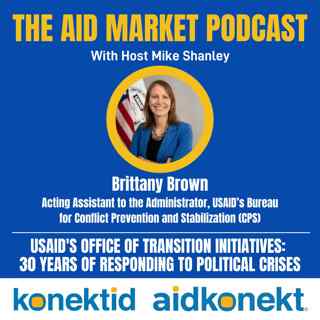

Ep 24: USAID's Office of Transition Initiatives: 30 Years of Responding to Political Crises

Ep 24: USAID's Office of Transition Initiatives: 30 Years of Responding to Political Crises

Brittany Brown, Acting Assistant to the Administrator of USAID's Bureau for Conflict Prevention and Stabilization, joins Mike Shanley to discuss the Office of Transition Initiatives (OTI). OTI has been an ongoing effort for 30 years, and Brittany shares some of their successes with working in other countries. Localization is a large aspect of the work that OTI is focused on, by working with local partners and change makers to ensure that everyone has a buy-in on the project a grant is funding. OTI partners with the National Security Council, State Department, and DOD in a variety of ways, and with someone from the OTI team on the Administration this year, they are seeing success with educating the government on impacts of certain decisions.

IN THIS EPISODE:

  • [1:17] Brittany covers some of the key successes and lessons learned across 30 years of OTI.

  • [4:00] Brittany shares an example of the OTI's work in Libya.

  • [6:30] Brittany shares about the work that has been done in Columbia.

  • [9:55] How does OTI work with local partners and what lessons can they share with other parts of USAID to best implement localization agendas and engage local partners?

  • [18:22] Brittany explains how OTI engages with the National Security Council.

  • [18:22] How does OTI work together with the State Department and DOD?

  • [20:50] What are some of the innovations and challenges that OTI has come up with?

  • [23:00] Brittany shares what initiatives and strategies she is excited about looking forward to with OTI.

  • [28:22] Brittany talks about how impactful it is when everyone works together on a project.

KEY TAKEAWAYS:

  • [3:30] OTI goes to countries to create a collaborative model, where everyone has buy-in. It isn't only the U.S. Government that determines what they need, instead it is the country requesting what they need, and then everyone working together to make that happen.

  • [24:00] One of the reasons that OTI is an important organization is because they are limited and can be very targeted in the places they are engaging. They typically only have around 15 programs happening at any moment.

  • [27:26] None of us are as smart as all of us thinking together. There are a lot of creative ways that can help get things done better and differently than before, and those ideas will come with everyone working together.

QUOTES:

  • [5:00] "We started asking the displaced people, what would it take for you to return? What is it, what do you need to return to Sirte, and then we immediately started doing the things they were asking for. So that meant we were just restoring regular services. It meant just government services, it meant sewage and trash collection, it meant running water, access to running water, it meant schools actually had to be functioning. It meant healthcare systems had to be stood up. We had to start cleaning up graffiti and signage that was left over from the ISIS occupation to make people feel like they actually had a future for themselves and their kids" - Brittany Brown

  • [12:44] "We don't have the brilliant ideas. It's actually the people who live in these communities and understand the local context, the local dynamics about what is happening, and it's using systems that already exist in these countries." - Brittany Brown

  • [27:25] "I think government bureaucrats get a bad rap for not being innovative and creative in these different ways. Everytime I interact with anyone in this building at the state department, anywhere else, there are these big, brilliant change makers in government that are thinking about how we do things better. They also are very open to ideas from the outside." - Brittany Brown

RESOURCES:

Aid Market Podcast

Aid Market Podcast YouTube

BIOGRAPHY:

Brittany Brown serves as Deputy Assistant Administrator of USAID's Bureau for Conflict Prevention and Stabilization (CPS). She was appointed by the Biden-Harris Administration to also serve as the Director for the U.S. Agency for International Development's Office of Transition Initiatives (OTI) in CPS.

Prior to OTI, Brittany worked as the Chief of Staff at the International Crisis Group after more than a decade in the U.S. Government, working for a range of government agencies, including USAID, the U.S. Departments of Justice, State, and Defense, and both the Obama and Trump White Houses. She served on the staff of the National Security Council as the acting Senior Director for African Affairs under the Trump Administration, and as the National Security Council's Horn of Africa Director under President Obama.

Brittany began her government career as a Presidential Management Fellow with the Drug Enforcement Administration (DEA). Before joining the U.S. Government, she worked with juvenile detainees and children in the foster care system. She also managed a GED program for women awaiting trial at Chicago's Cook County Jail.

She holds a Bachelor's degree in political science and sociology from DePaul University in Chicago and a Master of Arts in Public Policy and Administration from Northwestern University.

Denne episoden er hentet fra en åpen RSS-feed og er ikke publisert av Podme. Den kan derfor inneholde annonser.

Episoder(84)

Ep 84: Inside SpaceWERX's $500M Venture Model and Space Warfighting Priorities with Arthur Grijalva

Ep 84: Inside SpaceWERX's $500M Venture Model and Space Warfighting Priorities with Arthur Grijalva

Want to know how to break into the U.S. Space Force and scale your technology with over half a billion dollars in annual funding? In this episode, host Mike Shanley sits down with Arthur Grijalva, Dir...

9 Jul 38min
Ep 83: General Mike Minihan (ret.)

Ep 83: General Mike Minihan (ret.)

In this episode, retired four-star General Mike Minihan shares his experiences in military leadership, the importance of industry collaboration, and the strategic role of AI, data, and UAVs in modern ...

3 Jun 54min
Ep 82: Iain Boyd, Director, Center for National Security Initiatives, University of Colorado-Boulder

Ep 82: Iain Boyd, Director, Center for National Security Initiatives, University of Colorado-Boulder

This interview with Ian Boyd, director at the University of Colorado Boulder, explores the strategic and technological landscape of hypersonics, missile defense, and space domain awareness. It highlig...

3 Jun 31min
Ep 81: Col. Jahara Matisek - Rethinking Warfare around Space, Civil Society, Arctic Domain, and Critical Minerals

Ep 81: Col. Jahara Matisek - Rethinking Warfare around Space, Civil Society, Arctic Domain, and Critical Minerals

Disclaimer: Views are guest's own and not the official position of the U.S. Air Force, Department of Defense, or any part of the U.S. Government. Visit www.govdiscoveryai.com to learn more about our D...

21 Mai 50min
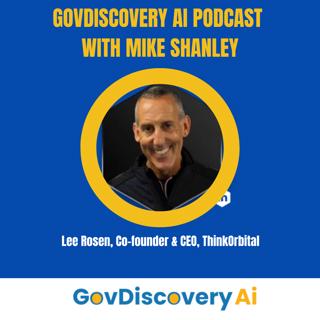
Ep 80: Lee Rosen, CEO, ThinkOrbital - GovDiscovery AI Podcast with Mike Shanley

Ep 80: Lee Rosen, CEO, ThinkOrbital - GovDiscovery AI Podcast with Mike Shanley

How to Build Big Infrastructure in Space: Insights from Lee Rosen LinkedIn: https://www.linkedin.com/company/thinkorbital Website: https://thinkorbital.com/ Email: marketing@thinkorbital.com Building ...

3 Apr 40min
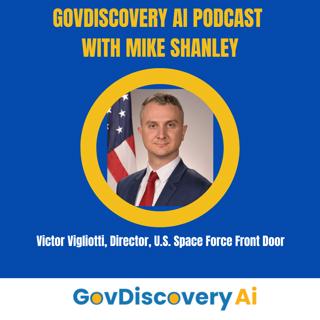
Ep 79 Victor Vigliotti, Director, U.S. Space Force Front Door

Ep 79 Victor Vigliotti, Director, U.S. Space Force Front Door

In this episode, Victor Vigliotti, Director of the Space Force Front Door, discusses how the US Space Force is transforming its knowledge management and vendor engagement processes. He shares insights...

19 Mar 36min
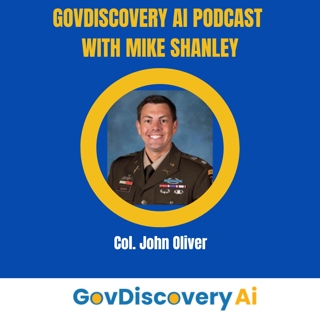
Ep 78 Col. John Oliver - U.S. Army Strategic Capital Initiative

Ep 78 Col. John Oliver - U.S. Army Strategic Capital Initiative

In this episode, Colonel John Oliver discusses the U.S. Army Strategic Capital Initiatives, exploring innovative partnerships with private capital and tech companies to modernize the industrial base a...

11 Mar 23min
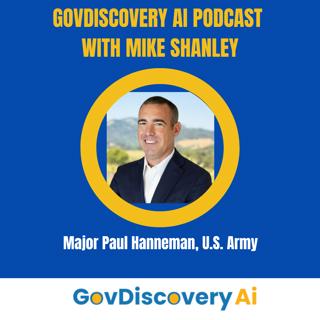
Ep. 77 Maj. Paul Hanneman - Building Software for the Solider

Ep. 77 Maj. Paul Hanneman - Building Software for the Solider

# How to Achieve Agnostic Technology in Defense: Insights from Major Paul Hanneman Learn how to implement agnostic technology in defense. Major Paul Hanneman shares insights on user empathy and collab...

6 Mar 31min

Populært innen Business og økonomi

stopp-verden
dine-penger-pengeradet
lydartikler-fra-aftenposten
rss-penger-polser-og-politikk
e24-podden
rss-borsmorgen-okonominyhetene
rss-skravla-gar
pengepodden-2
rss-pa-konto
tid-er-penger-en-podcast-med-peter-warren
finansredaksjonen
morgenkaffen-med-finansavisen
livet-pa-veien-med-jan-erik-larssen
utbytte
okonomiamatorene
lederpodden
liberal-halvtime
rss-kron-podden
paretopodden
rss-impressions-2