Desert Ferns with Dr. Michael Windham

Desert Ferns with Dr. Michael Windham

This is a science-heavy episode with Dr. Michael Windham, specialist in Cheilanthoid Ferns curator at Duke Herbarium. Even if you're not interested in this group, they're a great case study in numerous fascinating phenomena including convergent evolution, biogeography (dispersal vs. vicariance), why DNA sequencing is important to taxonomy, self-cloning to escape the limitations of being a fern in a desert, etc.


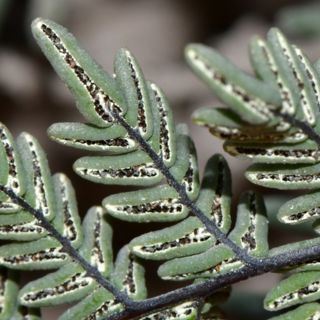
"Cheilanthoid Ferns" are a remarkable group of ferns - they grow in habitats where ferns seemingly shouldn't be able to grow - out of cracks in rocks and cliff faces in regions that are both usually very hot and very dry. Genera like Astrolepis, Myriopteris, Notholaena, Argyrochosma, Pellaea (the "coffe fern" in California), Cheilanthes, and more have been blowing my mind years as I frequently encountered them co-occurring in habitats with Cacti and spiny legumes. To the East, Myriopteris alabamensis grows all over drier rocky "microsites" throughout the Eastern half of North America.
These ferns are often either fuzzy as hell or blue, chalky-mint-green, and waxy with a wirey rachis. It'd be hard for anybody who takes a look at them to not be taken with how cool they look.

But how do they get it done? What are some of their adaptations? What is the evoutionary age of the family and where is the origin of diversity? What the hell is a "gametophyte" and are they unisexual or the fern equiavelent of being protogynous (and what the hell does "protogynous" mean anyway?). Why is molecular sequencing (looking at the DNA) so important for figuring out how all these plants are related to each other? What is convergent evolution and why have so many genera in this subfamily evolutionarily converged on the same strategies to cope with life in a dry environment? How do you identify species when so many of them look superficially alike and don't produce flowers (what we normally use to identify plants)? How long can their damn spores last (answer : centuries, in some cases).


We cover it all in this two hour podcast. If there's a term we use that you're not familiar with, look it up or join the Crime Pays patreon and send me a message. A brief list of topics somewhat sloppily-arranged in an "episode map" is below. Note: until I can alienate the casino advertisers, they seem to be especially herpetic on this episode. Ad-free episodes can be found on the Patreon.

apomixis : 1 hour 20

evolutionary age ; 75 ya

synapomorphies : revolute margins and pseudo-indusia

convergent evolution

center of diversity indicates center of origin

no farina in Notholaena, but flavonoid compounds on capitate hairs resembling cotton-candy

talking about cheilanthoid ferns to explain convergent evolution and how dna can resolve evolutionary relationships

difference between eusporangiate ferns and leptosporangiate

age of viability of fern spores

alternation of generations

antheridiogen

dispersal vs. vicariance 1:31

apomixis 1:36

Denne episoden er hentet fra en åpen RSS-feed og er ikke publisert av Podme. Den kan derfor inneholde annonser.

Episoder(291)

June in Ft. Worth Rants

June in Ft. Worth Rants

Episodes of the Crime Pays Podcast are available Ad-Free on the Patreon at www.patreon.com/crimepaysbutbotanydoesntRants about the Extinction of the Ft. Worth Prairie, the rediscovery of Dalea sabinal...

3 Jul 1h 37min
Interstate 8 Tour Rants

Interstate 8 Tour Rants

Episodes of the Crime Pays Podcast are available Ad-Free on the Patreon at www.patreon.com/crimepaysbutbotanydoesntIn this episode we rant about all night drives through the desert, meth-amphetamine a...

10 Jun 1h 51min

North Carolina Rants (NSFW)

North Carolina Rants (NSFW)

(NSFW) Rants about Dr Phil, Fire Ecology, Carnivorous Plants, the Piedmont Forests of North Carolina, Sandhills, Coastal Plain Longleaf Pine Savannas and more...All Episodes of the Crime Pays Podcast ...

25 Mai 1h 35min

Culture and Plants in Nuevo León, Mexico : Carlos "Aztekium" Velasco

Culture and Plants in Nuevo León, Mexico : Carlos "Aztekium" Velasco

Episodes of the Crime Pays Podcast are available Ad-Free on the Patreon at www.patreon.com/crimepaysbutbotanydoesntCarlos "Aztekium" Velasco is a biologist, educator, and naturalist in Nuevo León, Mex...

14 Mai 1h 15min

Oakland Bio - Saumitra Kelkar

Oakland Bio - Saumitra Kelkar

Saumitra Kelkar is a biologist and public educator In Oakland, California. This episode we talk about getting kids into nature, Bay area plant habitats, human selection of native plants and native pla...

8 Mai 1h 36min

Dirty Backyard Biology with Damon Tighe

Dirty Backyard Biology with Damon Tighe

In this episode we talk about the dead fly fungus, fertilizing Trichocereus with piss, how to get a good compost heap running, the science of backyard microbes, human manure composting, cultivating oy...

5 Mai 1h 59min

Nuevo Leon & Borderlands Rants

Nuevo Leon & Borderlands Rants

Rants about Mexican Cops, finding Arroyo Sweetwood in the wild, refugial canyons of the Sierra Madre that feel like humid forests in Georgia, and more .Ad-Free Episodes of the Crime Pays Podcast are a...

4 Mai 1h 53min

Rafflesia Rants

Rafflesia Rants

Ad-Free episodes of the Crime Pays But Botany Doesnt podcast are available on the Patreon at: www.patreon.com/crimepaysbutbotanydoesntRants about the Philippines, street trees of Manila, the jade vine...

17 Apr 1h 36min

Populært innen Humor

enkel-servering
rss-spartsklubben
papaya
storefri-med-mikkel-og-herman
harm-og-hegseth
tusvik-tnne
topp-3-med-wold-og-fladseth
verdens-verste
rss-nesten-hele-uka-med-lepperod
tore-og-haralds-podkast
misjonen-med-antonsen-og-golden
wolfgang-wee-uncut
hanna-de-heldige
rss-det-alle-snakker-om-med-siri-og-kim
gutta-backer
rss-dette-ma-aldri-skje-igjen
rss-na-er-det-halj
folk-flest-med-linn-og-nils
jan-thomas-og-einar-blir-venner
ma-pa-behandling-med-morten-ramm