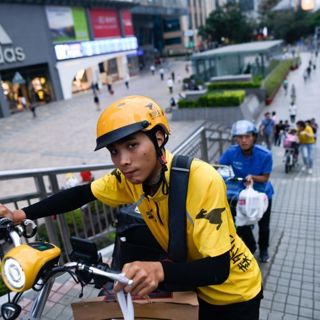

Algorithms and lockdowns: how China's gig economy works
Chinese Whispers18 Apr 2022

Algorithms and lockdowns: how China's gig economy works

‘One Shanghai courier uses own 70,000 yuan to buy necessities for people’, one Weibo hashtag trended last week. Instead of being seen as a damning indictment on what the state’s strict lockdown has induced people to do, the courier was lauded as a community hero and the story promoted by the censored platform. These kuaidi xiaoge (‘delivery bros’) are most likely gig economy workers. The industry was already an integral part to the Chinese urbanite’s life before the pandemic, but Covid has consolidated that role, as low-paid and hardworking gig economy drivers literally became critical to the survival of millions.
The Chinese gig economy is in many ways more advanced. The services are more extensive (grocery shopping and even designated drivers – a stranger to drive your car home on drinking nights – have been the norm for years) and the algorithms are more ruthless (closely monitoring and continuously shaving off delivery times. ‘The pandemic really brought the plight of these workers into the mainstream consciousness for the first time’, Viola Rothschild, my guest on this episode, tells me.
She is a PhD candidate at Duke University, and one of the few people – academics and journalists alike – who have looked into the Chinese gig economy. I’ve known Viola for years – we first met when we read for a masters in contemporary Chinese studies together.
On the episode, we discuss what working conditions are like (she recommends this article), the interactions between the state and the private sector (the largest players in the field are Alibaba and Didi Chuxing, both companies that have been penalised by the Chinese government in recent years), and what the pandemic – and particularly the Shanghai lockdown – has done to workers. We discuss the government’s efforts to improve working environments, but Viola tells me:
‘What workers get through unionisation is really about what the state wants to give them, if their goals align with the state’s at any given time in terms of pressuring these companies. This is especially thrown into clear relief when we see how the state treats workers who try to organise outside of this apparatus’
By that, Viola is referring to the kuaidi xiaoge who’ve been arrested for organising their own unions – it’s still deeply ironic that the most successful purportedly Marxist state in the world today is deeply suspicious of workers creating their own unions.
But fundamentally, as I push back at Viola, the problem is not only the private companies or the communist state, but also the consumers who demand faster and cheaper services. In that, ‘I think that the Chinese gig economy has a tonne in common with its American and British, and worldwide, counterparts’, Viola says. I totally agree.

Become a Spectator subscriber today to access this podcast without adverts. Go to spectator.co.uk/adfree to find out more.


For more Spectator podcasts, go to spectator.co.uk/podcasts.


Contact us: podcast@spectator.co.uk

Hosted on Acast. See acast.com/privacy for more information.

Episoder(122)

Eva Dou on the 'House of Huawei'

Eva Dou on the 'House of Huawei'

** Chinese Whispers is nominated in the Political Podcast Awards 2025. Vote for it to win the People's Choice category here **Among the casualties of Donald Trump’s trade war with China in his first p...

13 Jan 202549min

What’s in a name? Peter Hessler on what English names can reveal about China

What’s in a name? Peter Hessler on what English names can reveal about China

Why do so many Chinese people choose such curious English names? You must have come across this phenomenon – whether they are names from a past century, or surnames, nouns or even adjectives used as f...

23 Des 202434min
Xi Jinping's PLA purges

Xi Jinping's PLA purges

More than a year after Xi Jinping purged two senior generals in the People’s Liberation Army Rocket Force unit, China’s investigation into its military seems to be ongoing, with more scalps taken. In ...

9 Des 202435min

What's behind the Chinese migrant surge at the Darien Gap?

What's behind the Chinese migrant surge at the Darien Gap?

The Darien Gap is a 60 mile stretch of jungle that hundreds of thousands of migrants from all over South America trek through in order to reach the US-Mexico border. From there, they enter America in ...

25 Nov 202422min
Why Beijing is wary of a Russo-North Korean alliance

Why Beijing is wary of a Russo-North Korean alliance

There have been reports that some 11,000 North Korean troops are present in Russia and preparing to take part in the Russian invasion. While not acknowledged by either country, if true, this would mar...

11 Nov 202455min

Battle of Ideas – is China in decline?

Battle of Ideas – is China in decline?

** This episode of Chinese Whispers was recorded in front of a live audience as a part of the Battle of Ideas Festival 2024. **Is China in decline?I was born in China in the 90s, and growing up it fel...

28 Okt 20241h 35min

Corruption, power and the truth about my wife’s disappearance – with Desmond Shum

Corruption, power and the truth about my wife’s disappearance – with Desmond Shum

** On October 19, Cindy Yu and a panel of special guests will be recording a live Chinese Whispers at London's Battle of Ideas festival, talking the latest on China’s economic slowdown and asking – wh...

14 Okt 202443min
Will AI be the next arms race?

Will AI be the next arms race?

** On October 19, Cindy Yu and a panel of special guests will be recording a live Chinese Whispers at London's Battle of Ideas festival, talking the latest on China’s economic slowdown and asking – wh...

30 Sep 202448min

Populært innen Politikk og nyheter

giver-og-gjengen-vg
aftenpodden
aftenpodden-usa
forklart
lydartikler-fra-aftenposten
popradet
fotballpodden-2
stopp-verden
dine-penger-pengeradet
det-store-bildet
rss-gukild-johaug
nokon-ma-ga
hanna-de-heldige
rss-ness
e24-podden
aftenbla-bla
i-retten
frokostshowet-pa-p5
rss-dannet-uten-piano
grasoner-den-nye-kalde-krigen