Does China want to change the international rules-based order?

Does China want to change the international rules-based order?

China is often accused of breaking international rules and norms. Just last week at Mansion House, Foreign Secretary Liz Truss said: 'Countries must play by the rules. And that includes China'.

So what are its transgressions, and what are its goals for the international system? My guests and I try to answer this question in this episode through looking at China's attitude to and involvement in international organisations, past and present. Professor Rana Mitter, a historian at the University of Oxford and author of China's Good War , points out that there's a fundamental difference in China's approach compared to, say, Russia. 'Russia perceives itself as, essentially, a country that is really at the end of its tether in terms of the international system. Whereas China still sees plenty of opportunities to grow and expand its status'.

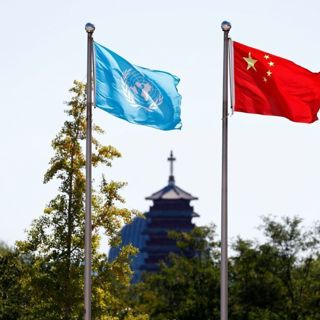
To that end, China is actually a member of dozens of international organisations, most notably – as we discuss in the episode – sitting on the United Nations Security Council, which gives it veto power on UN resolutions (though, Yu Jie, senior research fellow at Chatham House, points out that China is most often found abstaining rather than vetoing). It wants a seat at the table, but it also frequently accuses our existing set of international norms and rules as designed by the West. To begin with, then, China is seeking to rewrite the rules in its own favour – Jie gives the example of China's ongoing campaign to increase its voting share in the IMF, on the basis of its huge economy. 'It's not exactly overthrowing the existing international order wholesale, but choosing very carefully which parts China wants to change.'

This multilateral engagement has a historical basis. Nationalist China was keen to be seen as an equal and respected partner in the international community, and Rana points out – something I'd never thought of before – that China after the second world war 'was a very very unusual sort of state… Because it was the only state, pretty much, in Asia, that was essentially sovereign… Don’t forget that 1945 meant liberation for lots of European peoples, but for lots of Asian peoples – Indonesia, Vietnam, Malaya, wherever you want to name – they basically went back into European colonialism'. This (together with its then-alliance with the United States) gave the Republic of China a front row seat in the creation of the United Nations and, before then, the League of Nations.

It didn't take long for Communist China to start building links with the rest of the world, either. Mao 'had not spent decades fighting out in the caves and fields of China to simply become a plaything of Stalin’, Rana points out, making its multilateral relations outside of the alliance with the USSR vitally important. After it split with Moscow, and before the rapprochement with the US, the Sixties was a time of unwanted isolationism, ' which is well within living memory of many of the top leaders', says Rana, adding more to its present day desire to have as much sway as possible in the world, which still comes through international organisations.

Finally, my guests bust the myth – often propagated by Beijing – that China had no role in the writing of today's international laws, pointing out that Chinese and other non-western thinkers played a major role in the creation of the Universal Declaration of Human Rights . What's more, do western ideas have no place in guiding and governing China? After all, Karl Marx was certainly not Chinese, and that doesn't seem to bother his Chinese Communist believers.

Become a Spectator subscriber today to access this podcast without adverts. Go to spectator.co.uk/adfree to find out more.


For more Spectator podcasts, go to spectator.co.uk/podcasts.


Contact us: podcast@spectator.co.uk

Hosted on Acast. See acast.com/privacy for more information.

Episoder(122)

Life in a changing China

Life in a changing China

Since 1978, China has changed beyond recognition thanks to its economic boom. 800 million people have been lifted out of poverty as GDP per capita has grown eighty times. Some 60 per cent of the count...

27 Mai 202439min
China's vendetta against Nato

China's vendetta against Nato

Last week, President Xi Jinping visited Serbia. An unexpected destination, you might think, but in fact the links between Beijing and Belgrade go back decades. One event, in particular, has linked the...

13 Mai 202446min
How China is quietly cutting out American tech

How China is quietly cutting out American tech

Last week, President Joe Biden finally signed into law a bill that would take TikTok off app stores in the US, eventually rendering the app obsolete there. This is not the end of the saga, as TikTok h...

29 Apr 202432min
Was Marco Polo a 'sexpat'?

Was Marco Polo a 'sexpat'?

When I recently came across a book review asking the question ‘was Marco Polo a "sexpat"?’, I knew I had to get its author on to, well, discuss this important question some more. The 13th century Vene...

15 Apr 202424min
What Chinese hackers want

What Chinese hackers want

Over the last week the UK has been rocked by allegations that China was responsible for two cyber attacks in recent years – one on the Electoral Commission, where hackers successfully accessed the ope...

28 Mar 202426min

Life on the margins pt II: Li Ziqi and the phenomenon of the rural influencer

Life on the margins pt II: Li Ziqi and the phenomenon of the rural influencer

In the last episode, I discussed Chinese rural lives with Professor Scott Rozelle. One point he made which particularly stuck with me was the dying out of farming as an occuption – he'd said that most...

18 Mar 202422min
Life on the margins: how China's rural deprivation curbs its success

Life on the margins: how China's rural deprivation curbs its success

Too often our stories about China are dictated by the urban experience, probably because journalists inside and outside of China are often based in the big cities; Beijing specifically. Those who live...

4 Mar 202441min
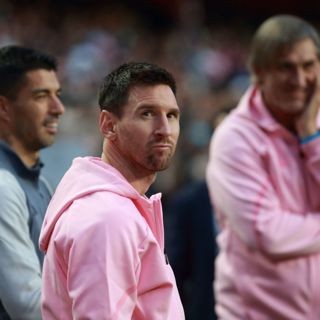
What the Messi row reveals about Chinese football

What the Messi row reveals about Chinese football

The Argentinian football star Lionel Messi has been trending on Weibo – and unfortunately, not for a good reason. It all started when Messi sat out a match in Hong Kong earlier this month. His reason ...

19 Feb 202439min

Populært innen Politikk og nyheter

giver-og-gjengen-vg
aftenpodden
aftenpodden-usa
forklart
lydartikler-fra-aftenposten
popradet
fotballpodden-2
stopp-verden
dine-penger-pengeradet
det-store-bildet
rss-gukild-johaug
nokon-ma-ga
hanna-de-heldige
rss-ness
e24-podden
aftenbla-bla
i-retten
frokostshowet-pa-p5
rss-dannet-uten-piano
grasoner-den-nye-kalde-krigen