Does China want to change the international rules-based order?

Does China want to change the international rules-based order?

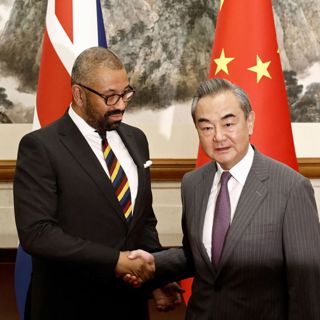
China is often accused of breaking international rules and norms. Just last week at Mansion House, Foreign Secretary Liz Truss said: 'Countries must play by the rules. And that includes China'.

So what are its transgressions, and what are its goals for the international system? My guests and I try to answer this question in this episode through looking at China's attitude to and involvement in international organisations, past and present. Professor Rana Mitter, a historian at the University of Oxford and author of China's Good War , points out that there's a fundamental difference in China's approach compared to, say, Russia. 'Russia perceives itself as, essentially, a country that is really at the end of its tether in terms of the international system. Whereas China still sees plenty of opportunities to grow and expand its status'.

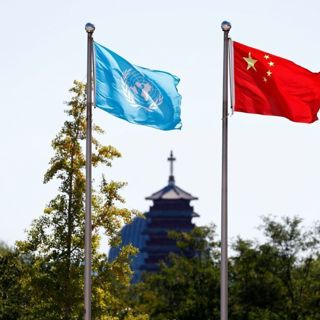
To that end, China is actually a member of dozens of international organisations, most notably – as we discuss in the episode – sitting on the United Nations Security Council, which gives it veto power on UN resolutions (though, Yu Jie, senior research fellow at Chatham House, points out that China is most often found abstaining rather than vetoing). It wants a seat at the table, but it also frequently accuses our existing set of international norms and rules as designed by the West. To begin with, then, China is seeking to rewrite the rules in its own favour – Jie gives the example of China's ongoing campaign to increase its voting share in the IMF, on the basis of its huge economy. 'It's not exactly overthrowing the existing international order wholesale, but choosing very carefully which parts China wants to change.'

This multilateral engagement has a historical basis. Nationalist China was keen to be seen as an equal and respected partner in the international community, and Rana points out – something I'd never thought of before – that China after the second world war 'was a very very unusual sort of state… Because it was the only state, pretty much, in Asia, that was essentially sovereign… Don’t forget that 1945 meant liberation for lots of European peoples, but for lots of Asian peoples – Indonesia, Vietnam, Malaya, wherever you want to name – they basically went back into European colonialism'. This (together with its then-alliance with the United States) gave the Republic of China a front row seat in the creation of the United Nations and, before then, the League of Nations.

It didn't take long for Communist China to start building links with the rest of the world, either. Mao 'had not spent decades fighting out in the caves and fields of China to simply become a plaything of Stalin’, Rana points out, making its multilateral relations outside of the alliance with the USSR vitally important. After it split with Moscow, and before the rapprochement with the US, the Sixties was a time of unwanted isolationism, ' which is well within living memory of many of the top leaders', says Rana, adding more to its present day desire to have as much sway as possible in the world, which still comes through international organisations.

Finally, my guests bust the myth – often propagated by Beijing – that China had no role in the writing of today's international laws, pointing out that Chinese and other non-western thinkers played a major role in the creation of the Universal Declaration of Human Rights . What's more, do western ideas have no place in guiding and governing China? After all, Karl Marx was certainly not Chinese, and that doesn't seem to bother his Chinese Communist believers.

Become a Spectator subscriber today to access this podcast without adverts. Go to spectator.co.uk/adfree to find out more.


For more Spectator podcasts, go to spectator.co.uk/podcasts.


Contact us: podcast@spectator.co.uk

Hosted on Acast. See acast.com/privacy for more information.

Episoder(122)

Does China care what Britain thinks?

Does China care what Britain thinks?

In 2010, David Cameron and George Osborne ushered in what they called ‘a golden era’ with China, the world’s rising superpower. They argued that Britain could be China’s best friend in the West. Thirt...

2 Okt 20231h 1min
What we know about Beijing's spies

What we know about Beijing's spies

Two years ago, Richard Moore, head of MI6, said that China was now the organisation’s ‘single greatest priority’.Parliamentarians and the British public have been starkly reminded of this by last week...

18 Sep 202331min
Is China still a Confucian country?

Is China still a Confucian country?

For thousands of years, Confucianism has run through the fabric of Chinese society, politics and culture. Decades of Communism has taken its toll on China, so can it still be considered a Confucian co...

4 Sep 202328min
What Beidaihe reveals about the changing nature of Communist leadership

What Beidaihe reveals about the changing nature of Communist leadership

178 miles to the east of Beijing, there’s a beach resort called Beidaihe. The water is shallow and the sand is yellow and fine. Luxurious holiday villas dot the coastline. Starting from the 1950s, lea...

21 Aug 202325min
Does China need a new economic playbook?

Does China need a new economic playbook?

At the end of last year, some thought that the Chinese economic recovery after three years of zero Covid could happen just as fast as zero Covid itself ended being government policy. I admit, that inc...

7 Aug 202341min
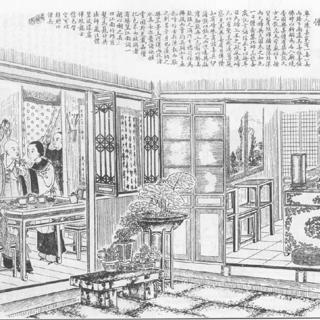
Did some good come from the Qing’s dying century?

Did some good come from the Qing’s dying century?

In the 1800s, Qing China’s final century, European powers were expanding eastwards. The industrialised West, with its gunboats and muskets, and the soft power of Christianity, pushed around the dynast...

24 Jul 202336min
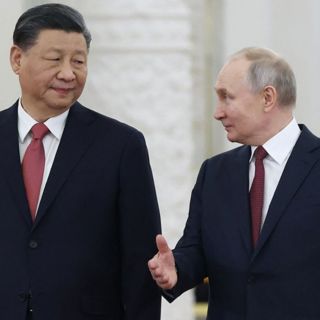
Beijing and Prigozhin: what does China think of the Wagner uprising?

Beijing and Prigozhin: what does China think of the Wagner uprising?

It’s now a week since the Wagner Group revolted against the Kremlin.Though the dramatic uprising was quelled within 24 hours and the group’s leader, Yevgeny Prigozhin, is now exiled to Belarus, the ep...

30 Jun 202336min
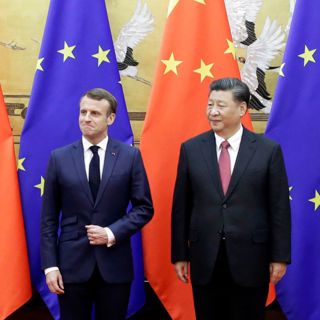
How divided is Europe on China?

How divided is Europe on China?

The word ‘West’ is often used as a shorthand to describe liberal democracies in Europe, and perhaps in Asia too, such that we’ll often talk about ‘the West’s attitude to China’, or the ‘West’s relatio...

19 Jun 202338min

Populært innen Politikk og nyheter

giver-og-gjengen-vg
aftenpodden
aftenpodden-usa
forklart
stopp-verden
popradet
dine-penger-pengeradet
det-store-bildet
rss-gukild-johaug
nokon-ma-ga
lydartikler-fra-aftenposten
fotballpodden-2
hanna-de-heldige
aftenbla-bla
rss-ness
rss-espen-lee-usensurert
e24-podden
rss-dannet-uten-piano
rss-penger-polser-og-politikk
rss-utenrikskomiteen-med-bogen-og-grasvik