233. Shocks and surprises at the war’s end

233. Shocks and surprises at the war’s end

Following the German surrender in May 1945, the ‘Big Three’ – the United States, the Soviet Union and Britain – met for the third and last time in conference. And this time, appropriately, they met on German territory, in Potsdam near Berlin. It was Soviet-held territory too, perhaps significant given the power with which the Soviet Union was emerging from the war.

Indeed, its delegation was the only one to keep the same leader, Joseph Stalin, at its head, as he had been at Tehran and Yalta.

Roosevelt had died.

As for the British, after nearly ten years without a general election, they finally held one, and to general surprise, the victorious war Prime Minister Churchill was defeated by his deputy, Clement Attlee, the Labour leader. Attlee would form the first ever Labour government with a parliamentary majority. He would also take over from Churchill as leader of the British delegation at Potsdam.

The conference took place under the shadow of the first successful test of a nuclear device, the day before the conference started. The US was now a nuclear power. That gave it quite an edge in international power politics.

Although the device had been designed to use against Nazi Germany, since only Japan was left in the war, and given how high the casualties would be in an invasion of the Japanese home islands, the Americans dropped an atom bomb on Hiroshima on 6 August 1945. To make sure the message had got through, they dropped another on Nagasaki on the 9th. The Japanese surrendered on the 15th, the only concession to their sensibilities being that the Emperor was not deposed.

When the final Japanese surrender document was signed on 2 September, World War 2 was at last over.


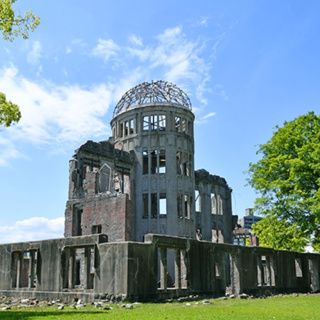
Illustration: The A-bomb dome in Hiroshima, Japan. Public Domain

Music: Bach Partita #2c by J Bu licensed under an Attribution-NonCommercial-No Derivatives (aka Music Sharing) 3.0 International License


Episoder(275)

258. Major’s bastards and Labour’s deal

258. Major’s bastards and Labour’s deal

By winning the 1992 general election, John Major had gained his own mandate to form a government, instead of imply inheriting Margaret Thatcher’s. He’d shown himself capable of leading the Conservativ...

31 Aug 202514min
257. Iron Lady out, Grey Man in

257. Iron Lady out, Grey Man in

With the poll tax, Thatcher took one bad decision to many. From the point of view of orthodox Thatcherite thought, it sounded like a good idea. She’d been working for years to shrink the state but, wh...

24 Aug 202514min
256. Maggie losing it

256. Maggie losing it

Having looked last week at how Maggie Thatcher was running out of options for how to carve out a new role for Britain on the world stage, this week we look at how things were going at home. After all,...

17 Aug 202514min
255. Maggie: lioness or poodle?

255. Maggie: lioness or poodle?

Maggie Thatcher in 1987 pulled off a trick that had eluded all other British Prime Ministers of the twentieth century: she won three general elections in a row. Even more, she won a second Commons lan...

10 Aug 202514min
254. Maggie reaching the top

254. Maggie reaching the top

Thatcher’s victories, including a general election landslide and breaking the miners’ strike, emboldened her to launch another phase in the reduction of the role of the state in the British economy. N...

3 Aug 202514min
253. The Enemy Within

253. The Enemy Within

What had converted Maggie Thatcher from something of a lame duck into a front runner for the next British general election?While the economy had begun to pick up, that had been patchy at best, with so...

27 Jul 202514min
252. Iron Lady

252. Iron Lady

Mrs Thatcher’s first term in office was one of the great get out of jail events. She came into office intent on braking with the Keynesianism and social democracy of the postwar consensus. She drew on...

20 Jul 202514min
251. Unlucky Jim

251. Unlucky Jim

In 1976, Jim Callaghan took over from Harold Wilson as leader of the Labour Party and British Prime Minister. He was a competent politician, though not an outstanding one. He did his job well, but he ...

13 Jul 202514min

Populært innen Historie

med-egne-oyne
rss-dette-ma-aldri-skje-igjen
rss-katastrofe
henrettelsespodden
historier-som-endret-norge
rss-benadet
historier-som-endret-verden
sektledere
rss-frontkjemperne
aftenposten-historie
rss-strid-de-norske-borgerkrigene
rss-nadelose-nordmenn-gestapo
historiepodden
rss-bisarr-historie
rss-politisk-preik
liberal-halvtime
vare-historier
undersattene
rss-gamle-greier
rss-historiepodden-ww2