The Original Fight for the Equal Rights Amendment
Unsung History18 Okt 2021

The Original Fight for the Equal Rights Amendment

After the 19th Amendment was ratified in 1920, enfranchising (some) women, lots of questions remained. If women could vote, could they serve on juries? Could they hold public office? What about the array of state-laws that still privileged husbands and fathers over wives and daughters in regard to property and earnings rights?


In February 1921, Alice Paul, head of the National Woman’s Party declared: “Now that political freedom has been won, we hope to wipe out sex discrimination in law, so that the legal status of women will be self-respecting.” Their strategy to accomplish this, on the advice of legal scholar Professor Albert Levitt of George Washington University was to push for a new constitutional amendment, which became known as the Equal Rights Amendment.


Between 1923 and 1932, Congress held six hearings on the ERA, but it faced fierce opposition until the mid-1930s. By the mid-1930s, support for the ERA began to increase dramatically, as congressional subcommittees started to report the amendment favorably nearly every year after 1936. In 1940 the Republican Party added the ERA to its party platform. Four years later the Democratic party did the same.


On October 12, 1971, the House of Representatives finally voted on the ERA, introduced by Michigan Democrat Martha Griffiths. The vote passed 354 to 24, with 51 not voting. On March 22, 1972, the Senate also passed the bill, 84-8, with 8 not voting. Then the fight moved to the states. As of October 2021, 38 states have ratified the amendment, the final three states coming long after the original deadline, but the amendment has not been added to the Constitution.


I’m joined in this episode by Dr. Rebecca DeWolf, author of the new book: Gendered Citizenship: The Original Conflict over the Equal Rights Amendment, 1920–1963, who also graciously fact checked the introduction to the episode.


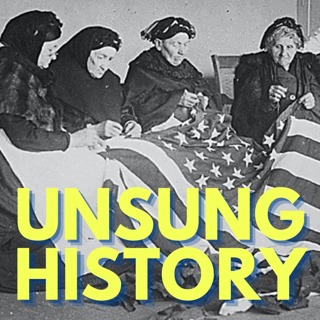
Our theme song is Frogs Legs Rag, composed by James Scott and performed by Kevin MacLeod, licensed under Creative Commons. Episode image is: “A group of young members of the National Woman's Party before the Capitol. They are about to invade the offices of the senators and congressmen from their states, to ask them to vote for Equal Rights.“ Washington D.C, ca. 1923. Library of Congress. https://www.loc.gov/item/mnwp000193/.

Additional Sources and Links:


Advertising Inquiries: https://redcircle.com/brands

Denne episoden er hentet fra en åpen RSS-feed og er ikke publisert av Podme. Den kan derfor inneholde annonser.

Episoder(230)

Jane Addams, Hull House, and Chicago's Nineteenth Ward

Jane Addams, Hull House, and Chicago's Nineteenth Ward

In the fall of 1889, Jane Addams and Ellen Gates Starr opened Hull House on Chicago’s Near West Side, full of good intentions to help the poor people of the neighborhood. They were a force for good, p...

10 Aug 46min
Buddy Bradley

Buddy Bradley

Buddy Bradley, born in the Jim Crow South in 1905, made his way to Harlem at age 16 where he learned to tap dance and became a chorus boy. He was sought out on Broadway as both teacher and choreograph...

27 Jul 50min
The All-American Girls Professional Baseball League

The All-American Girls Professional Baseball League

During World War II, afraid that major league baseball would need to pause while men were overseas fighting, Philip K. Wrigley, chewing gum mogul and owner of the Chicago Cubs, spearheaded a new profe...

13 Jul 54min
The Declaration of Independence

The Declaration of Independence

The Continental Congress voted to break from Great Britain on July 2, 1776, and approved the text of the Declaration of Independence on July 4, but it took weeks for the news to spread throughout the ...

29 Jun 48min
The Statue of Liberty and the Empire State Building

The Statue of Liberty and the Empire State Building

The Statue of Liberty and the Empire State Building loom large in the American imagination, symbolizing the conflicting ideas of liberty and empire; their meanings and characters have shifted over tim...

15 Jun 38min
An American History of Purses

An American History of Purses

Today the US handbag market is estimated to be nearly $12 billion, with most of the purchasing done by women, but into the early 20th Century purses hadn’t yet become the nearly-exclusive domain of wo...

1 Jun 40min
The Lady Bird Special

The Lady Bird Special

On the morning of Tuesday, October 6, 1964, the Lady Bird Special, a 19-car train carrying First Lady Claudia “Lady Bird” Johnson, her supporters, members of the press, and a security detail, departed...

18 Mai 41min
Policing Slavery & Black Rebellion in the American South

Policing Slavery & Black Rebellion in the American South

Enslaved Africans were forcibly shipped to Virginia starting in 1619 in response to a severe labor shortage. From the beginning, enslaved laborers resisted by fleeing and through violence, and white e...

4 Mai 50min

Populært innen Fakta

fastlegen
dine-penger-pengeradet
relasjonspodden-med-dora-thorhallsdottir-kjersti-idem
foreldreradet
treningspodden
jakt-og-fiskepodden
rss-kunsten-a-leve
mikkels-paskenotter
rss-strid-de-norske-borgerkrigene
hverdagspsyken
sinnsyn
fryktlos
gravid-uke-for-uke
rss-sarbar-med-lotte-erik
rss-var-forste-kaffe
kvallm
tomprat-med-gunnar-tjomlid
rss-impressions-2
rss-bak-luftfarten
laringsmiljo-i-skole-og-barnehage-uis-podkast