Will there be a unconditional basic income?  (part 1) | Dr. Pero Mićić

Will there be a unconditional basic income? (part 1) | Dr. Pero Mićić

Is your job compromised by artificial intelligence and robotics? No? Go google it ...

Everywhere we hear and read about the idea that it would be great if everyone would get an unconditional basic income, completely without any work or other condition or prerequisite.

But will it come to that? Will there be an unconditional basic income? In the next 20-30 years?

What is actually a basic income?

The concept of an Unconditionnal BI is that every inhabitant of a country receives an income without any preconditions or prerequisits. Usually you hear an amount of 1,000 euros, dollars or similar amounts in other currencies. Supporters of a UBI say that this would have a number of advantages. People woud feel safer. The incredibly complicated and expensive system of social benefits will be drastically simplified.

The often degrading and humiliating application procedures would get completely unnecessary. Very few would do nothing, nothing useful to society at least, and spend their days in the social hammock. The opponents say

  • That millions will then lean back and let the hard-working people finance their livelihoods.
  • That this is completely unaffordable, because, for example in Germany, it would cost three times the federal budget.
  • And that it is therefore only utopian social romanticism.

The idea is old

Thomas Morus wrote in 1516 about a kind of basic income. His book is called Utopia. Thomas Jefferson and Abraham Lincoln and also Martin Luther King spoke for it and even Richard Nixon wanted to introduce it, but failed in the Senate. Even the great liberal economic thinkers Friedrich von Hayek and Milton Friedman saw advantages in the idea.

Perception: Today a basic income is "nice to have" for the most part. Despite presumable advantages, after decades of discussion, nations and states have so far either done nothing at all or have only done experiments that have not been continued. So the need is not so great apparently. Or the resistance is very great. Obviously, there has been no need to do so up to now. There has not been sufficient necessity. Therefore a UBI seems to be only nice to have from the current point of view.

But let's have a look at what the future holds for us.Let's put on the blue glasses of the future. These are the glasses for our assessment of the probable future. It's not about forecasts, but about assumptions about the future, which is a big difference. Below is a link to a video about the five glasses for the future.

Assumption: AI and robotics will take over more and more functions and tasks that previously only humans could do.

Green: Opportunities and options

The possible answers are: Yes, there will be a UBI. There will be no basic income at all. There will be a conditional Basic Income

  • People with low incomes or who live on social benefits will feel more secure. They will feel less fear of existence. They will feel calmer.
  • People will seek salvation less in dangerously simple right-wing or left-wing radical solutions.
  • People will feel freer. They will not be so dependent on employers.
  • Low earners will choose a job more freely, somewhat more independently and will then do this job more self-determined and motivated.
  • The complicated and complex system of social benefits will be drastically simplified.
  • The often degrading application procedures will disappear.

Only very few will do nothing at all. The experiments from Canada in the 70s and Finland recently have shown that only 1-2% stopped working. People will take on more meaningful tasks, such as caring for children in daycare centres and schools and caring for the elderly, for example as mobility companions, or providing security services in residential areas or creating works of art. People will dare more to take risks in order to develop themselves. For example, to become self-employed. In Kenya, around 90% founded a company in a basic income test. People are becoming more creative and can sometimes get deeper into a project that doesn't have to earn money straight away. This creates a lot of innovation.

What are the counterarguments?

Over four or five decades it has simply not been possible to introduce a UBI anywhere in a serious and permanent way. Some argue that employers could lower normal salaries because the state pays the difference to regular salaries. This may happen, but it can be prevented by a legal minimum wage per day or hour. No, it is unlikely to cost any jobs in total. It should be an ethical principle that we have an economy in which one can live relatively well from full-time work. No matter what.

Another argument against a UBI is that no one will then be doing the difficult, dirty, unattractive work. For example, in nursing care for the elderly or the police work on the street.

That is too short-sighted. Rather would and will such work have to be paid significantly better than today. Otherwise - in fact - there will really be no one else to do this work. Or it will be done by intelligent robots.

Crucial argument 1: It is nonsensical and unnecessary to pay the UBI really to everyone.

It is usually demanded that the UBI be paid to everyone. Independent of income. Also to the millionaire. Just for the sake of simplicity. That is absurd in several ways.

1000 euros for each would, for example in Germany, make about a trillion Euros: That is three times the federal budget.

A lot of money would be paid to people who neither need a UBI, nor would they really experience it as a significant difference in their lives.

It is very easy to find out who would really need and benefit from a UBI and who would not. And all that without the huge bureaucracies that exist today.

Since everyone then knows that there is a basic income, the feeling of security is created in many people, even if no UBI is paid yet.

Crucial argument 2: I do not see the need to make it unconditional.

Freedom and responsibility should always coincide. Hence also rights and duties for society. There is not really a convincing reason for unconditionality that is convincing in the historical, philosophical and ethical context. Why should we make people pure recipients, now that we are even disparagingly calling them consumers? A terrible word.

Of course, it would be ideal if nobody had to worry about anything anymore. But I that is unrealistic.

Because then others would have to take care of you.

It is no good to impose responsibility for one's own well-being on others.

And: We must develop our solutions with a global perspective. The focus of the world, both economically and culturally, is gradually shifting to Asia. In the next 20-30 years, people there are unlikely to switch to a leisure society. They will continue to develop and compete with us with vision, strategy and implementation power.

The UBI requires several major reorganizations at the same time, some of which have a revolutionary character. It is better to take big, but feasible steps because they are more realistic and wiser from a systemic point of view. Otherwise, a basic income will remain a utopian idea.

Option 2: There will be no basic income at all.

Minus: Here I have only one Argument and that is a negative one. If our assumptions about the future are reasonably correct, then if we do not introduce a basic income, in whatever form, so that virtually nobody has to live in real poverty, the danger of social distortions is very great. There will perhaps even be a bang, as some people say. Whatever that means in concrete terms.

The probability cannot be neglected that the intelligentization and robotizatoin of the economy will lead to 10, 20, 30 or more percent unemployment. This is too dangerous.

Denne episoden er hentet fra en åpen RSS-feed og er ikke publisert av Podme. Den kan derfor inneholde annonser.

Episoder(62)

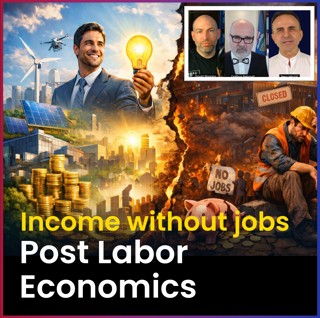
Interview on Post Labor Economics: David Shapiro + Dalibor Petrovic | Dr. Pero Mićić

Interview on Post Labor Economics: David Shapiro + Dalibor Petrovic | Dr. Pero Mićić

Join the "BRIGHT FUTURE LEADERS" community for free:  https://www.futuremanagementgroup.com... Lead your team into a challenging future and future-proof your business. We need to rethink our core assu...

22 Mar 1h 23min
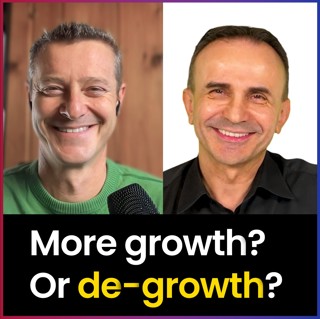
Do we really need more growth? Is de-growth a good idea? | Dr. Pero Mićić

Do we really need more growth? Is de-growth a good idea? | Dr. Pero Mićić

Join the "BRIGHT FUTURE LEADERS" community for free:  https://www.futuremanagementgroup.com... Lead your team into a challenging future and future-proof your business. Do we really need any more growt...

15 Des 20251h 21min
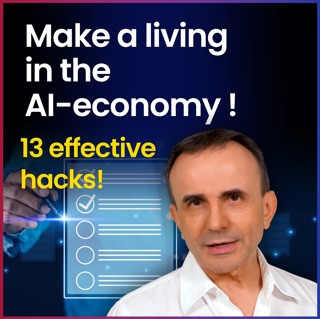
How to make a living in an AI economy. 13 concrete recommendations | Dr. Pero Mićić

How to make a living in an AI economy. 13 concrete recommendations | Dr. Pero Mićić

Join the "BRIGHT FUTURE LEADERS" community for free:  https://www.futuremanagementgroup.com... Lead your team into a challenging future and future-proof your business. What will you do when 60-80% of ...

22 Nov 202519min
Will AI result in catastrophic poverty or in abundance for everyone? (3 scenarios) | Dr. Pero Mićić

Will AI result in catastrophic poverty or in abundance for everyone? (3 scenarios) | Dr. Pero Mićić

Join the "BRIGHT FUTURE LEADERS" community for free:  https://www.futuremanagementgroup.com... Lead your team into a challenging future and future-proof your business. What do you do for a living toda...

30 Jan 202525min

Humanoid Robots: How much cost per hour? | Dr. Pero Mićić

Humanoid Robots: How much cost per hour? | Dr. Pero Mićić

Join the "BRIGHT FUTURE LEADERS" for free and future-proof your business: https://www.futuremanagementgroup.com... On this channel, I advise you in making yourself and your business more future-proof....

14 Jun 202415min

Humanoid Robots: How they learn and innovate

Humanoid Robots: How they learn and innovate

Join the "BRIGHT FUTURE LEADERS" for free and future-proof your business: https://www.futuremanagementgroup.com... On this channel, I advise you in making yourself and your business more future-proof....

22 Mai 202414min

Intelligent Humanoid Robots: Are they really coming?

Intelligent Humanoid Robots: Are they really coming?

Join the "BRIGHT FUTURE LEADERS" for free and future-proof your business: https://www.futuremanagementgroup.com... If and when humanoid robots find their way into our world, they will change work, the...

28 Mar 202413min

The solution to labor shortage? (all facts) | Dr. Pero Mićić

The solution to labor shortage? (all facts) | Dr. Pero Mićić

Join the "BRIGHT FUTURE LEADERS" for free and future-proof your business: https://www.futuremanagementgroup.com... Humanoid robots will reshape the world, says the Chinese government in a guideline fo...

4 Mar 202417min

Populært innen Business og økonomi

stopp-verden
dine-penger-pengeradet
lydartikler-fra-aftenposten
rss-penger-polser-og-politikk
e24-podden
rss-borsmorgen-okonominyhetene
rss-skravla-gar
pengepodden-2
rss-pa-konto
finansredaksjonen
livet-pa-veien-med-jan-erik-larssen
aftenbladet-intervjuer
utbytte
tid-er-penger-en-podcast-med-peter-warren
morgenkaffen-med-finansavisen
lederpodden
liberal-halvtime
okonomiamatorene
pengesnakk
rss-politisk-preik