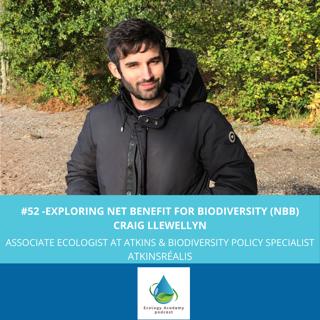
#52 - Exploring Net Benefit for Biodiversity with Craig Llewellyn

#52 - Exploring Net Benefit for Biodiversity with Craig Llewellyn

Welcome to another insightful episode of the Ecology Academy podcast, hosted by Richard Dodd. Join us as we delve into the world of ecology with special guest Craig Llewellyn, Associate Ecologist and Biodiversity Policy Specialist at Atkins Realis. In this first part of a two-part series, we focus on the concept of 'Net Benefit for Biodiversity' within Wales' Planning Policy. Discover how this policy aims to enhance biodiversity at a broader ecosystem level using the innovative DECCA framework.

Craig Llewellyn shares his extensive experience and insights on the ecological assessment process, comparing the Welsh net benefit approach to England's biodiversity net gain. Learn about the components of the DECA framework—Diversity, Extent, Condition, Connectivity, and Adaptation to Change—and how they play a crucial role in sustainable development. Tune in to understand how ecological policies are evolving to meet current and future challenges in biodiversity conservation.

Background to NBB

The 2016 Environment (Wales) Act introduced a new legal duty on all public authorities to maintain and enhance biodiversity in carrying out their functions (the "Section 6 Duty”). The duty requires public authorities to promote the resilience of ecosystems. The newly implemented 12th Edition of Planning Policy Wales (PPW 12th Edition) requires planning authorities (LPAs) must demonstrate they have taken all reasonable steps to fulfil the Section 6 duty.

In Wales, the biodiversity net gain regime is termed “Net Benefit for Biodiversity” (NBB). While it has a similar intent to Biodiversity Net Gain (BNG) in England in delivering an overall improvement in biodiversity, NBB does not use a metric-based approach like BNG, which sets a baseline number of biodiversity units and requires developers to improve biodiversity by a minimum of 10%.

NBB supports a proactive approach to be taken by developers to biodiversity, wider ecosystem benefits, and resilience at the design stage. NBB applies to all development in Wales, even in cases where biodiversity value is being maintained rather than enhanced.

Unlike the quantitative approach of BNG for development in England, NBB takes a more site-specific and qualitative assessment based on the DECCA resilience attributes and the step-wise mitigation hierarchy.

  • Diversity – Maintaining and enhancing diversity at all levels and scales
  • Extent – Incorporating measures to maintain and increase semi-natural habitat area and linkages
  • Condition – The condition affected by factors like climate change, invasive species, recreation, etc.
  • Connectivity – Maintaining/creating links between and within habitats
  • Aspects of resilience – The product of the above four attributes

Any proposed biodiversity enhancements must be appropriate to the local and national environment, considering strategic plans, local strategies, and evidence like area statements.

Ecologists need to take a “whole system approach” looking at the baseline biodiversity value and resilience of the entire site, its context in the wider landscape, and opportunities for enhancing resilience in line with the DECCA attributes.

A key principle of NBB is that biodiversity enhancement should be proportionate to the scale and nature of the proposed development.

While this means small developments can more easily deliver net benefit, it also means planning permission may be refused if no enhancement is proposed as part of an application (PPW 6.4.12).

Even where biodiversity value has been maintained on a site, the policy at 6.4.16 states “there must still be a proactive process to look for and secure enhancement through the design and implementation of the development.” Hence, going above and beyond simple mitigation is essential.

Developers in Wales will need to be aware of NBB and the Section 6 Duty. This brings additional complexity and cost to the development process.

Following the DECCA ecosystem resilience principles and step-wise avoidance/mitigation approach needs to be a central consideration from the very start of the development planning process. Innovative solutions, partnership working, and an appreciation of cumulative impacts in the wider area will all help deliver biodiversity benefits.

Episoder(53)

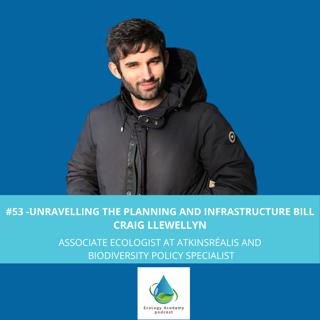
#53 - Unravelling the Planning and Infrastructure Bill: Craig Llewellyn

#53 - Unravelling the Planning and Infrastructure Bill: Craig Llewellyn

Welcome back to the Ecology Academy Podcast, where host Richard Dodd offers an insightful deep dive into the current hot topic - the Planning and Infrastructure Bill. In this compelling episode, joine...

5 Mai 202534min

#51 - Show Me the Data: Local Environmental Record Centres with Adam Rowe

#51 - Show Me the Data: Local Environmental Record Centres with Adam Rowe

Join host Richard Dodd in this enlightening episode of the Ecology Academy podcast as he converses with Adam Rowe, the CEO of the South East Wales Biodiversity Centre (SEWBReC). Discover the significa...

3 Mar 20251h 1min

#50 - The Life of Batman: An In-depth Conversation with Richard Crompton

#50 - The Life of Batman: An In-depth Conversation with Richard Crompton

Welcome to the Ecology Academy podcast, where host Richard Dodd interviews Richard Crompton from Ecology On Demand. Dive into a fascinating discussion as Richard shares insights from his 26-year caree...

3 Feb 202556min

#49 - The Travelling Ecologist: Mark Roper shares tales from New Zealand and Europe

#49 - The Travelling Ecologist: Mark Roper shares tales from New Zealand and Europe

Happy New Year!   Join Richard Dodd in this episode of the Ecology Academy podcast as he sits down with Mark Roper, an experienced ecologist and consultant from New Zealand, who shares his fascinating...

6 Jan 202551min

#48 - Unlocking Biodiversity Net Gain: Insights and Challenges for Ecologists

#48 - Unlocking Biodiversity Net Gain: Insights and Challenges for Ecologists

Join Richard Dodd and repeat guest Julia Baker on the final Ecology Academy podcast of 2024 as they delve into the significant legal changes surrounding biodiversity net gain in 2024. This episode exp...

2 Des 202446min

#47 - Exploring AI's Role in Ecology and Beyond: A Conversation with Tim Cook on becoming more AI Confident

#47 - Exploring AI's Role in Ecology and Beyond: A Conversation with Tim Cook on becoming more AI Confident

Join Richard Dodd in this episode of the Ecology Academy podcast as he delves into the intersection of ecology and artificial intelligence with Tim Cook, the founder of AI Confident. Tim shares insigh...

4 Nov 202454min

#46 - Overcoming Imposter Syndrome

#46 - Overcoming Imposter Syndrome

Join host Richard Dodd in this insightful episode of the Ecology Academy podcast as he delves into the topic of imposter syndrome and its impact on ecologists. After a summer hiatus, Richard returns t...

7 Okt 202431min

Populært innen Business og økonomi

stopp-verden
lydartikler-fra-aftenposten
dine-penger-pengeradet
e24-podden
rss-penger-polser-og-politikk
rss-borsmorgen-okonominyhetene
rss-pa-konto
pengesnakk
pengepodden-2
utbytte
finansredaksjonen
morgenkaffen-med-finansavisen
liberal-halvtime
livet-pa-veien-med-jan-erik-larssen
tid-er-penger-en-podcast-med-peter-warren
stormkast-med-valebrokk-stordalen
rss-sunn-okonomi
rss-skravla-gar
rss-markedspuls-2
lederpodden