
The 3-Step Foolproof Way to Find Lost Things When You Have ADHD

The 3-Step Foolproof Way to Find Lost Things When You Have ADHD

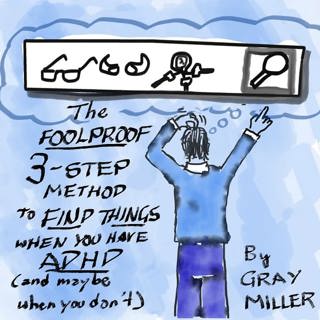
drawing by the author using Adobe Fresco #byHumansForHumans #noAI

Raise your hand if you've ever found yourself rummaging through drawers, wandering through room after room in your house, checking backpacks and briefcases and pockets repeatedly, all while muttering "I know I saw that somewhere…"

"That", of course, is a thing that you did not need when you saw it last. It registered as a blip on your conscious mind — the feeling of "Oh, I see that. Good to know I still have it" without the burden of actually remembering where it is located.

Then, a few days/weeks/months later, you suddenly realize it would be useful for some task or project — or, worse, it's essential for it. For example:

  • your partner just surprised you with a getaway to the Caribbean — where's my passport?

  • your cat ate one of your earbuds right before your Zoom meeting, but you know you have a spare pair — somewhere.

  • you accidentally left your glasses at work, but you have an old pair in the junk drawer? No. Closet shelf? No. Dresser? No. The other shoulder bag! No. *sigh*

As you're stumbling around the house with blurred vision apologizing to your boss for the echo while your partner is reminding you that the flights need to be booked, know that there is a straightforward method to finding the thing you need.

The 3-step guide to finding that thing.

Step 1: Give up.

It's lost. Just admit it. Even if you live in a 600-square-foot house and have rearranged the furniture twice looking for it, it is gone — vanished through a wormhole to another part of the multiverse. Take solace in the realization that somewhere there is an alternate version of yourself who is holding that thing, muttering "Where did this come from? I don't remember having this," just like you did last week.

It's not personal. It's just how the laws of nature and physics work.

Step 2: Order a replacement.

It used to be a lot harder when we lived as hunters and were forced to chip our replacement obsidian arrowheads after searching for hours in the bush by the spot where we missed the capybara. At least there were some nice berries there as a consolation prize as our mates and children watched us with hungry eyes as we made a few more shafts. And I'd like to think there was some consolation in knowing that millennia later some anthropologist would get a byline in NatGeo after finding the one you lost.

Now, replacing those things you lost is as easy as a click away — even if you don't have next-day delivery, there's usually a one-week trial you can use.

Or get past the free-shipping threshold by ordering two of whatever it is you lost — that way you're sure to have a spare in another place you will forget within an hour of carefully placing it there. You must make sure to order it online — don't go out and buy it in person.

Step 3: Lose something else.

This is the tricky part because you can't fake it. Pretending to look for something else in order to warp the space-time continuum into revealing the thing you actually need almost never works.

The universe knows.

But if you actually put yourself in a situation where there is another thing (let's call it Thing 2) that you

  1. need,

  2. remember seeing recently, but

  3. cannot locate in the first, second, or third places you think to look

…then you can start looking for this new lost object, again checking through all the same places, bags, cushions, pets, vehicles, plants, light fixtures, and top-shelf kitchen cupboards.

You won't find it — that's not going to happen.

But along the way, you will find the first thing that you needed but couldn't find. It will be in a spot you are pretty sure you looked before as if it spontaneously appeared from some alternate dimension — and indeed, some suggest that is exactly what happened. It will also be in a spot that you remember putting it, your past self placing it carefully because, at the time, it made sense. It's not your past self's fault; that ally put it there specifically so that it would be safe, ready for when you needed it.

They were wrong.

But now you can go back online and cancel that replacement you ordered (well, you would be able to if you had a better functioning working memory. That's ok — when it arrives, you get the opportunity to forget to return it). Reflect on how fortunate you are to live in this miraculous age! You can't un-chip obsidian.

What about finding Thing 2?

The beauty of this process, like all natural cycles like the seasons and parthenogenesis is that it can be repeated ad infinitum with Thing 3, Thing 4, and so on.

Yesterday I found Thing 45,673 — an old set of Apple AirPods. It was next to the little chest of drawers in my closet. I didn't need it any more — I use BeatsPro now — but it's nice to know I have it.
I also didn't find the mic stand extender that I was actually looking for when I found the AirPods. That's ok; I'll need a USB cord soon, or that notebook where I scribbled that reminder, and the extender will show up.

I think the lesson I'm supposed to learn is that it's not so much about the finding, it's about the looking. Or non-attachment. Or minimalism? I'm not really sure.

I just know that this process has happened enough times to become something that I can rely on.

Two alternate methods that also work for finding things:

Since you read this far, I will share with you two other techniques that pretty reliably work to find things that you are sure you had, remember seeing somewhere, but are nowhere to be found.

1. When you put something somewhere, tell somebody. This comes from my friend and talented artist Kevin Beck. It's not about the person he tells remembering it — they have absolutely no responsibility to even hear him say it. Somehow the act of saying out loud "I'm putting my iPad on the desk" makes it almost impossible to forget. I suspect it has something to do with the fact that while the brain forgets the act of putting the object somewhere, it remembers the act of telling someone about it.
Pretty sure if I tried it I'd remember telling the person — but I wouldn't remember what I said. Further testing is needed.

2. Ask my partner. Admittedly, I'm not sure this method scales, but the other remarkably successful way I've located items is by asking my partner if she's seen it. Often, even if she doesn't know what it is, was not around when I put it away, or even was aware that it existed, the act of her suggesting a place where it might be remarkably increases the odds that it will end up being there — Even if it's a place I've already looked.

She denies being magical, and I believe her. Based on Clarke's Law, she simply has some sufficiently advanced multiversal teleportation technology that happens to be remarkably helpful in my life.
I don't ask. I'm simply grateful.

Episoder(20)

ADHD: The Scattering

ADHD: The Scattering

Let me tell you about the winter when the Idea Monster came and sat in his brain and almost kept the last five NaPodPoMo podcasts from happening. And also…about the fun game about ADHD that I'm creati...

30 Nov 202314min

ADHD in Relationships: Interview with my partner, Natasha

ADHD in Relationships: Interview with my partner, Natasha

This was a hard one to post, because my partner is loving and honest and so there are parts of this interview that my brain tells me will make you hate me. But authenticity is important, as is trust, ...

12 Nov 202333min

How My ADHD Brain Created a Nightmare of Social Anxiety

How My ADHD Brain Created a Nightmare of Social Anxiety

After my diagnosis, even my dreams make more sense. Sort of. Note: all people mentioned in this article are fictitious constructs of my subconscious brain. Even the one who is real. Since my relat...

12 Nov 202311min

The Dangerously Addictive Law of Mobility

The Dangerously Addictive Law of Mobility

Made for Open Space. But tempting for the world... Here's the thing about Open Space: aside from providing people with the oppor- tunity to share the things they're passionate about, it also provides ...

11 Nov 202311min

The Four Principles of Open Space

The Four Principles of Open Space

Whoever. Whatever. Whenever. It's Over. That's what makes it all work. My elevator pitch on Open Space goes something like this: "You know how regular conventions give you a program that tells you w...

10 Nov 20238min

Why Open Space Events are Tailor-Made for People with ADHD

Why Open Space Events are Tailor-Made for People with ADHD

Including some thoughts on overcoming impostor syndrome as a professional. I actually wrote an entire article about this on October 25th, 2023, and posted it both to my Medium account and to the ADHD ...

9 Nov 202311min

The Least Helpful Advice I've Ever Been Given About ADHD

The Least Helpful Advice I've Ever Been Given About ADHD

Please stop telling me my brain has a "Special Superpower." "I'm a fish in a forest." I'm pretty sure at some point I'm going to make t-shirts with this statement. It's my reaction to...

8 Nov 20238min

From Now to Not-Now: ADHD and Temporal Discounting

From Now to Not-Now: ADHD and Temporal Discounting

The many ways professionals with ADHD find to externalize their executive function and get %$#@ done. TRANSCRIPT OF PODCAST "Hang on a minute," my coworker said through the zoom. "I need to take care ...

7 Nov 202311min

Populært innen Helse

lydartikler-fra-aftenposten
fastlegen
hvordan-har-du-det-mann
rss-gukild-johaug
psykodrama
rss-garne-damer
leger-om-livet
relasjonspodden-med-dora-thorhallsdottir-kjersti-idem
foreldreradet
rss-lopedrommen
bak-fasaden-en-reise-i-livet-med-sykepleier-ine
morten-ramm-lar-kakla-ga-til-du-sovner
rss-lev-vel
klimaks
hjernesterk
hormonelle-frida
sinnsyn
rss-kunsten-a-leve
helsetipspodden
treningsprat