Primary Source XXIV: The Hosting of the Achaeans

Primary Source XXIV: The Hosting of the Achaeans

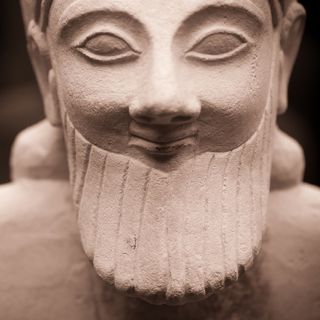
Bear with me. This is a long (but important!) episode description. Cyprus is mentioned only once in The Iliad. Kinyras, The King of Cyprus, gifts Agamemnon a breastplate as he prepares for war against Troy: "First [Agamemnon] strapped the splendid greaves around his shins, fitted with silver bindings around his ankles; Next he girt about his chest a breastplate, which in time before, Kinyras gave him to be a guest friend, for the great rumor had been heard in Cyprus that the Achaeans were about to sail out in their ships to Troy; for this reason Kinyras gave it to him, seeking favor with the king." -The Iliad 11:15-21 However, Cyprus is more intertwined in the Homeric Epics than that sole reference would seem to suggest. According to the ancient scholar and historian, Apollodorus, Kinyras was a legendary King of Cyprus and Priest of Aphrodite who was known for his beauty and musical skill. Apollodorus describes Kinyras as the father of several notable figures in Greek mythology, including the handsome Adonis. In his most famous work, The Library and Epitome (Bibliotheca), Apollodorus informs the reader that in the prelude to the Trojan War, Menelaus and Odysseus visited Kinyras to solicit him for ships to send to Troy. However, the King of Cyprus, being the Priest of Aphrodite, deceived them. Though he promised to send 50 ships, Kinyras provided only one for Agamemnon's cause -- and the rest were made of clay: "Menelaus went with Odysseus and Talthybius to Kinyras in Cyprus and tried to persuade him to join the battle. But he [Kinyras] made a gift of a breastplate for Agamemnon, who was not present; and vowing to send fifty ships, he sent one, which [name lost] the son of Mygdalion commanded. And molding the rest out of clay, he launched them into the sea." -Apollodorus 3.9 Kinyras technically fulfilled his obligation but drew the ire of Agamemnon. In later fragments and references, we learn that Agamemnon had, in fact, cursed the King of Cyprus, and drove him from his lands with his Achaean fleet (which some have said corresponds to the so-called Mycenaean Colonization that took place after the Trojan War). Kinyras would ultimately find refuge in Amathus -- the last "indigenous" city on Cyprus.* And then there is The Cypria -- one of the lost Epics that make up the Trojan Cycle.** It is possible that Apollodorus' story is referenced in its fragments but unfortunately, we know very little about The Cypria. The poem is thought to have covered the events leading up to the Trojan War, including the infamous Judgment of Paris and the Rape of Helen. It is believed to have been authored not by Homer, but by one Stasinus...of Cyprus. Next month I welcome John Franklin from University of Vermont to discuss the very Cypriot connections to this important lost Trojan Tale! --------------------------------------------------------------------- * For more on Amathus' "indigeneity," see episode 2, "The Linguistic History of Cyprus with Pippa Steele" and "Amathus with Thierry Petit" on Patreon! ** The Trojan Cycle (often referred to as the Epic Cycle) was a collection of the epic poems related to the Trojan War. Most readers are familiar with The Iliad and the Odyssey simply because they are the only works to have survived. Unlike the Homeric epics, these other poems exist only in fragmented pieces and summaries. There are, in fact, six other poems that made up the Epic Cycle. The order is as follows: The Cypria, The Iliad, Aethiopis, Little Iliad, Iliou Persis, Nostoi, the Odyssey and the Telegony.

Denne episoden er hentet fra en åpen RSS-feed og er ikke publisert av Podme. Den kan derfor inneholde annonser.

Episoder(125)

*NEW EPISODE!* 53. Fragments of Faience, Glints of Gold: Cyprus and Egypt in Contact with Louise Steel

*NEW EPISODE!* 53. Fragments of Faience, Glints of Gold: Cyprus and Egypt in Contact with Louise Steel

Dr. Louise Steel is an archaeologist whose work focuses on challenging colonial interpretations of Cypriot history by emphasizing the agency of the local population. Through postcolonial theory, she e...

2 Aug 49min

Primary Source LIII. The Misfortunes of Wen-Amun

Primary Source LIII. The Misfortunes of Wen-Amun

In the early 11th century BCE, the Egyptian official Wen-Amun was dispatched on a diplomatic mission to Byblos to acquire timber for the sacred barque of Amun-Ra. His journey quickly unraveled -- purs...

15 Jul 2min

*BONUS!* "Enemy Ships Have Been Sighted at Sea:" The Final Letters from Ugarit

*BONUS!* "Enemy Ships Have Been Sighted at Sea:" The Final Letters from Ugarit

Lately I've been seeing a growing number of memes pointing out the "blink-and-you'll-miss-it" references to the Sea Peoples in Christopher Nolan's The Odyssey. It's encouraging to see one of the ancie...

11 Jul 3min

52. When Kinship Failed: Cyprus & The Black Death with Tassos Papacostas

52. When Kinship Failed: Cyprus & The Black Death with Tassos Papacostas

"Out of necessary cruelty, fathers abandoned their sons, and sons fled from their fathers, as the evident danger overcame all the rules of kinship, love, and nature." - Francesco Loredano AKA Henry G...

2 Jul 1h

*BONUS!* Building and Living an Archaeological Fieldwork Project with Luca Bombardieri

*BONUS!* Building and Living an Archaeological Fieldwork Project with Luca Bombardieri

Luca Bombardieri, Associate Professor in Aegean and Cypriot Archaeology at the University of Siena in Italy and the scientific director at the Erimi Archaeological Project in Cyprus, explores what it ...

20 Jun 18min

Primary Source LII: Loredano & The Black Death

Primary Source LII: Loredano & The Black Death

The Black Death swept across Europe in the mid-14th century, killing millions and leaving entire regions devastated. No corner of the continent was spared, and Cyprus too fell victim to the deadly pan...

15 Jun 2min

51. Out of the Frying Pan and into the Fire: Cyprus Between Athens & Persia with Christian Körner

51. Out of the Frying Pan and into the Fire: Cyprus Between Athens & Persia with Christian Körner

After the failed revolt against Persian rule, Cyprus experienced a brief and uneasy calm. But that peace quickly unraveled, as the island was drawn into the heart of the renewed conflict between Athen...

2 Jun 42min

Primary Source LI: An Excerpt from Diodorus Siculus

Primary Source LI: An Excerpt from Diodorus Siculus

Diodorus Siculus was a 1st-century BCE Greek historian from Agyrium in Sicily who wrote during the late Roman Republic. His most famous work, the Bibliotheca historica ("Historical Library"), is a mas...

15 Mai 1min

Populært innen Historie

rss-dette-ma-aldri-skje-igjen
henrettelsespodden
historier-som-endret-norge
sektledere
historier-som-endret-verden
rss-benadet
med-egne-oyne
rss-nadelose-nordmenn-gestapo
aftenposten-historie
rss-frontkjemperne
historiepodden
historiske-kjendiser
liberal-halvtime
rss-strid-de-norske-borgerkrigene
diktatorpodden
vare-historier
virkelig-grusomt
rss-alt-var-bedre-for
historiepodden-ww2
rss-gamle-greier