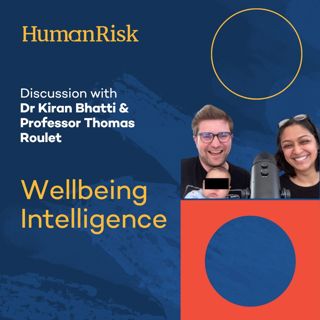

Dr Kiran Bhatti & Professor Thomas Roulet on Wellbeing Intelligence

Dr Kiran Bhatti & Professor Thomas Roulet on Wellbeing Intelligence

What if we treated mental health like a capability instead of a crisis? On this episode, I'm talking to a business school professor and a counselling psychologist about their new book that looks at practical ways we can manage mental health. Not after it manifests itself, but beforehand.

Episode Summary
Mental health has become part of the workplace conversation, but all too often, that conversation stops at slogans and superficial gestures. On this episode, I explore what it really means to build mental wellbeing into the culture of an organisation with two guests who bring very different — and deeply complementary — perspectives.

Dr. Kiran Bhatti is a counselling psychologist working one-on-one with individuals experiencing anxiety, trauma, and burnout. Professor Thomas Roulet is an organisational sociologist at the University of Cambridge who researches the social dynamics of modern workplaces.

Together, they've written Wellbeing Intelligence, a book that offers a smarter, more integrated approach to mental health at work. Our conversation blends the clinical and the organisational.

We talk about why mental health needs to be treated not just as an emergency response but as a proactive skillset, why high performers are often the most vulnerable, and why grand programmes can fall flat if they don’t feel human. Kiran explains how physical symptoms can mask deeper emotional struggles, and Thomas highlights the invisible tensions that can shape how teams feel and function.

We unpack how leaders can signal care without being intrusive, and how a culture of safety is built more through micro-interactions than policies. This episode is for anyone trying to build workplaces that support — rather than erode — human wellbeing. It’s full of practical insight, honest reflection, and just the right amount of theory to make it stick. You’ll also hear what parenting a newborn has taught them about emotional intelligence and stress, and why the best mental health support often starts with listening, not fixing.

And we break new ground on the show. Not just by having the first couple on as guests, but also because we're joined by their newborn son, who plays his part in making the show more human!

Guest Biographies
Dr. Kiran Bhatti is a counselling psychologist with over 15 years of experience working with individuals and organisations on issues related to mental health, trauma, and emotional wellbeing. She describes herself as someone who works at the intersection of science and soul — blending evidence-based psychological techniques with a deep respect for human complexity. In her practice, she focuses on empowering clients to make sense of their experiences and build sustainable emotional resilience.

Professor Thomas Roulet is a Professor of Organisational Sociology and Leadership at Cambridge Judge Business School and a Fellow at King's College, University of Cambridge. His research explores the social dynamics of organisations, including topics like stigma, conformity, culture, and leadership. He’s published widely on how organisations manage tensions, and how individuals navigate identity and meaning at work. His writing has appeared in Harvard Business Review, The Conversation, and major academic journals.

Together, they co-authored Wellbeing Intelligence: Building Better Mental Health at Work, combining their clinical and organisational expertise to offer a fresh approach to workplace wellbeing that moves beyond tokenistic initiatives.

AI-Generated Timestamped Summary
[00:00:00] Introduction and the concept of "wellbeing intelligence"
[00:03:52] Why mental health should be viewed as a spectrum, not a binary
[00:07:10] The limitations of performative wellbeing initiatives
[00:09:24] How leaders can signal real care without being intrusive
[00:13:17] The interplay between physical and emotional symptoms
[00:16:45] Why psychological safety needs to be lived, not just stated
[00:21:06] What makes high performers especially vulnerable to burnout
[00:26:08] Cultural tensions: hybrid work, visibility, and presenteeism
[00:29:33] Real-life stories of clients struggling in 'healthy' work cultures
[00:34:12] What we can learn from parenting a newborn about stress response
[00:38:05] Thomas on data vs experience in mental health measurement
[00:41:52] Kiran on the role of micro-connections in building trust
[00:44:30] Why middle managers are often the most squeezed and unsupported
[00:48:17] The risk of "outsourcing" care via tech or tools
[00:52:01] Final thoughts on how to embed wellbeing into everyday leadership
[00:55:12] Outro and links to the book and guest profiles

Links
Dr Khiran Bhatti - https://www.drkiranbhatti.com/

Professor Thomas Roulet - https://www.thomasroulet.com/

Wellbeing Intelligence - https://profilebooks.com/work/wellbeing-intelligence/

Thomas' previous appearance on the show on Negative Social Evaluations - https://www.humanriskpodcast.com/dr-thomas-roulet-on-negative/


Denne episoden er hentet fra en åpen RSS-feed og er ikke publisert av Podme. Den kan derfor inneholde annonser.

Episoder(368)

Charlie Hurst, Tom Noble and Will Sudlow on Flat White or F*ck Off

Charlie Hurst, Tom Noble and Will Sudlow on Flat White or F*ck Off

What happens when someone runs with a business idea they've heard as a thought experiment on a podcast? Can a business have an expletive in its name? And is it possible to run a business that sells a ...

22 Feb 1h 15min

Amy Watson on Violence Against Women & Girls

Amy Watson on Violence Against Women & Girls

What if we stopped telling women how to stay safe, and started asking why violence against them keeps happening in the first place? On this episode, I’m joined for a second time, by Amy Watson, the fo...

15 Feb 1h 39min
Professor Veronica Root Martinez on Purpose-Driven Compliance

Professor Veronica Root Martinez on Purpose-Driven Compliance

Who determines what 'good' Compliance actually looks like?  The obvious answer is regulators (and in some jurisdictions) prosecutors. But what if it were the regulated Firms themselves?  That's the id...

7 Feb 1h 2min
Professor Tina Weisser on Trusting AI In An Uncertain World

Professor Tina Weisser on Trusting AI In An Uncertain World

As Artificial Intelligence (AI) gets smarter and tkaes over more tasks, what happens to human dynamics like trust, transparency, leadership and empathy. How can humans and machines wowrk togehter effe...

27 Jan 1h 9min

Becky Holmes on Romance Scams

Becky Holmes on Romance Scams

What lies behind Romance Fraud? Romance fraud is one of the fastest-growing forms of fraud worldwide, and one of the most emotionally devastating. It’s also one of the most misunderstood.On this epis...

21 Jan 1h 8min
Amy Kean on Grief

Amy Kean on Grief

Why do we struggle to talk about grief? Why that matters and what we can do about it, is the subject of this episode.SummaryGrief is something almost all of us will experience, and yet something we st...

12 Jan 1h 4min
Dr Guy Champniss on Business, BeSci and AI

Dr Guy Champniss on Business, BeSci and AI

Are we losing our ability to think critically as we rely more on AI?Episode SummaryMy guest is social psychologist Dr Guy Champniss to explore the role of behavioural science in business and the emerg...

7 Des 20251h 1min

Professor Yuval Feldman on Can The Public Be Trusted?

Professor Yuval Feldman on Can The Public Be Trusted?

Why do governments rely on coercion and punishment when voluntary cooperation often produces better, more sustainable outcomes?Episode SummaryOn this episode, I’m joined once again by Professor Yuval ...

23 Nov 20251h 5min

Populært innen Vitenskap

fastlegen
tingenes-tilstand
jss
rss-zahid-ali-hjelper-deg
rekommandert
sinnsyn
rss-paradigmepodden
liberal-halvtime
vett-og-vitenskap-med-gaute-einevoll
forskningno
rss-overskuddsliv
villmarksliv
kvinnehelsepodden
nordnorsk-historie
grunnstoffene
tidlose-historier
rss-inn-til-kjernen-med-sunniva-rose
nevropodden
dekodet-2
rss-rekommandert