Billy Joel: And So It Goes, From the Inside, Part 1

Billy Joel: And So It Goes, From the Inside, Part 1

How do you make an honest film about Billy Joel when Billy Joel doesn't want to talk about himself anymore?

Steve Cohen walked into a rehearsal in 1974 as a 20-year-old lighting guy who didn't much care for "Piano Man." After his first show with the band, Billy Joel poured him a Black Russian by a Holiday Inn pool in Milwaukee and told him the audience had reacted in places it never had before. "So here," Billy said, "welcome to the band." Fifty years later, Steve is Billy's creative director and an executive producer of the HBO documentary Billy Joel: And So It Goes.

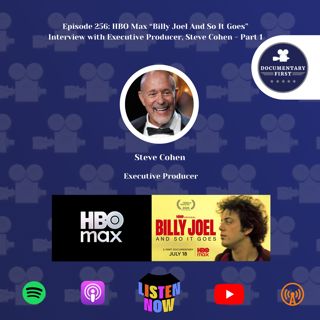
In Episode 256, the first of two parts, Christian Taylor sits down with Steve Cohen. Christian, a Billy Joel fan since her teens on Long Island, admits at the top that this is the interview of a lifetime for her. Steve tells the story of how the film came together: a three-and-a-half-hour first conversation with Susan Lacy, the founder of PBS's American Masters, who turned out to be his neighbor on the East End of Long Island; a pitch from Todd Milliner and Sean Hayes; and Tom Hanks and Gary Goetzman, who signed on as long as Susan Lacy would direct. When Steve told Billy he would have no editorial control, Billy answered, "What have I got to hide?"

Steve explains what made the film work. Co-director Jessica Levin brought a superfan's knowledge of every corner of the catalog. Susan Lacy insisted on interviewing Billy at a piano, his security blanket, and most of the interviews moved to Steve's own homes, where Billy could relax. Steve talks about persuading Billy's first wife, Elizabeth, to sit down for the film, about the songs that grew out of their relationship, and about the line from Billy, quoted in the film, that Christian and Steve agree explains the whole catalog: if there's a skeleton key to his work, it's his relationships with other people. As Billy once told Steve, "It's not for you to call yourself an artist. Let someone else call you an artist."

WATCH THE FILM

Billy Joel: And So It Goes (HBO, 2025), directed by Susan Lacy and Jessica Levin, is streaming on HBO Max: https://www.hbomax.com/show/2abc1a61-f4ac-4b0e-ae84-3cc5a3b53d03

In this episode, you'll learn:

  • How a 20-year-old lighting designer became part of Billy Joel's band in 1974
  • Why Billy Joel refused to tell his own story for years
  • How Susan Lacy came to direct And So It Goes
  • How Tom Hanks, Gary Goetzman, Sean Hayes and Todd Milliner got the film made at HBO
  • Why Billy Joel agreed to a documentary with no editorial control
  • How two co-directors, one classical music lover and one superfan, shaped the film
  • Why Billy Joel was interviewed at a piano, and why the location changed
  • How Steve persuaded Elizabeth to take part
  • Why relationships are the key to Billy Joel's songwriting
  • How Susan Lacy builds scenes from stacks of printed transcripts

CHAPTERS

0:00 An Interview of a Lifetime

2:07 How Steve Cohen Met Billy Joel in 1974

5:10 The 100th Show and a Five-Hour Film

11:48 "Let Someone Else Call You an Artist"

13:50 How Susan Lacy Came to Direct

18:00 "What Have I Got to Hide?"

22:21 Classical Roots and the Holocaust Story

25:05 Elizabeth Weber and the Love Songs

30:33 Relationships Are the Skeleton Key

33:53 Interviewing at the Piano

38:15 Stacks of Transcripts and Nonlinear Editing

FREQUENTLY ASKED QUESTIONS

What is Billy Joel: And So It Goes?

Billy Joel: And So It Goes is a 2025 two-part HBO documentary directed by Susan Lacy and Jessica Levin, running about five hours. Its executive producers include Tom Hanks, Gary Goetzman, Sean Hayes, Todd Milliner and Steve Cohen. Billy Joel sat for interviews but had no editorial control, and the film ties his life story back to his songs.

Who is Steve Cohen?

Steve Cohen is Billy Joel's longtime creative director and lighting designer. He started a lighting company at 20, cold-called managers, and began working with Billy Joel in 1974. He has since designed tours for many other artists, produced the documentary Last Play at Shea, and served as an executive producer of Billy Joel: And So It Goes.

How did Susan Lacy get Billy Joel to open up?

According to Steve Cohen, Susan Lacy insisted on interviewing Billy Joel at a piano, which Steve calls his security blanket. After a first interview at Billy's house full of distractions, most sessions moved to Steve's homes, where Billy felt at ease. Each interview went deeper, and Billy told her she got him to go places he doesn't normally go.

Did Billy Joel have editorial control over And So It Goes?

No. Steve Cohen says he told Billy Joel that saying yes meant no editorial involvement and trusting the filmmakers to tell the story. Billy's answer was, "What have I got to hide?" Steve's role was to open doors: arranging interviews, opening the archives, and persuading people like Billy's first wife, Elizabeth, to take part.

SPONSORED BY ARTILLERY SPORTS

This episode is brought to you by Artillery Sports, which makes durable sports equipment and uses a portion of its profits to help care for the nation's veterans. Use the code DocFirst for 10% off your first order. https://artillerysports.com

LISTEN AND FOLLOW

Listen and subscribe wherever you get podcasts: https://pod.fo/e/4a7fa3

Watch on YouTube: https://www.youtube.com/@documentaryfirst

SUPPORT THE SHOW

Join our community on Patreon: https://www.patreon.com/c/DocumentaryFirst

CONNECT WITH DOCUMENTARY FIRST

All platforms: https://linktr.ee/doc1st

Christian Taylor on LinkedIn: https://www.linkedin.com/in/meetchristiantaylor

ABOUT THE GUEST

Steve Cohen

Creative Director for Billy Joel; Executive Producer, Billy Joel: And So It Goes

Steve Cohen grew up in Canoga Park, California, and started a lighting company at 20. Billy Joel was his first major client, in 1974, and Steve has been his lighting designer and creative director ever since. He has designed tours and television for many other artists, directed Billy Joel's early music videos, produced the documentary Last Play at Shea, and was the executive producer and lighting designer of the special on Billy Joel's 100th show at Madison Square Garden.

ABOUT DOCUMENTARY FIRST

Documentary First is a weekly podcast about the people behind documentaries and how the work changed them. Host Christian Taylor, director of the award-winning The Girl Who Wore Freedom, talks with filmmakers from Ken Burns to first-time directors. Listen Notes ranks the show in the top 5% of all podcasts worldwide.

RESOURCES MENTIONED


Denne episoden er hentet fra en åpen RSS-feed og er ikke publisert av Podme. Den kan derfor inneholde annonser.

Episoder(298)

The Velveteen Rabbit and Old Home Movies: What Is Real?

The Velveteen Rabbit and Old Home Movies: What Is Real?

What does The Velveteen Rabbit, a 1922 children's book about a stuffed toy, have to do with old home movies and AI?In Margery Williams' classic story, an old toy called the Skin Horse tells a stuffed ...

15 Okt 16min
Archival Footage: Why Use Home Movies?

Archival Footage: Why Use Home Movies?

What happens to a family's home movies when no one knows what to do with them?Phil Maher was a software engineer looking for a sense of purpose when he started watching his grandfather's family reels ...

8 Okt 49min
How Do You Get a Documentary Made? Ask the Woman Who Co-Runs RKO

How Do You Get a Documentary Made? Ask the Woman Who Co-Runs RKO

Do you have a documentary, or do you have a Wikipedia entry?Somebody decides whether your documentary gets made. Sophia Dilley is one of those people. She runs Concord Originals, the division behind S...

10 Sep 53min
Beyond Banners: How to Make a Documentary With No Film School

Beyond Banners: How to Make a Documentary With No Film School

Who finishes your film if you can't?Andre N. Jackson had never made a film. He had twenty years in technology and security, an idea that arrived while he was sitting in a barber's chair, and no way in...

21 Aug 40min
Why Can't Your Documentary Find an Audience? l Deep Dive on Ep. 284

Why Can't Your Documentary Find an Audience? l Deep Dive on Ep. 284

When did your audience stop being people and become a number?Most independent films and podcasts do not fail because the work is bad. They fail because no one ever felt like they belonged to them. Thi...

13 Aug 13min
Ep. 284 I How to Fund a Documentary Without the Industry

Ep. 284 I How to Fund a Documentary Without the Industry

How do you fund a documentary when the whole industry says no?How do you fund a documentary without film funds, grants, or a commissioning broadcaster, and still reach a huge audience? Dutch filmmaker...

6 Aug 51min
Who Believed in You First?

Who Believed in You First?

Who believed in you before you could believe in yourself? In this Deep Dive, documentary filmmaker Christian Taylor makes a quiet case that we rarely overcome self-doubt on our own. Almost no one fini...

30 Jul 13min
Cold War in Philly: Joe Amodei Directs His First Documentary

Cold War in Philly: Joe Amodei Directs His First Documentary

What happens when a film distributor with more than 40 years in the business finally makes his own documentary?Joe Amodei grew up in Philadelphia watching the Flyers with his parents, sisters and brot...

23 Jul 54min

Populært innen Samfunn

rss-spartsklubben
giver-og-gjengen-vg
aftenpodden
konspirasjonspodden
aftenpodden-usa
popradet
rss-nesten-hele-uka-med-lepperod
rss-henlagt-andy-larsgaard
alt-fortalt
wolfgang-wee-uncut
min-barneoppdragelse
grenselos
fladseth
synnve-og-vanessa
rss-espen-lee-usensurert
rss-herrepanelet
rss-dette-ma-aldri-skje-igjen
frokostshowet-pa-p5
fryktlos
198-land-med-einar-trnquist