3I/ATLAS: The third interstellar object ever found

3I/ATLAS: The third interstellar object ever found

Just three interstellar objects have ever been detected in our Solar System, each arriving from the depths of interstellar space. In this episode, we explore the latest: 3I/ATLAS, a newly discovered interstellar comet first spotted on July 1, 2025.

Bryce Bolin, research scientist at Eureka Scientific, joins host Sarah Al-Ahmed to share what makes this object special. As one of the few astronomers who has studied all three known interstellar objects—1I/ʻOumuamua, 2I/Borisov, and now 3I/ATLAS—he offers unique insight into how these rare visitors expand our understanding of planetary systems beyond our own.

We also check in with Bruce Betts, chief scientist of The Planetary Society, for a look at the upcoming ESA and JAXA’s Comet Interceptor mission, which may one day chase down a future interstellar comet.

Discover more at: https://www.planetary.org/planetary-radio/2025-3i-atlas

See omnystudio.com/listener for privacy information.

Episoder(1300)

ESCAPADE begins its journey to Mars

ESCAPADE begins its journey to Mars

NASA’s twin ESCAPADE spacecraft have finally launched on their journey to Mars. Designed to study how the solar wind interacts with Mars’ patchy magnetic fields and drives the loss of its atmosphere, ESCAPADE is NASA’s first dual-spacecraft mission to the Red Planet and a major milestone for the SIMPLEx program’s small, low-cost planetary explorers. The mission began its voyage aboard Blue Origin’s New Glenn rocket after several weather and space weather delays, marking the vehicle’s first science launch. We begin with Ari Koeppel, AAAS Science & Technology Policy Fellow and Space Policy Intern at The Planetary Society, who was at Cape Canaveral for the prelaunch activities. Ari shares what it was like to navigate repeated scrubs and even a powerful solar storm, along with the emotional experience of watching a spacecraft carrying an instrument he helped build begin its voyage to Mars. Next, we are joined by Dr. Rob Lillis, ESCAPADE’s Principal Investigator and Associate Director for Planetary Science at UC Berkeley’s Space Sciences Laboratory. Rob explains how ESCAPADE aims to unravel Mars’ complex space environment using two coordinated orbiters, why its measurements are key to understanding atmospheric escape, and how its innovative trajectory made the mission possible after the loss of its original rideshare opportunity. Finally, Dr. Bruce Betts, Chief Scientist of The Planetary Society, returns for What’s Up to talk about why Mars produces aurora even without a global magnetic dynamo. Discover more at: https://www.planetary.org/planetary-radio/2025-escapadeSee omnystudio.com/listener for privacy information.

3 Des 1h 6min

Smart Girl Dumb Questions: Casey Dreier answers why space is worth it

Smart Girl Dumb Questions: Casey Dreier answers why space is worth it

This week on Planetary Radio, we’re sharing a special conversation from our friends at the Smart Girl Dumb Questions podcast. Host Nayeema Raza sits down with The Planetary Society’s Chief of Space Policy, Casey Dreier, to explore one of the most common questions in space exploration: Why does space matter, and is it really worth the cost? Casey breaks down how space exploration impacts daily life, from GPS and weather forecasting to cutting-edge technologies and scientific discoveries that could reshape our future. Together, Nayeema and Casey unpack the big ideas behind NASA’s ~$25 billion budget at a moment when U.S. national priorities are shifting. Stick around after the interview for a special U.S. Thanksgiving-week edition of What’s Up with Chief Scientist Bruce Betts. Discover more at: https://www.planetary.org/planetary-radio/2025-smart-girl-dumb-questionsSee omnystudio.com/listener for privacy information.

26 Nov 1h

Book Club Edition: The Martians: The True Story of an Alien Craze that Captured Turn-of-the-Century America by David Baron

Book Club Edition: The Martians: The True Story of an Alien Craze that Captured Turn-of-the-Century America by David Baron

There was a time when almost everyone, from Alexander Graham Bell to the Wall Street Journal, believed there was a supremely intelligent civilization on Mars, one that was probably trying to talk to Earthlings. Most of this belief could be traced to an amateur astronomer and charismatic speaker named Percival Lowell. David Baron tells this story in “The Martians: The True Story of an Alien Craze that Captured Turn-of-the-Century America,” the product of seven years of research into this strange chapter of history. He shares many of the most surprising, fascinating, and very entertaining details, including much that had been lost to history, in this book club conversation with Mat Kaplan. Discover more at: https://www.planetary.org/planetary-radio/book-club-david-baronSee omnystudio.com/listener for privacy information.

21 Nov 1h 3min

Epic Spaceman: Making cosmic scale human

Epic Spaceman: Making cosmic scale human

When his filmmaking career stalled during the pandemic, Toby Lockerbie turned to the one place that had never stopped inspiring him: the Universe. With no background in visual effects, he taught himself the tools needed to transform complex space science into cinematic stories using everyday objects and beautifully crafted visuals to make the Cosmos feel human. His channel, Epic Spaceman, now reaches millions and has earned multiple Webby Awards for its innovative approach to visualizing scale, awe, and accessible science. This week on Planetary Radio, Toby joins host Sarah Al-Ahmed to discuss the creation of Epic Spaceman, how visual metaphors can change how we understand the Universe, and why awe remains one of the most powerful tools for science communication. Then we welcome Bruce Betts back for What’s Up, where we reflect on the end of the Japanese Aerospace Exploration Agency’s Akatsuki mission to Venus. Discover more at: https://www.planetary.org/planetary-radio/2025-epic-spacemanSee omnystudio.com/listener for privacy information.

19 Nov 59min

The Planetary Society goes to TwitchCon 2025

The Planetary Society goes to TwitchCon 2025

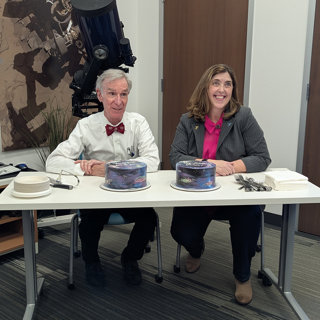
The Planetary Society heads to TwitchCon 2025 to explore how scientists and educators use livestreaming to share the excitement of discovery. We begin with Moohoodles, one of Twitch’s pioneering space science streamers and co-host of the live panel “The Planetary Society: Space, Time, and You.” She explains how she built a thriving community around astrobiology and space exploration long before Twitch even had a Science & Technology category. Then we share moments from the panel, featuring a special video message from Bill Nye, CEO of The Planetary Society, and highlights of how livestreaming helps inspire new audiences to look up. At the Science & Technology Meet and Greet, Sharkg33k and Paleontologizing explain how their streams connect life on Earth to exploration beyond our planet. Later, Jack Kiraly, The Planetary Society’s Director of Government Relations, joins the show for a Space Policy Update on Jared Isaacman’s renomination as NASA Administrator, examining what it could mean for the agency’s leadership and direction. The episode wraps up with What’s Up with Bruce Betts, The Planetary Society’s chief scientist, celebrating the third anniversary of the end of the LightSail 2 mission and sharing a new random space fact. Discover more at: https://www.planetary.org/planetary-radio/2025-twitchconSee omnystudio.com/listener for privacy information.

12 Nov 1h 1min

Space Policy Edition: Should a (potential) biosignature revive Mars Sample Return?

Space Policy Edition: Should a (potential) biosignature revive Mars Sample Return?

In 1996, a controversial claim of fossilized life in a Martian meteorite ignited a golden age of Mars exploration. Nearly 30 years later, a potential biosignature detected by the Perseverance rover at Jezero Crater has sparked…nothing, not even a formal effort to revive the beleaguered robotic Mars Sample Return project. Why did the claims surrounding the Allan Hills meteorite (which were ultimately rejected) kick off 25 years of unprecedented robotic exploration of the Red Planet? And why did the discovery at Cheyava Falls fail to ignite the same level of interest? Lou Friedman, former Executive Director of The Planetary Society and longtime proponent of Mars Sample Return, joins the show to contrast these to tipping points of Mars exploration, and argues why space scientists should seize this discovery to push for a scientific future at the Red Planet. Discover more at: https://www.planetary.org/planetary-radio/spe-lou-friedman-on-msr-and-tipping-point-eventsSee omnystudio.com/listener for privacy information.

7 Nov 1h 21min

Do Aliens Speak Physics?

Do Aliens Speak Physics?

If we ever meet intelligent extraterrestrials, will we even be able to talk about physics? Physicist Daniel Whiteson of UC Irvine and cartoonist Andy Warner join Sarah Al-Ahmed to explore one of science’s strangest and most profound questions: if alien civilizations exist, would their understanding of the Universe look anything like ours? Their new book, “Do Aliens Speak Physics?”, discusses the nature of knowledge itself, asking whether math and physics are truly universal, or if even our most “objective” truths are shaped by our human perspective. Together, they consider what it would take to communicate with alien intelligence and how humor and illustration can make those big cosmic ideas feel surprisingly down-to-Earth. Then, stick around for What’s Up with Bruce Betts, as we discuss how difficult it is to explain physics to humans, let alone extraterrestrial life. Discover more at: https://www.planetary.org/planetary-radio/2025-do-aliens-speak-physicsSee omnystudio.com/listener for privacy information.

5 Nov 59min

Ripples on the Cosmic Ocean

Ripples on the Cosmic Ocean

What happens in space doesn’t stay in space. Historian Dagomar Degroot joins Planetary Radio host Sarah Al-Ahmed to explore how shifting solar cycles, volcanic eruptions on Venus, Martian dust storms, and even mistaken sightings of lunar forests have influenced life, science, and society on Earth. His new book, “Ripples on the Cosmic Ocean: An Environmental History of Our Place in the Solar System,” reframes the Solar System as part of our cosmic environment, one that has shaped humanity’s past and will define our future. Then, Planetary Society Director of Government Relations Jack Kiraly updates us on the latest developments in space policy, including the ongoing search for NASA’s next administrator and proposed changes to the Artemis program’s launch vehicles. And stick around for Bruce Betts, The Planetary Society’s chief scientist, in What’s Up. Discover more at: https://www.planetary.org/planetary-radio/2025-ripples-on-the-cosmic-oceanSee omnystudio.com/listener for privacy information.

29 Okt 1h 9min

Populært innen Vitenskap

fastlegen
rekommandert
jss
fremtid-pa-frys
rss-rekommandert
tingenes-tilstand
forskningno
tomprat-med-gunnar-tjomlid
abels-tarn
villmarksliv
sinnsyn
smart-forklart
rss-paradigmepodden
noen-har-snakket-sammen
diagnose
fjellsportpodden
dekodet-2
vett-og-vitenskap-med-gaute-einevoll
tidlose-historier
rss-overskuddsliv