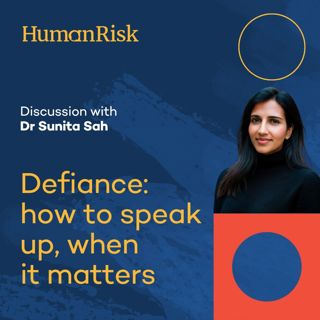
Dr Sunita Sah on Defiance - how to speak up when it matters

Dr Sunita Sah on Defiance - how to speak up when it matters

Why do we follow orders or go along with things that feel wrong? Why might defiance be better than compliance? And how can we go about becoming more defiant?

Episode Summary
I’ve always been fascinated by why people obey, even when it clashes with their instincts or values. In this conversation, I’m joined by Dr Sunita Sah — a physician-turned-organisational psychologist whose work explores the hidden social, cultural, and psychological forces behind compliance.

Drawing from her research and personal journey, Sunita reframes defiance as alignment with our true values, not reckless rebellion. We unpack concepts like “insinuation anxiety” — the discomfort of signalling someone else might be wrong — and explore her five-stage model of defiance, from recognising tension to taking decisive action. Sunita explains why compliance is often mistaken for consent, why both have distinct definitions, and why many of us have never practised saying “no” skillfully.

Along the way, she shares vivid examples from medicine, aviation, parenting, and history, including the calculated defiance of Rosa Parks. For leaders, Sunita offers a challenge: create environments where dissent is safe and effective, and treat defiance as valuable feedback.

For all of us, she suggests starting small — practising low-stakes resistance to build our “defiance muscle.” Whether you’re a rule-maker, rule-follower, or both, this episode invites you to rethink the stories you tell yourself about compliance, and to see saying “no” as a powerful tool for living with integrity.

Guest Bio Self-Description:
Dr Sunita Sah is a physician-turned-organisational psychologist and Professor of Management Studies at Cornell University. Her research examines the social, organisational, and psychological forces that influence decision-making, particularly in contexts involving authority, conflicts of interest, and ethical dilemmas.

She is the author of Defy: The Power of No in a World That Demands Yes (US title: Defy: How to Speak Up When It Matters), a book that reframes defiance as a vital life skill.

AI-Generated Timestamped Summary
[00:00:00] Opening & why we obey even when it feels wrong
[00:02:00] Sunita’s career journey: medicine to organisational psychology
[00:05:00] Personal experiences shaping her research
[00:07:00] Redefining compliance vs. consent
[00:10:00] The five elements of informed consent
[00:11:00] Introducing “insinuation anxiety”
[00:14:00] High-stakes and low-stakes examples of silence
[00:18:00] Why people resist defiance — lack of skill and practice
[00:20:00] New definition of defiance as value alignment
[00:23:00] Tension as the first stage of defiance
[00:25:00] Stage 3: asking clarification questions
[00:27:00] Scripts for skilful defiance
[00:30:00] Practising in low-stakes situations
[00:33:00] Speaking up for others vs. for oneself
[00:36:00] Defiance as a skill, not a personality
[00:38:00] Calculating safety and effectiveness of defiance
[00:41:00] Costs of compliance vs. costs of defiance
[00:44:00] Clarifying values to lower stress and improve integrity
[00:46:00] Leadership responsibility for safe dissent
[00:48:00] Performative vs. genuine speak-up systems
[00:50:00] Defiance as contagious behaviour
[00:52:00] The role of mischief and playful resistance
[00:56:00] Saying yes when the world expects no
[00:58:00] Advice for compliance officers and leaders
[01:00:00] Upcoming courses on defiance and decision-making

Links
Sunita's website: https://www.sunitasah.com
Defy: The Power of No in a World That Demands Yes — https://www.sunitasah.com/defy

Sunita's Cornell University faculty profile — https://www.johnson.cornell.edu/faculty-research/faculty/sunitasah/


Denne episoden er hentet fra en åpen RSS-feed og er ikke publisert av Podme. Den kan derfor inneholde annonser.

Episoder(368)

Barbara Freese on Denial - how large companies undermine social trust in Science & Democracy

Barbara Freese on Denial - how large companies undermine social trust in Science & Democracy

On this episode, I explore the concept of denial; something we know is bad on an individual level. But what happens when denial takes place on an industrial scale? That's literally what my guest on t...

26 Aug 20201h

Kelly Peters on Bringing Scientific Thinking to Business

Kelly Peters on Bringing Scientific Thinking to Business

How can we use creativity to solve complex business problems?That's what Kelly Peters, my guest on this episode does.Kelly is the CEO and co-founder of BEWorks, a purpose-driven company whose goal is ...

24 Aug 202057min

Paul Orlando on Unintended Consequences or why we sometimes don't think things through

Paul Orlando on Unintended Consequences or why we sometimes don't think things through

Why do things often not turn out the way we planned them? That's what my guest, Paul Orlando is interested in discovering. In his blog 👉https://unintendedconsequenc.es/ Paul explores Unintended Con...

21 Aug 20201h

Radio Host Iain Dale on Radio, Politics & Polarization

Radio Host Iain Dale on Radio, Politics & Polarization

"Why Can't We All Just Get Along?" is a question that we've probably all asked at some point in recent times. And it's one that my guest on this episode, Iain Dale, seeks to answer in his brand new b...

19 Aug 20201h 1min

Dan Kaszeta on 'No Go Zones', Internet Trolls & Nerve Agents

Dan Kaszeta on 'No Go Zones', Internet Trolls & Nerve Agents

What would you do if someone made false allegations online about your home city? Would you go into battle on social media? You would if you're my guest on this episode. Dan Kaszeta was so annoyed by ...

13 Aug 20201h 8min

Neil Clark on Managing Human Factors in Safety-critical industries

Neil Clark on Managing Human Factors in Safety-critical industries

In industries where human error can be the difference between life & death, how can we manage Human Risk?The answer is Human Factors, a specialism that blends Behavioural Science & Psychology into ope...

11 Aug 202057min

Hanna Thomas Uose on why video calls don't give us Zoom Fatigue, but rather Zoom Trauma

Hanna Thomas Uose on why video calls don't give us Zoom Fatigue, but rather Zoom Trauma

You’ve heard of Zoom Fatigue. But what about Zoom Trauma? It sounds extreme, but an article by my guest on this episode Hanna Thomas Uose suggests that this is precisely what we’re experiencing. I ...

8 Aug 202058min

Dr Todd Haugh on the Behavioral Aspects of Ethics & Compliance

Dr Todd Haugh on the Behavioral Aspects of Ethics & Compliance

As the risks of failing to comply with regulations & ethical standards increase, how can we ensure that employees do what we want them to? This question underpins my whole Human Risk mission; if we s...

6 Aug 20201h 5min

Populært innen Vitenskap

fastlegen
tingenes-tilstand
jss
rss-zahid-ali-hjelper-deg
rekommandert
sinnsyn
rss-paradigmepodden
liberal-halvtime
vett-og-vitenskap-med-gaute-einevoll
forskningno
rss-overskuddsliv
villmarksliv
kvinnehelsepodden
nordnorsk-historie
grunnstoffene
tidlose-historier
rss-inn-til-kjernen-med-sunniva-rose
nevropodden
dekodet-2
rss-rekommandert