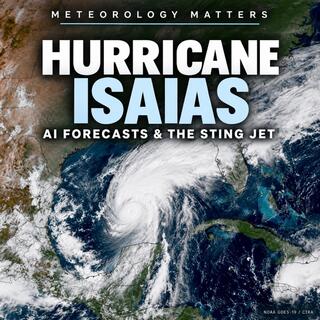
Hurricane Erin Update & Rapid Intensification Explained

Hurricane Erin Update & Rapid Intensification Explained

August 17, 1025: Hurricane Erin, recently a Category 5 storm, underwent one of the fastest intensifications ever observed, reaching the second lowest pressure ever recorded for an August hurricane after Hurricane Allen in 1980. While the storm is fortunate to be on a path that avoids direct land impact, its powerful energy will still significantly affect coastal areas.

Key Facts about Hurricane Erin:

  • Intensification & Current Status: Erin rapidly intensified to a Category 5, then weakened to a Category 3 due to an "eyewall replacement cycle" which expanded its size. It is forecast to intensify again as it moves north, east of the Bahamas, and will continue to grow in circulation diameter.
  • Offshore Track: The storm is tracking west 150 miles offshore of Puerto Rico, will turn north before reaching the Bahamas, and will pass between North Carolina and Bermuda before heading out to sea. This path is "extremely fortunate" in avoiding direct land impact.
  • Widespread Coastal Impacts: Despite being offshore, Erin will put "a tremendous amount of energy into the ocean," affecting all coastlines from the Caribbean to Canada, including the Bahamas and the U.S. East Coast.
  • Wave & Current Impacts: A larger diameter storm "will move more water and make stronger currents that impact the coast." Beach conditions will be affected in Florida and the Southeast on Tuesday, peaking in the Mid-Atlantic and New England on Wednesday and Thursday.
  • Rip Current Warning: Florida, particularly from Palm Beach County north to the Georgia border, will experience noticeable effects, including the "possibility of rip currents." The rule for rip currents is to "swim parallel to the beach."
  • Fringe Winds: Eastern North Carolina, the Virginia Tidewater, and the Delmarva Peninsula are most likely to experience "fringe effects from Erin’s winds about Wednesday," though "nothing severe is expected."
  • Next African System: Computer models show a disturbance in the eastern Atlantic potentially developing into a "disruptive system" approaching the Caribbean islands by late week.
  • Key Themes and Facts on Rapid Intensification:
  • Definition of Rapid Intensification: The National Hurricane Center defines rapid intensification (RI) as an increase in wind speed by 35 mph (46 kph) in 24 hours.
  • Doubling of Extreme Intensification: In the last 20 years (2001-2020), 8.1% of Atlantic tropical cyclones intensified from a Category 1 or weaker to a major hurricane (Category 3 or greater) within 24 hours. This rate was only 3.2% from 1971 to 1990. For a 36-hour window, the likelihood has "more than doubled" in the modern era (10.3%) compared to the historical era (4.23%).
  • Role of Ocean Warming:Primary Fuel: "With warmer oceans serving as fuel, Atlantic hurricanes are now more than twice as likely as before to rapidly intensify..." Oceans "have been setting heat records monthly since April" with "90% of the excess warming that humans have caused to the planet going into our oceans."
  • Scientific Consensus: "As anthropogenic emissions have warmed the planet, the world's oceans have warmed at the surface, where average temperatures have increased ~0.88 °C from 1850–1900 to 2011–2020. The rate at which ocean surfaces have warmed has also accelerated, with 0.60 °C of this warming occurring since 1980." This "simultaneous increases in both extreme SSTs and maximum TC intensification rates suggests that human-caused warming has already had a measurable impact on the speed with which TCs strengthen."

Denne episoden er hentet fra en åpen RSS-feed og er ikke publisert av Podme. Den kan derfor inneholde annonser.

Episoder(234)

When Politics Turns on Science Globally

When Politics Turns on Science Globally

Weather scientists are increasingly being ignored, censored, arrested, or pushed aside by political movements around the world. From NOAA staffing cuts in the United States to jailed earthquake scient...

15 Mai 45min

2026 Weather Shock: Super El Niño, Record Heat, and a Planet Running Hot

2026 Weather Shock: Super El Niño, Record Heat, and a Planet Running Hot

A Super El Niño may be forming for 2026, and it could push global heat, extreme weather, flooding, drought, and hurricane impacts into dangerous new territory.A Super El Niño may be forming for 2026, ...

8 Mai 33min

AI Weather Forecasts Are Getting Smarter. So Why Are We Weakening NOAA?

AI Weather Forecasts Are Getting Smarter. So Why Are We Weakening NOAA?

AI is revolutionizing weather forecasting. New models like Google DeepMind’s GraphCast and GenCast, ECMWF’s AIFS, and NOAA’s experimental AI-GEFS are producing faster, cheaper, and increasingly accura...

5 Mai 42min

AI Just Beat Hurricane Forecasting… Should We Be Worried?

AI Just Beat Hurricane Forecasting… Should We Be Worried?

AI just changed hurricane forecasting forever. In 2025, it outperformed traditional models and even challenged official NHC forecasts. Artificial Intelligence is no longer experimental in meteorology ...

21 Apr 53min

Will Hurricane Forecasts Get Worse? Inside the NOAA Budget Cuts

Will Hurricane Forecasts Get Worse? Inside the NOAA Budget Cuts

Could hurricane forecasts actually get worse? A deep dive into the proposed 2027 budget cuts to NOAA and how eliminating key research could impact storm prediction, safety, and future forecast accurac...

13 Apr 32min

Fired, Sued, and Still Forecasting: The Matt Devitt vs WINK News Battle

Fired, Sued, and Still Forecasting: The Matt Devitt vs WINK News Battle

Fired. Sued. And still forecasting.The sudden termination of longtime Southwest Florida meteorologist Matt Devitt has exploded into one of the most fascinating media and legal battles in recent years....

4 Apr 37min

“It Only Takes One”: Why 2026’s Hurricane Season Could Be Worse Than It Looks

“It Only Takes One”: Why 2026’s Hurricane Season Could Be Worse Than It Looks

The 2026 hurricane season warning nobody is talking about. The numbers may be average but the risk is anything but because “It only takes one”.The 2026 Atlantic hurricane season may look average on pa...

28 Mar 40min

This Should NOT Be Happening in March… 112° Heat + Hawaii Flood Disaster

This Should NOT Be Happening in March… 112° Heat + Hawaii Flood Disaster

In this episode of Meteorology Matters, we break down two extreme and highly unusual weather events happening right now:🔥 Record-shattering March heat reaching 112°F🌊 Dangerous flooding impacting pa...

21 Mar 38min

Populært innen Politikk og nyheter

giver-og-gjengen-vg
aftenpodden
aftenpodden-usa
stopp-verden
forklart
popradet
fotballpodden-2
det-store-bildet
lydartikler-fra-aftenposten
nokon-ma-ga
dine-penger-pengeradet
rss-gukild-johaug
hanna-de-heldige
rss-espen-lee-usensurert
rss-ness
aftenbla-bla
rss-dannet-uten-piano
grasoner-den-nye-kalde-krigen
e24-podden
frokostshowet-pa-p5