The Great American Eclipse

The Great American Eclipse

The total solar eclipse is almost here! In this special episode of The LIUniverse, Dr. Charles Liu and co-host Allen Liu bring you both the basics and some more in-depth investigations of how eclipses work, how to see them, and what makes them so unique. This episode includes clips from Chuck’s recent public talk at the College of Staten Island to a packed house. So, if you hear some background chatter, it’s the audience getting as excited about the eclipse as we are.

Today’s joyfully cool cosmic thing is, of course, the eclipse itself! Dr. Liu discusses why total solar eclipses are so rare at any given spot on the planet, and how illustrations of eclipses can miss the mark. While a total eclipse will happen somewhere on Earth every year or two, each is only visible in a narrow band, so to see one you need to get lucky – or travel.

With a path over land stretching from Mazatlán, Mexico (where Dr. Liu saw a previous eclipse in 1991) through Newfoundland, Canada, there are already tens of millions of people in place to see this astronomical wonder this time around. Millions more will travel to join them. Since the Moon’s shadow races across the landscape at about 1,000 miles per hour, Chuck likens the visual effect to something out of Lord of the Rings.

Speaking of rings, the “diamond ring effect” and the “Baily’s beads” will become visible right before totality as the sun peeks through the Moon’s valleys. Chuck and Allen talk about how to protect your eyes so to enjoy these last rays of sun safely.

Dr. Liu shares how best to get yourself into the ~100 mile wide path of totality. One piece of advice: Don’t try to battle the traffic driving up on the morning of the 8th!

What if you can’t reach totality? Charles explains that 99% of the best parts of an eclipse happen in that last 1% of the eclipse where the Sun becomes completely covered. Don’t worry if you can’t make it to the path of totality – Charles and Allen share cool stuff you can watch for including a method for calculating the true size of the Moon (link below).

Dr. Liu also explains his idea about how to have the most fun with the eclipse, and why his favorite 2017 eclipse photo isn’t a masterpiece.

If you’re a fan of the LIUniverse, you know we love questions. At Dr. Liu’s recent public talk at the College of Staten Island, he fielded live questions from the audience which we’ve included here. The first is about a comet called 12P Pons-Brooks that you can spot in the direction of the sun during the eclipse, perhaps just on the edge of visibility with your unaided eye.

The next question is about how we are able to predict eclipses so far in advance. Allen explains how the Babylonians used Lunar eclipses (or “Blood Moons”) as the key to predict Solar eclipses. Allen also adds his own calculations about where else in the solar system you can see a total eclipse – it’s often said that the Earth is the only planet where total eclipses happen, but that might only be partially correct. Also, find out where you’d need to park a spaceship to create your own eclipse whenever you want!

Our last question ponders why the Sun throws out such large and bright flares and coronal streamers which become visible as fiery red and ghostly white spikes coming from the Sun during an eclipse. The answer explains how the Sun is like a pot of boiling water, with some fun science terms thrown in for flavor! Can you say “magnetohydrodynamics” three times fast? We conclude the discussion with a little more Solar physics: how we’ve recently sent a space probe into those very same coronal streamers, and how the Sun is nearing the peak of its 11 year cycle, offering some bonus chances to test out your eclipse glasses.

The LIUniverse wants to help you have the best, safest, and most informed experience for the celestial display of the decade. We hope you enjoy this episode. Please support us on Patreon.

How to measure the Moon’s size.

Smarter Every Day’s ISS video.

Credits for Images Used in Episode

– Baily’s beads, 2017 total solar eclipse – NASA/Aubrey Gemignani, Public Domain

– Diamond ring, 2017 total solar eclipse – NASA/Aubrey Gemignani, Public Domain

– The ISS in front of 2017 eclipse – NASA/Bill Ingalls, CC BY 2.0

– Comet 12P Pons-Brooks – Nielander, Public Domain

– A Total Lunar Eclipse in January 2019 – Giuseppe Donatiello, Public domain

– Phobos in front of the Sun (from Perseverance rover) – NASA/JPL-Caltech/ASU/MSSS/SSI, Public Domain

– Jupiter and Galilean Moons (photos combined) – NASA/JPL/DLR, Public Domain

– The bubbling surface of the Sun – NSO/NSF/AURA, CC BY 4.0

– Solar Flare seen from Skylab in 1973 – NASA, Skylab 4 crew, Public Domain

– Coronal streamers seen by Parker Solar Probe – NASA, Public Domain

– The giant sunspot in Feb. 2024 – NASA SOHO space probe, Public Domain

#TheLIUniverse #CharlesLiu #AllenLiu #SciencePodcast #AstronomyPodcast #TotalSolarEclipse #GreatAmericanEclipse #eclipse #sunspot #coronalstreamer #solarflare #Sun #Comet12PPonsBrooks #Baily’sbeads #Diamondring #magnetohydrodynamics #Jupiter #GalileanMoons #Moon

Denne episoden er hentet fra en åpen RSS-feed og er ikke publisert av Podme. Den kan derfor inneholde annonser.

Episoder(78)

ChuckGPT - Patreon Question Edition

ChuckGPT - Patreon Question Edition

It’s time for the Season 5 finale of The LIUniverse, which means another episode of ChuckGPT where we answer our audience’s most vexing questions – this time via video from our Patreon Patrons. And to...

13 Jun 38min
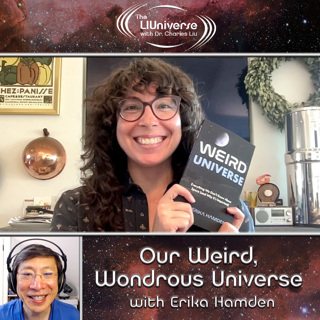
Our Weird, Wondrous Universe with Erika Hamden

Our Weird, Wondrous Universe with Erika Hamden

How do distant galaxies form? If you have two distant clouds of hydrogen, why does one turn into a star and another doesn’t? To find out, Dr. Charles Liu and co-host Allen Liu welcome Dr. Erika Hamden...

30 Mai 43min
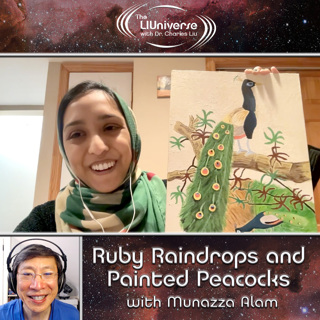
Ruby Raindrops and Painted Peacocks with Munazza Alam

Ruby Raindrops and Painted Peacocks with Munazza Alam

Are there really exoplanets with where it rains ruby and emerald raindrops? How do we measure the atmospheres of exoplanets light years away? To find out, Dr. Charles Liu and co-host Allen Liu welcome...

16 Mai 45min
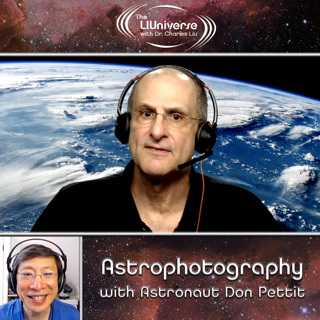
Astrophotography with Astronaut Don Pettit

Astrophotography with Astronaut Don Pettit

Can the physics you learned in High School take you to the stars? Who is behind many of your favorite pictures of space? What is it actually like to live and work in space? You might be surprised to k...

2 Mai 47min
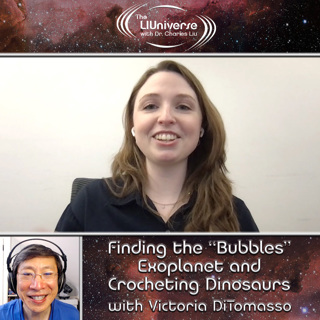
Finding the “Bubbles” Exoplanet and Crocheting Dinosaurs with Victoria DiTomasso

Finding the “Bubbles” Exoplanet and Crocheting Dinosaurs with Victoria DiTomasso

How do we find exoplanets? What is the Milky Way’s “Thick Disk” and what makes it so special? To find out, Dr. Charles Liu and co-host Allen Liu welcome Harvard astronomer Dr. Victoria DiTomasso, who ...

11 Apr 47min
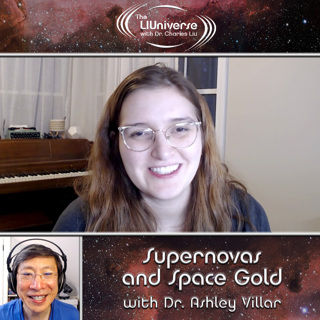
Supernovas and Space Gold with Dr. Ashley Villar

Supernovas and Space Gold with Dr. Ashley Villar

How do stars die? And what happens when they do? To find out, Dr. Charles Liu and co-host Allen Liu welcome Dr. Ashley Villar, who teaches astronomy at Harvard and whose team studies supernovas as the...

21 Mar 40min
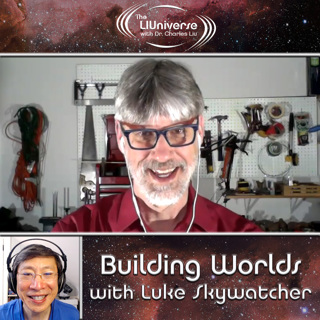
Building Worlds with Luke Skywatcher

Building Worlds with Luke Skywatcher

How do planetary systems form? If you wanted to observe them, where would you look and what would you look for? To find out, Dr. Charles Liu and co-host Allen Liu welcome Luke Keller, professor of Ast...

8 Mar 43min
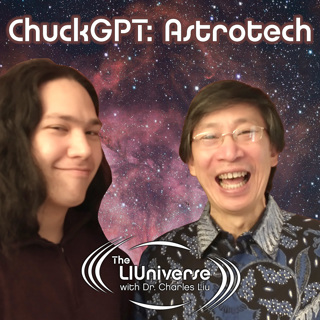
Chuck GPT: Astrotech

Chuck GPT: Astrotech

How can a helicopter fly in space? How does LIGO detect gravitational waves? How do quantum electronic devices like Josephson junctions work? Could AI turn evil and destroy humanity? What about those ...

8 Feb 55min

Populært innen Vitenskap

fastlegen
tingenes-tilstand
romkapsel
abels-tarn
jss
liberal-halvtime
vett-og-vitenskap-med-gaute-einevoll
rekommandert
villmarksliv
dekodet-2
sinnsyn
fjellsportpodden
rss-overskuddsliv
rss-rekommandert
tomprat-med-gunnar-tjomlid
rss-inn-til-kjernen-med-sunniva-rose
kvinnehelsepodden
hva-er-greia-med
rss-lundqvist-podden
diagnose