Megamasers and Magnetic Fields with Dr. Jackie Villadsen

Megamasers and Magnetic Fields with Dr. Jackie Villadsen

What’s the difference between a maser and a megamaser? How does uncertainty lead science to its newest discoveries? To find out, Dr. Charles Liu and co-host Allen Liu welcome back radio astronomer Dr. Jackie Villadsen, a professor at Bucknell University currently researching star/planet magnetic interaction in exoplanet systems.

As always, though, we start off with the day’s joyfully cool cosmic thing. In November 2024 a group of researchers announced that they’d found a series of megamasers around the supermassive black hole system NGC1068, and that for the first time ever, they’d measured the polarization of the water megamasers. Jackie, who studies a different kind of maser, explains what they are (“just a really, really big laser pointer in space that shoots out radio waves or microwaves”) and why they’re important.

Jackie studies masers around nearby stars, which are much smaller than megamasers that can be seen from other galaxies. Allen shares the fact that some megamasers can be around half a parsec (trillions of miles) across and bigger than our entire solar system.

Then it’s time for our first question for Jackie. It’s from Guadalupe, who says, “I recall reading or watching a video that stated there is liquid on Mars beneath an "ice cap" - is that right?” According to Dr. Villadsen, the question is right on the cutting edge of our understanding, with promising evidence emerging right now that suggests the answer might be yes, although more investigation is necessary before we can confirm it.

After our break, Jackie tells us about the research she’s doing using the Karl G. Jansky Very Large Array (VLA) while on her current sabbatical. You’ll hear about Karl Jansky’s breakthrough discovery of radio waves from space made nearly 100 years ago. Jackie brings us up to speed on the evolution of radio astronomy and why we’re able to get more data than ever out of the same telescopes.

Our next question comes from Bryant: “What do you think would have happened if the universe was created a bit earlier than usual? Would anything have changed?” It turns out, there’s more than one way to look at this speculative question, and Jackie and Chuck ponder the possibility of having miscalculated the age of the universe and the impact that an older universe would have on the rate of universal expansion, the perception of dark energy, and more.

Next up, Jackie tells us about the research she and her colleagues (including grad students!) have been involved with looking for star/planet magnetic interaction in nearby exoplanet systems. The search is inspired by the interaction in our solar system between the magnetic field of Jupiter and two of its closest moons, Io and Ganymede. While there are no confirmed examples yet, they already have one candidate out of the seven exoplanet systems they’ve studied.

Our next question comes from Samuel, who asks, “As an astrophysics professor, how is the work-life balance and overall lifestyle of a researcher? My dream is to become a mechanical engineer in the field of astrophysics.” Jackie explains how she approaches work, and what it took to reach the balanced state she’s in now compared to when she was a grad student.

We end the episode with another of Jackie’s book recommendations. Last time she was here she recommended the adult sci-fi romance, “The Ladies Guide to Celestial Mechanics” by Olivia Waite. This time, it’s another adult sci-fi romance with a bit of a mystery woven through it, “The Stars Too Fondly” by Emily Hamilton. The title is taken from a poem, “The Old Astronomer to His Pupil” by Sarah Williams, from which Jackie reads a snippet. She and Chuck also discuss one of their favorite poems, “The Learned Astronomer,” by Walt Whitman, found in his collection, “Leaves of Grass.”

We hope you enjoy this episode of The LIUniverse, and, if you do, please support us on Patreon.

Credits for Images Used in this Episode:

  • Radar sounding of Mars subsurface - Cross-section of a portion of the north polar ice cap of Mars, derived from satellite radar sounding – Mars Express/ESA
  • Martian north polar cap as it appeared to the Mars Global Surveyor (MGS) Mars Orbiter Camera (MOC) in early northern summer. – Credit: NASA/JPL/MSSS
  • The Very Large Array (VLA). – Credit: NRAO/AUI/NSF
  • Very Large Array, pictured with meteor. – Credit: Bettymaya Foott, NRAO/AUI/NSF
  • Animation of Jupiter’s magnetosphere. – Credit: NASA
  • Animation of Jupiter’s aurora. – Credit: NASA/Hubble

#theliuniverse #charlesliu #allenliu #sciencepodcast #astronomypodcast #jackievilladsen #maser #megamaser #vla #verylargearray #exoplanets #jupiter #magneticfield #magnetosphere #aurora #wateronmars #blackholes #adultscifi #romance #thestarstoofondly #emilyhamilton #theoldastronomertohispupil #sarahwilliams #thelearnedastronomer #waltwhitman #leavesofgrass

Denne episoden er hentet fra en åpen RSS-feed og er ikke publisert av Podme. Den kan derfor inneholde annonser.

Episoder(79)

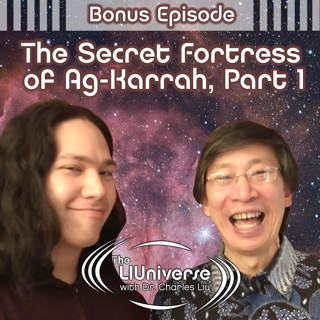
Bonus Episode: The Secret Fortress of Ag-Karrah, Part 1 (Actual Play)

Bonus Episode: The Secret Fortress of Ag-Karrah, Part 1 (Actual Play)

What happens when an astronomer, a mathematician, an educator, a physics student and a biomedical engineer set off to explore the Secret Fortress of Ag-Karrah? You get Part One of this summer’s bonus ...

16 Aug 48min
ChuckGPT - Patreon Question Edition

ChuckGPT - Patreon Question Edition

It’s time for the Season 5 finale of The LIUniverse, which means another episode of ChuckGPT where we answer our audience’s most vexing questions – this time via video from our Patreon Patrons. And to...

13 Jun 38min
Our Weird, Wondrous Universe with Erika Hamden

Our Weird, Wondrous Universe with Erika Hamden

How do distant galaxies form? If you have two distant clouds of hydrogen, why does one turn into a star and another doesn’t? To find out, Dr. Charles Liu and co-host Allen Liu welcome Dr. Erika Hamden...

30 Mai 43min
Ruby Raindrops and Painted Peacocks with Munazza Alam

Ruby Raindrops and Painted Peacocks with Munazza Alam

Are there really exoplanets with where it rains ruby and emerald raindrops? How do we measure the atmospheres of exoplanets light years away? To find out, Dr. Charles Liu and co-host Allen Liu welcome...

16 Mai 45min
Astrophotography with Astronaut Don Pettit

Astrophotography with Astronaut Don Pettit

Can the physics you learned in High School take you to the stars? Who is behind many of your favorite pictures of space? What is it actually like to live and work in space? You might be surprised to k...

2 Mai 47min
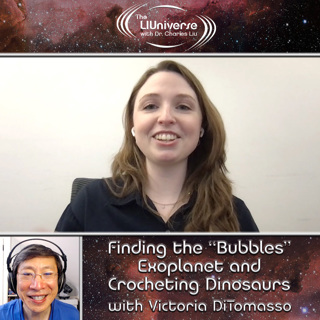
Finding the “Bubbles” Exoplanet and Crocheting Dinosaurs with Victoria DiTomasso

Finding the “Bubbles” Exoplanet and Crocheting Dinosaurs with Victoria DiTomasso

How do we find exoplanets? What is the Milky Way’s “Thick Disk” and what makes it so special? To find out, Dr. Charles Liu and co-host Allen Liu welcome Harvard astronomer Dr. Victoria DiTomasso, who ...

11 Apr 47min
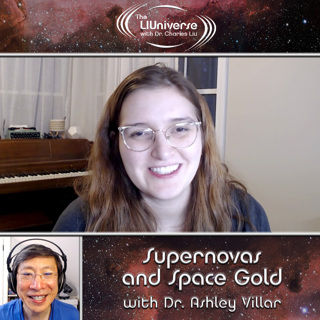
Supernovas and Space Gold with Dr. Ashley Villar

Supernovas and Space Gold with Dr. Ashley Villar

How do stars die? And what happens when they do? To find out, Dr. Charles Liu and co-host Allen Liu welcome Dr. Ashley Villar, who teaches astronomy at Harvard and whose team studies supernovas as the...

21 Mar 40min
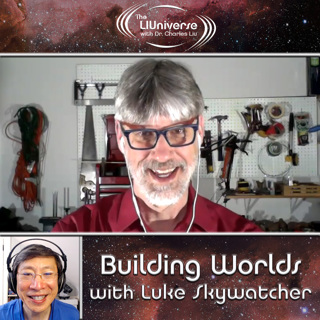
Building Worlds with Luke Skywatcher

Building Worlds with Luke Skywatcher

How do planetary systems form? If you wanted to observe them, where would you look and what would you look for? To find out, Dr. Charles Liu and co-host Allen Liu welcome Luke Keller, professor of Ast...

8 Mar 43min

Populært innen Vitenskap

fastlegen
tingenes-tilstand
romkapsel
jss
liberal-halvtime
rekommandert
villmarksliv
abels-tarn
dekodet-2
vett-og-vitenskap-med-gaute-einevoll
sinnsyn
fjellsportpodden
rss-overskuddsliv
rss-rekommandert
tomprat-med-gunnar-tjomlid
rss-inn-til-kjernen-med-sunniva-rose
hva-er-greia-med
rss-nysgjerrige-norge
diagnose
kvinnehelsepodden