Zimbabwe: Journalism in an Era of Economic Sanctions

Zimbabwe: Journalism in an Era of Economic Sanctions

In October 2023, Zimbabwe's Vice President, Constantino Chiwenga announced that Zimbabwe has lost more than US$150 billion in revenues due to sanctions imposed by the European Union, United States, and other countries since the early 2000s.

"Since 2001, we estimate that Zimbabwe has lost or missed over US$150 billion through frozen assets, trade embargoes, and export and investment restrictions from potential bilateral support, development loans, IMF and World Bank balance of payments support and commercial loans,” Chiwenga told an anti-sanctions rally held in Harare on 25 October 2023.

The question of sanctions and their impact on Zimbabwe's economy remains a controversial subject across the country.

Late last year, an economics professor at Zimbabwe's National University of Science and Technology, Stevenson Dhlamini also told the VOA that the government's claim of financial loss due to sanction has been consistent and accurate over the years.

“The cumulative effect of the sanctions by the US, EU, and the UK do have a cumulative impact that could be to that level of financial loss,” Dhlamini told the VOA.

However, another senior economist with the Labor and Economic Development Research Institute of Zimbabwe, Prosper Chitambara disagrees with Dhlamini, saying instead that multiple factors have affected the country’s economy, and not just the sanctions.

“How do you separate the effects of sanctions from the effects of corruption, or from the effects of external shocks or climate-induced shocks” Chitambara asked.

In this episode, Africanist Press shares a conversation with young Zimbabwean journalists on the state of the media in Zimbabwe, and the challenges they face as journalists in an era of economic sanctions in the country.

The discussion was moderated by Africanist Press editor, Chernoh Alpha Bah in Gweru, Zimbabwe.

This episode is part of a new Africanist Press Series on Zimbabwe that examines the impact of economic sanctions on various sectors of the population, and how communities and individuals in the country have developed independent initiatives in response to everyday challenges.


Denne episoden er hentet fra en åpen RSS-feed og er ikke publisert av Podme. Den kan derfor inneholde annonser.

Episoder(77)

Between a Family Legacy and Egyptology: The Role of the Aboudi Bookstore in Egypt

Between a Family Legacy and Egyptology: The Role of the Aboudi Bookstore in Egypt

This episode examines the Aboudi Bookstore and its role in Egyptology, the scientific and academic study of ancient Egypt. Established in 1909 in Luxor by Egyptologist and tour guide Professor Mohamed...

8 Jun 20min
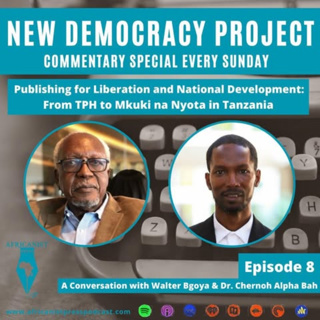
Publishing for Liberation and National Development: From TPH to Mkuki na Nyota in Tanzania

Publishing for Liberation and National Development: From TPH to Mkuki na Nyota in Tanzania

When Tanzania gained independence in 1961, Julius Nyerere saw publishing as a key part of decolonization and nation-building. In 1966, he founded the Tanzania Publishing House (TPH), putting state pub...

1 Jun 1h 19min

Building a Literary Community: The Work of the Writers Association of the Gambia

Building a Literary Community: The Work of the Writers Association of the Gambia

In this episode, we spotlight the Writers Association of the Gambia and its efforts to build a vibrant literary community, featuring Dr. Cherno Omar Barry, the Association's President, who shares insp...

25 Mai 42min

The Role of Libraries in African Development: A Look at the Gambia National Library Service Authority

The Role of Libraries in African Development: A Look at the Gambia National Library Service Authority

In this episode, we explore how national libraries drive African development. Drawing on insights from Bakary Sanyang, Director General of the Gambia National Library Service Authority, we examine the...

18 Mai 38min

Bookstores in Africa's Nation-Building: The Story of Timbooktoo in The Gambia

Bookstores in Africa's Nation-Building: The Story of Timbooktoo in The Gambia

In this podcast episode, we talk with Ousainou and Kathy Jagne, founders of Timbooktoo Bookstore in Banjul, Gambia. With 28 years of experience running an independent bookstore, they explain how books...

10 Mai 38min

Reimagining New Technology in African Classrooms: A Conversation with Laetitia Musheche

Reimagining New Technology in African Classrooms: A Conversation with Laetitia Musheche

In this episode,  we feature a conversation with Laetitia Musheche, founder of BauHouse Arts Academy, on reimagining new technology in African classrooms and the need to build an all-African-centered ...

5 Mai 48min

Sierra Leone's Tripartite Agreement: A Triangle of Illegality

Sierra Leone's Tripartite Agreement: A Triangle of Illegality

In this episode, we focus on the Tripartite Agreement’s creation of a triangle of illegality, examining how it violated Sierra Leone’s Constitution and public election laws, and its ongoing threat to ...

27 Apr 41min

Democracy is not a Tripartite Agreement: The APC and SLPP's Undemocratic Politics of Rotating Power

Democracy is not a Tripartite Agreement: The APC and SLPP's Undemocratic Politics of Rotating Power

In this episode, we focus on why the Tripartite Agreement is regarded as illegal, specifically highlighting its legal and political implications. We also analyze how foreign organizations are actively...

20 Apr 48min

Populært innen Politikk og nyheter

giver-og-gjengen-vg
aftenpodden
aftenpodden-usa
fotballpodden-2
forklart
popradet
stopp-verden
det-store-bildet
lydartikler-fra-aftenposten
rss-gukild-johaug
hanna-de-heldige
dine-penger-pengeradet
rss-ness
aftenbla-bla
e24-podden
rss-espen-lee-usensurert
rss-penger-polser-og-politikk
ta-dokumentar
nokon-ma-ga
grasoner-den-nye-kalde-krigen