#223 – Neel Nanda on leading a Google DeepMind team at 26 – and advice if you want to work at an AI company (part 2)

#223 – Neel Nanda on leading a Google DeepMind team at 26 – and advice if you want to work at an AI company (part 2)

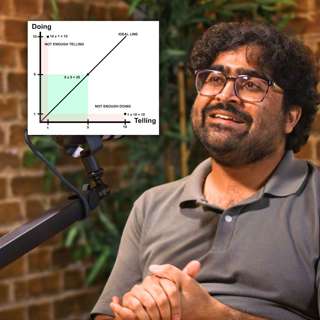
At 26, Neel Nanda leads an AI safety team at Google DeepMind, has published dozens of influential papers, and mentored 50 junior researchers — seven of whom now work at major AI companies. His secret? “It’s mostly luck,” he says, but “another part is what I think of as maximising my luck surface area.”

Video, full transcript, and links to learn more: https://80k.info/nn2

This means creating as many opportunities as possible for surprisingly good things to happen:

  • Write publicly.
  • Reach out to researchers whose work you admire.
  • Say yes to unusual projects that seem a little scary.

Nanda’s own path illustrates this perfectly. He started a challenge to write one blog post per day for a month to overcome perfectionist paralysis. Those posts helped seed the field of mechanistic interpretability and, incidentally, led to meeting his partner of four years.

His YouTube channel features unedited three-hour videos of him reading through famous papers and sharing thoughts. One has 30,000 views. “People were into it,” he shrugs.

Most remarkably, he ended up running DeepMind’s mechanistic interpretability team. He’d joined expecting to be an individual contributor, but when the team lead stepped down, he stepped up despite having no management experience. “I did not know if I was going to be good at this. I think it’s gone reasonably well.”

His core lesson: “You can just do things.” This sounds trite but is a useful reminder all the same. Doing things is a skill that improves with practice. Most people overestimate the risks and underestimate their ability to recover from failures. And as Neel explains, junior researchers today have a superpower previous generations lacked: large language models that can dramatically accelerate learning and research.

In this extended conversation, Neel and host Rob Wiblin discuss all that and some other hot takes from Neel's four years at Google DeepMind. (And be sure to check out part one of Rob and Neel’s conversation!)


What did you think of the episode? https://forms.gle/6binZivKmjjiHU6dA

Chapters:

  • Cold open (00:00:00)
  • Who’s Neel Nanda? (00:01:12)
  • Luck surface area and making the right opportunities (00:01:46)
  • Writing cold emails that aren't insta-deleted (00:03:50)
  • How Neel uses LLMs to get much more done (00:09:08)
  • “If your safety work doesn't advance capabilities, it's probably bad safety work” (00:23:22)
  • Why Neel refuses to share his p(doom) (00:27:22)
  • How Neel went from the couch to an alignment rocketship (00:31:24)
  • Navigating towards impact at a frontier AI company (00:39:24)
  • How does impact differ inside and outside frontier companies? (00:49:56)
  • Is a special skill set needed to guide large companies? (00:56:06)
  • The benefit of risk frameworks: early preparation (01:00:05)
  • Should people work at the safest or most reckless company? (01:05:21)
  • Advice for getting hired by a frontier AI company (01:08:40)
  • What makes for a good ML researcher? (01:12:57)
  • Three stages of the research process (01:19:40)
  • How do supervisors actually add value? (01:31:53)
  • An AI PhD – with these timelines?! (01:34:11)
  • Is career advice generalisable, or does everyone get the advice they don't need? (01:40:52)
  • Remember: You can just do things (01:43:51)

This episode was recorded on July 21.

Video editing: Simon Monsour and Luke Monsour
Audio engineering: Ben Cordell, Milo McGuire, Simon Monsour, and Dominic Armstrong
Music: Ben Cordell
Camera operator: Jeremy Chevillotte
Coordination, transcriptions, and web: Katy Moore

Episoder(325)

#12 - Beth Cameron works to stop you dying in a pandemic. Here’s what keeps her up at night.

#12 - Beth Cameron works to stop you dying in a pandemic. Here’s what keeps her up at night.

“When you're in the middle of a crisis and you have to ask for money, you're already too late.” That’s Dr Beth Cameron, who leads Global Biological Policy and Programs at the Nuclear Threat Initiative...

25 Okt 20171h 45min

#11 - Spencer Greenberg on speeding up social science 10-fold & why plenty of startups cause harm

#11 - Spencer Greenberg on speeding up social science 10-fold & why plenty of startups cause harm

Do most meat eaters think it’s wrong to hurt animals? Do Americans think climate change is likely to cause human extinction? What is the best, state-of-the-art therapy for depression? How can we make ...

17 Okt 20171h 29min
#10 - Nick Beckstead on how to spend billions of dollars preventing human extinction

#10 - Nick Beckstead on how to spend billions of dollars preventing human extinction

What if you were in a position to give away billions of dollars to improve the world? What would you do with it? This is the problem facing Program Officers at the Open Philanthropy Project - people l...

11 Okt 20171h 51min
#9 - Christine Peterson on how insecure computers could lead to global disaster, and how to fix it

#9 - Christine Peterson on how insecure computers could lead to global disaster, and how to fix it

Take a trip to Silicon Valley in the 70s and 80s, when going to space sounded like a good way to get around environmental limits, people started cryogenically freezing themselves, and nanotechnology l...

4 Okt 20171h 45min
#8 - Lewis Bollard on how to end factory farming in our lifetimes

#8 - Lewis Bollard on how to end factory farming in our lifetimes

Every year tens of billions of animals are raised in terrible conditions in factory farms before being killed for human consumption. Over the last two years Lewis Bollard – Project Officer for Farm An...

27 Sep 20173h 16min
#7 - Julia Galef on making humanity more rational, what EA does wrong, and why Twitter isn’t all bad

#7 - Julia Galef on making humanity more rational, what EA does wrong, and why Twitter isn’t all bad

The scientific revolution in the 16th century was one of the biggest societal shifts in human history, driven by the discovery of new and better methods of figuring out who was right and who was wrong...

13 Sep 20171h 14min
#6 - Toby Ord on why the long-term future matters more than anything else & what to do about it

#6 - Toby Ord on why the long-term future matters more than anything else & what to do about it

Of all the people whose well-being we should care about, only a small fraction are alive today. The rest are members of future generations who are yet to exist. Whether they’ll be born into a world th...

6 Sep 20172h 8min
#5 - Alex Gordon-Brown on how to donate millions in your 20s working in quantitative trading

#5 - Alex Gordon-Brown on how to donate millions in your 20s working in quantitative trading

Quantitative financial trading is one of the highest paying parts of the world’s highest paying industry. 25 to 30 year olds with outstanding maths skills can earn millions a year in an obscure set of...

28 Aug 20171h 45min

Populært innen Fakta

fastlegen
dine-penger-pengeradet
relasjonspodden-med-dora-thorhallsdottir-kjersti-idem
treningspodden
rss-strid-de-norske-borgerkrigene
foreldreradet
rss-sunn-okonomi
jakt-og-fiskepodden
takk-og-lov-med-anine-kierulf
sinnsyn
rss-kunsten-a-leve
merry-quizmas
gravid-uke-for-uke
hverdagspsyken
smart-forklart
hagespiren-podcast
rss-kull
lederskap-nhhs-podkast-om-ledelse
fryktlos
uroskolen