How do chimps communicate?
Many Minds17 Jun 2020

How do chimps communicate?

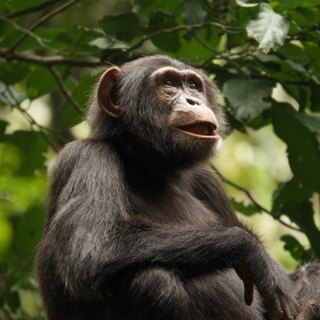
Welcome back everyone! My guest on today's show is Dr. Cat Hobaiter. Cat is a Lecturer at the University of St Andrews, where she's part of research unit called the Centre for Social Learning and Cognitive Evolution. Cat spends a good chunk of her time, not in Scotland, however, but in Africa, where she conducts fieldwork on great apes. Her primary research site is in the Budongo Forest Reserve in Uganda. Along with her team there, she studies the social behavior of wild chimpanzees—in particular, how they communicate with each other.

Much of our conversation centers on how chimps communicate through gesture—through bodily theatrics like stomping, drumming, clapping, somersaulting, and pirouetting. We discuss when chimps use these gestures, how they acquire them, and the thorny issue of what they mean. We also talk about how the gestures of chimpanzees compare to the gestures of other primates—including those bonobos, gorillas, and human toddlers. Cat and I do make our way over to other topics, too—we touch on some work she and her colleagues have done on the so-called "cooperative eye" hypothesis. We talk about the day-to-day of what it's like to do fieldwork on great apes. And we talk about how the chimps at Budongo are faring in these pandemic times.

Not many of us get the opportunity to observe our closest primate cousins in the wild. I've certainly never been so lucky. But maybe the next best thing is to hear from someone who has—particularly someone like Cat who has spent more than a decade watching chimps closely, puzzling out their propensities, and generally just figuring out what they're up to.

I learned a lot from this conversation—and had fun to boot. I think you will do. So without any more preamble, here is my conversation with Dr. Cat Hobaiter!

A transcript of this interview is available here.

Notes and links

2:45 – Learn more about the Budongo Forest Reserve here.

7:45 – Chimpanzees are "neophobic"—afraid of new things, like humans. As a result, primatologists spend a lot of time habituating chimps to their presence.

14:15 – An article about Jane Goodall's classic work on chimpanzees.

17:00 – An influential paper by Dr. Hobaiter and a colleague on the gestural repertoire of wild chimpanzees.

19:25 – Examples of many of the gestures we discuss are viewable at: http://greatapedictionary.ac.uk/video-resources/gesture-videos/

20:55 – A study in which Dr. Hobaiter and a colleague examine how many of the anatomically possible gestures chimpanzees actually make use of. (A small percentage, it turns out.)

25:15 – An important early paper on the intentional use of gesture in orangutans.

32:00 – A paper by Dr. Hobaiter and a colleague reviewing the debate on where chimp gestures come from. An influential earlier book in these debates.

44:25 – An article by Kirsty Graham and colleagues on the bonobo gestural repertoire. See also a more recent article featuring a direct comparison between bonobos and chimpanzees.

48:05 – Comparing a chimpanzee pant hoot and a human impersonation of a chimpanzee pant hoot.

52:40 – A recent article in Aeon about the controversy surrounding chimpanzee pointing.

58:45 – A paper by Dr. Hobaiter and colleagues on possible cases of pointing in the wild by chimpanzees.

1:01:45 – A recent study by Dr. Hobaiter and colleagues comparing the gestures of apes with those of human toddlers. For a popular write-up of this article, see here.

1:13:10 – A 2007 study comparing the flexibility of gestures and vocalizations in apes.

1:16:20 – A 2019 paper by Dr. Hobaiter and colleagues investigating sclera and the "cooperative eye" hypothesis in chimps, bonobos, and humans. The original article proposing the hypothesis.

1:25:00 – A recent report on how primatologists are trying to keep primates safe during the pandemic. For news about the chimps at Budongo during the pandemic, see here.

Cat Hobaiter's end-of-show recommendation:

A special issue of Animal Cognition devoted to the study of primate gesture, edited by Erica Cartmill and Cat Hobaiter.

The best way to keep up with Dr. Hobaiter is on Twitter: @NakedPrimate. You can learn more about her research at: http://greatapedictionary.ac.uk/about/

Many Minds is a project of the Diverse Intelligences Summer Institute (DISI) (https://www.diverseintelligencessummer.com/), which is made possible by a generous grant from the Templeton World Charity Foundation to UCLA. It is hosted by Kensy Cooperrider, with creative support from DISI Directors Erica Cartmill and Jacob Foster, and Associate Director Hilda Loury. Our artwork is by Ben Oldroyd (https://www.mayhilldesigns.co.uk/). Our transcripts are created by Sarah Dopierala (https://sarahdopierala.wordpress.com/).

You can subscribe to Many Minds on Apple, Stitcher, Spotify, Pocket Casts, Google Play—or wherever you like to listen to podcasts.

We welcome your comments, questions, and suggestions. Feel free to email us at: manymindspodcast@gmail.com.

Denne episoden er hentet fra en åpen RSS-feed og er ikke publisert av Podme. Den kan derfor inneholde annonser.

Episoder(167)

From the archive: Varieties of childhood

From the archive: Varieties of childhood

Hi friends! We're taking a bit of a summer pause. We'll be back soon—in the meanwhile, enjoy this listener favorite from our archives! ----- [originally aired July 10, 2025] Childhood is a special tim...

31 Jul 1h 28min

From the archive: Philosophers on psychedelics

From the archive: Philosophers on psychedelics

Hi friends! We're taking a bit of a summer pause. We will be back soon—in the meanwhile, enjoy this listener favorite from our archives! ----- [originally aired May 14, 2025] Some call it the "psyched...

17 Jul 1h 40min
The origins of Darwin's ideas

The origins of Darwin's ideas

No discipline, no sphere of intellectual life, has been untouched by the work of Charles Darwin. He died in 1882 but his ideas are very much alive; they're now central to how we understand the natural...

3 Jul 1h 19min

The sparkling deep

The sparkling deep

It's tempting to see bioluminescence as an oddity, one of those rare eccentricities of life on earth. And, on land, maybe that's true. But our planet is mostly water, and out in the open ocean biolumi...

20 Jun 1h 20min

Is Man the Hunter just a myth?

Is Man the Hunter just a myth?

There's a story about of our past that you know well. It goes like this: At some point earlier in human evolution, we started to hunt. Men in particular—perhaps channeling some deep-seated aggressive ...

5 Jun 1h 32min

Babies, dogs, and the riddles of word learning

Babies, dogs, and the riddles of word learning

It's kind of astonishing, really, that kids ever learn words. Each one poses a little riddle. Does this sound string refer to a person? A category of things? Or maybe some other feature of the bloomin...

22 Mai 1h 18min

The inner life of the hand

The inner life of the hand

Newton saw in the human hand proof of the divine; Darwin saw a key to our species' success. Many others, too, have described the hand in hyperbolic terms, as a paragon of design, a cornerstone of huma...

7 Mai 1h 10min

From the archive: The cuttlefish and its coat of many colors

From the archive: The cuttlefish and its coat of many colors

Hi friends! We're skipping a beat to take care of some spring housekeeping tasks. We will be back in May! In the meanwhile, enjoy this listener favorite from our archives! ----- [originally aired Apri...

22 Apr 1h 33min

Populært innen Fakta

fastlegen
dine-penger-pengeradet
relasjonspodden-med-dora-thorhallsdottir-kjersti-idem
foreldreradet
treningspodden
jakt-og-fiskepodden
rss-kunsten-a-leve
rss-strid-de-norske-borgerkrigene
mikkels-paskenotter
hverdagspsyken
sinnsyn
fryktlos
gravid-uke-for-uke
rss-var-forste-kaffe
rss-sarbar-med-lotte-erik
laringsmiljo-i-skole-og-barnehage-uis-podkast
rss-orjasater
rss-impressions-2
kvallm
lrerrommet