Cosmopolitan carnivores
Many Minds18 Apr 2024

Cosmopolitan carnivores

They tend to move under the cover of darkness. As night descends, they come for your gardens and compost piles, for your trash cans and attic spaces. They are raccoons, skunks, and coyotes. And if you live in urban North America, they are a growing presence. Whether you consider them menacing, cute, fascinating, or all of the above, you have to grant that they are quite a clever crew. After all, they've figured out how to adapt to human-dominated spaces. But how have they done this? What traits and talents have allowed them to evolve into this brave new niche? And are they still evolving into it?

My guest today is Dr. Sarah Benson-Amram. Sarah is Assistant Professor of Forest and Conservation Sciences and Zoology at the University of British Columbia; she also directs the Animal Behavior & Cognition Lab at UBC. Sarah's research group focuses on the behavioral and cognitive ecology of urban wildlife. They ask what urban wildlife can teach us about animal cognition more generally and try to understand ways to smooth human-wildlife interactions.

Here, Sarah and I talk about her work on that trio I mentioned before: raccoons, skunks, and coyotes. These three species are all members of the mammalian order of carnivora, a clade of animals that Sarah has focused on throughout her career and one that has been underrepresented in studies of animal cognition. We discuss the traits that have allowed these species—and certain members of these species—to thrive in dynamic, daunting urban spaces. We also talk about the big picture of the evolution of intelligence—and how urban adapter species might shed light on what is known as the cognitive buffer hypothesis. Along the way, we touch on: the neophilia of raccoons and the neophobia of coyotes, puzzle boxes, the Aesop's fable task, hyenas and elephants, brain size, individual differences, human-wildlife conflict, comparative gastronomy, and the cognitive arms race that might be unfolding in our cities.

If you have any feedback for us, we would love to hear from you. Guest suggestions? Topics or formats you'd like to see? Blistering critiques? Effusive compliments? We're open to all of it. You can email us at manymindspodcast at gmail dot com. That's manymindspodcast at gmail. Though, honestly, if it's really an effusive compliment, feel free to just post that publicly somewhere.

Alright friends, on to my conversation with Sarah Benson-Amram. Enjoy!

A transcript of this episode is available here.

Notes and links

8:50 – A study of manual dexterity in raccoons.

11:30 – A video featuring raccoon chittering, among other vocalizations.

12:00 ­– A recent academic paper on the categorization of wildlife responses to urbanization—avoider, adapter, exploiter—with some critical discussion.

14:00 – A study of how animals are becoming more nocturnal in response to humans.

18:00 – An encyclopedia article on the Social Intelligence Hypothesis, by one of its originators, Richard Byrne. A recent appraisal of how the hypothesis has fared across different taxa.

18:30 – A recent review article by Dr. Benson-Amram and colleagues surveying carnivore cognition.

25:00 ­– On the question of urban vs rural animals, see the popular article, 'Are cities making animals smarter?'

28:00 – A study by Dr. Benson-Amram and colleagues using puzzle boxes to study behavioral flexibility in captive raccoons. See also her follow-up study, conducted with a large team of neuroscience collaborators, examining the brains of raccoons who successfully solved the puzzle boxes.

34:30 – An earlier study by Dr. Benson-Amram on innovative problem solving in hyenas.

36:30 – Our earlier episode on animal personality with Dr. Kate Laskowski.

39:00 – A study by Dr. Benson-Amram and colleagues exploring raccoons' ability to solve the Aesop's Fable task. She has also used this task with elephants.

44:00 – A study by Dr. Benson-Amram and colleagues examining reversal learning in raccoons, skunks, and coyotes.

49:00 – An article articulating the "cognitive buffer hypothesis."

51:00 – A paper discussing—and "reviving"—the so-called ecological intelligence hypothesis.

53:00 – A study by Dr. Benson-Amram and colleagues comparing brain size and problem-solving ability in mammalian carnivores.

56:00 – A paper by Dr. Benson-Amram and colleagues on cognition in so-called nuisance species, in which they discuss the idea of a "cognitive arms race."

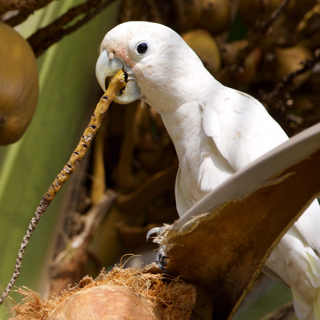
57:30 – A paper on bin-opening in cockatoos and how it might be leading to an "innovation arms race."

Recommendations

How Monkeys See the World, Dorothy Cheney and Robert Seyfarth

Are We Smart Enough to Know How Smart Animals Are? by Frans De Waal

An Immense World, by Ed Yong (featured in a previous episode!)

Urban Carnivores, by Stanley D. Gehrt, Seth P. D. Riley, and Brian L. Cypher

Many Minds is a project of the Diverse Intelligences Summer Institute, which is made possible by a generous grant from the Templeton World Charity Foundation to UCLA. It is hosted and produced by Kensy Cooperrider, with help from Assistant Producer Urte Laukaityte and with creative support from DISI Directors Erica Cartmill and Jacob Foster. Our artwork is by Ben Oldroyd. Our transcripts are created by Sarah Dopierala.

Subscribe to Many Minds on Apple, Stitcher, Spotify, Pocket Casts, Google Play, or wherever you listen to podcasts. You can also now subscribe to the Many Minds newsletter here!

We welcome your comments, questions, and suggestions. Feel free to email us at: manymindspodcast@gmail.com.

For updates about the show, visit our website or follow us on Twitter: @ManyMindsPod.

Denne episoden er hentet fra en åpen RSS-feed og er ikke publisert av Podme. Den kan derfor inneholde annonser.

Episoder(162)

Babies, dogs, and the riddles of word learning

Babies, dogs, and the riddles of word learning

It's kind of astonishing, really, that kids ever learn words. Each one poses a little riddle. Does this sound string refer to a person? A category of things? Or maybe some other feature of the bloomin...

22 Mai 1h 18min

The inner life of the hand

The inner life of the hand

Newton saw in the human hand proof of the divine; Darwin saw a key to our species' success. Many others, too, have described the hand in hyperbolic terms, as a paragon of design, a cornerstone of huma...

7 Mai 1h 10min

From the archive: The cuttlefish and its coat of many colors

From the archive: The cuttlefish and its coat of many colors

Hi friends! We're skipping a beat to take care of some spring housekeeping tasks. We will be back in May! In the meanwhile, enjoy this listener favorite from our archives! ----- [originally aired Apri...

22 Apr 1h 33min

Illuminating cave art

Illuminating cave art

Deep in our past, in the dark depths of caves, our ancestors did something strange and beautiful. Working by firelight, some doodled little designs. Others made hand stencils. Some saw a bulge of rock...

9 Apr 1h 25min

What can AI teach us about the mind?

What can AI teach us about the mind?

Everyone is talking about AI these days. Often these conversations are about how AI might upend education, or work, or social life, or maybe civilization itself. But among cognitive scientists and psy...

26 Mar 1h 21min

Mutualisms all the way down

Mutualisms all the way down

No one is an island. We all depend on each other in critical, often tangled ways. And when I say "we" and "each other" I don't just mean humans. Yes, we humans rely on other humans. But we also rely o...

11 Mar 1h 8min

Seven metaphors for AI

Seven metaphors for AI

If you wanted a petri dish for understanding metaphors—how they emerge and evolve and jostle with each other—it would be hard to do better than the world of AI. We talk about AI systems variously as c...

26 Feb 55min

Origins of the kiss

Origins of the kiss

Humans do some pretty weird things. Some of us will sit in searingly hot rooms or jump into icy ponds. Others risk their lives trying to climb to new heights or dive to new depths. And every once in a...

12 Feb 1h 1min

Populært innen Fakta

fastlegen
dine-penger-pengeradet
relasjonspodden-med-dora-thorhallsdottir-kjersti-idem
rss-bisarr-historie
foreldreradet
treningspodden
jakt-og-fiskepodden
mikkels-paskenotter
rss-sunn-okonomi
rss-strid-de-norske-borgerkrigene
dopet
sinnsyn
rss-kunsten-a-leve
hverdagspsyken
rss-sarbar-med-lotte-erik
fryktlos
sovnlos
rss-kull
hagespiren-podcast
gravid-uke-for-uke