The other half of the brain
Many Minds23 Jan 2025

The other half of the brain

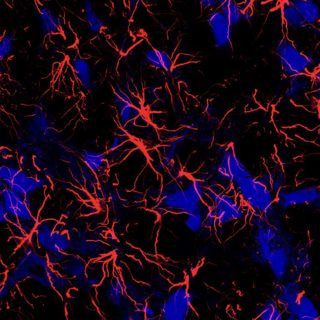
Neurons have long enjoyed a kind of rock star status. We think of them as the most fundamental units of the brain—the active cells at the heart of brain function and, ultimately, at the heart of behavior, learning, and more. But neurons are only part of the story—about half the story, it turns out. The other half of the brain is made up of cells called glia. Glia were long thought to be important structurally but not particularly exciting—basically stage-hands there to support the work of the neurons. But in recent decades, at least among neuroscientists, that view has faded. In our understanding of the brain, glia have gone from stage-hands to co-stars.

My guest today is Dr. Nicola Allen. Nicola is a molecular neuroscientist and Associate Professor at the Salk Institute in La Jolla, California. She and her lab study the role of glial cells—especially astrocytes—in brain function and dysfunction.

Here, Nicola and I talk about how our understanding and appreciation of glial cells has changed. We do a bit of Brain Cells 101, reviewing the main division between neurons and glia and then sketching the subtypes within each category. We discuss the different shapes and sizes of glial cells, as well as the different functions. Glia are an industrious bunch. They're involved in synapse formation and pruning, the production of myelin, the repair of injuries, and more. We also talk about how glial cells have been implicated in various forms of brain dysfunction, from neurodegeneration to neurodevelopmental syndromes. And how, as a result, these cells are attracting serious attention as a site for therapeutic intervention.

Well, it's that time of year again folks. Applications are now open for the 2025 Diverse Intelligences Summer Institute, or DISI. This is an intense program—highly interdisciplinary, highly international—for scholars and storytellers interested in all forms and facets of intelligence. If you like thinking about minds, if you like thinking about humans and animals and plants and AIs and collectives and ways they're alike and different—you would probably like DISI. For more info, check out disi.org—that's D-I-S-I dot org. Review of applications begins March 1st, so don't dally too too long.

Alright friends—on to my conversation with Dr. Nicola Allen. Enjoy!

A transcript of this episode is available here.

Notes and links

3:00 – Correction: "glia" actually comes from the Greek—not the Latin—for "glue."

3:30 – See this short primer on glia by Dr. Allen and Dr. Ben Barres. For a bit of the history of how glial cells were originally conceived, see this article on Ramón y Cajal's contributions to glia research.

10:00 – On the nascent field of "neuroimmunology," see here.

14:00 – On the idea that "90% of brain cells are glia" see this article by (former guest) Suzana Herculano-Houzel.

18:00 – The root "oligo" in "oligodendrocyte" means "few" (and is thus the same as the "olig" in, e.g., "oligarchy"). It is not related to the "liga-" in "ligament."

28:00 – On the idea that the glia-neuron ratio changes as brains grow more complex, see again the article by Dr. Herculano-Houzel.

30:00 – See Dr. Allen's paper on the idea of glia as "architects." See also Dr. Allen's paper on the idea of glia as "sculptors."

33:00 – See Dr. Allen's paper on the idea of the "tripartite synapse."

42:00 – A recent paper reviewing the phenomenon of adult neurogenesis.

48:00 – See Dr. Allen's recent review of the role of astrocytes in neurodegeneration.

51:30 – A recent article on the roles of APOE in Alzheimer's.

Recommendations

Glia (2nd edition), edited by Beth Stevens, Kelly R. Monk, and Marc R. Freeman

Many Minds is a project of the Diverse Intelligences Summer Institute, which is made possible by a generous grant from the John Templeton Foundation to Indiana University. The show is hosted and produced by Kensy Cooperrider, with help from Assistant Producer Urte Laukaityte and with creative support from DISI Directors Erica Cartmill and Jacob Foster. Our artwork is by Ben Oldroyd. Our transcripts are created by Sarah Dopierala.

Subscribe to Many Minds on Apple, Stitcher, Spotify, Pocket Casts, Google Play, or wherever you listen to podcasts. You can also now subscribe to the Many Minds newsletter here!

We welcome your comments, questions, and suggestions. Feel free to email us at: manymindspodcast@gmail.com.

For updates about the show, visit our website or follow us on Twitter (@ManyMindsPod) or Bluesky (@manymindspod.bsky.social).

Denne episoden er hentet fra en åpen RSS-feed og er ikke publisert av Podme. Den kan derfor inneholde annonser.

Episoder(162)

Babies, dogs, and the riddles of word learning

Babies, dogs, and the riddles of word learning

It's kind of astonishing, really, that kids ever learn words. Each one poses a little riddle. Does this sound string refer to a person? A category of things? Or maybe some other feature of the bloomin...

22 Mai 1h 18min

The inner life of the hand

The inner life of the hand

Newton saw in the human hand proof of the divine; Darwin saw a key to our species' success. Many others, too, have described the hand in hyperbolic terms, as a paragon of design, a cornerstone of huma...

7 Mai 1h 10min

From the archive: The cuttlefish and its coat of many colors

From the archive: The cuttlefish and its coat of many colors

Hi friends! We're skipping a beat to take care of some spring housekeeping tasks. We will be back in May! In the meanwhile, enjoy this listener favorite from our archives! ----- [originally aired Apri...

22 Apr 1h 33min

Illuminating cave art

Illuminating cave art

Deep in our past, in the dark depths of caves, our ancestors did something strange and beautiful. Working by firelight, some doodled little designs. Others made hand stencils. Some saw a bulge of rock...

9 Apr 1h 25min

What can AI teach us about the mind?

What can AI teach us about the mind?

Everyone is talking about AI these days. Often these conversations are about how AI might upend education, or work, or social life, or maybe civilization itself. But among cognitive scientists and psy...

26 Mar 1h 21min

Mutualisms all the way down

Mutualisms all the way down

No one is an island. We all depend on each other in critical, often tangled ways. And when I say "we" and "each other" I don't just mean humans. Yes, we humans rely on other humans. But we also rely o...

11 Mar 1h 8min

Seven metaphors for AI

Seven metaphors for AI

If you wanted a petri dish for understanding metaphors—how they emerge and evolve and jostle with each other—it would be hard to do better than the world of AI. We talk about AI systems variously as c...

26 Feb 55min

Origins of the kiss

Origins of the kiss

Humans do some pretty weird things. Some of us will sit in searingly hot rooms or jump into icy ponds. Others risk their lives trying to climb to new heights or dive to new depths. And every once in a...

12 Feb 1h 1min

Populært innen Fakta

fastlegen
dine-penger-pengeradet
relasjonspodden-med-dora-thorhallsdottir-kjersti-idem
rss-bisarr-historie
foreldreradet
treningspodden
jakt-og-fiskepodden
mikkels-paskenotter
rss-sunn-okonomi
rss-strid-de-norske-borgerkrigene
dopet
sinnsyn
rss-kunsten-a-leve
hverdagspsyken
rss-sarbar-med-lotte-erik
fryktlos
sovnlos
rss-kull
hagespiren-podcast
gravid-uke-for-uke