The primeval soil of play
Many Minds12 Jun 2025

The primeval soil of play

Puppies wrestling and mock-biting each other. Toddlers playing hide and seek. Kittens pouncing—repeatedly—on a toy mouse. You've no doubt looked on at scenes like this with amusement. And you've no doubt seen some of those viral videos—of ravens sledding down hills, of bumble bees playing with balls. All these moments make us smile, maybe even giggle. But the scientific questions they raise merit serious attention. Where do we see play in the animal kingdom? Where do we not? What functions does play serve? Do we—and many other creatures—have an elemental need for play?

My guest today is Dr. Gordon Burghardt. Gordon is a longtime Professor in the Department of Psychology and the Department of Ecology and Evolutionary Biology at the University of Tennessee. For decades now, Gordon has been a pioneer in the study of animal play, with a particular focus on play in reptiles and other animals not usually considered playful. His 2005 book, The Genesis of Animal Play, remains a landmark in the field.

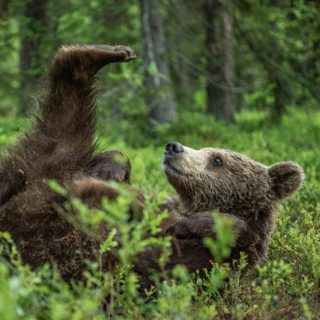
Here, Gordon and I talk about the major types of play: locomotor play, object play, and social play. We discuss the five criteria he has proposed for recognizing play across animal taxa. We survey several of the functions of play that have been proposed over the decades, and discuss how—in the end—play doesn't seem to have just one function. We also talk about human play—about what sets it apart, and about the possibility that play lies at the root of many of the capacities and institutions we think of as distinctively, impressively human. Along the way, Gordon and I touch on play in bears, pythons, turtles, fruit flies, and octopuses. We consider play between members of taxonomically distant species. We talk about "self-handicapping"; the surplus resource theory of play; the importance of "risky play" and "free play"; the immersive quality of play; bodily and vocal play signals in mammals; and whether human play is increasingly endangered.

Without further ado, here's my conversation with Dr. Gordon Burghardt. Enjoy!

A transcript of this episode is available here.

Notes and links

3:00 – A news article on the finding of "play-like" behavior in fruit flies. The original study.

4:30 – For recent reviews of play by Dr. Burghardt and colleagues, covering the three major types of play, the five criteria for recognizing play, and many other topics, see here, here, and here.

12:00 – For more on Dr. Burghardt's early research and hand-rearing of black bears, see here.

23:30 – For the recent study on ball play in bumble bees, see here.

26:00 – For an example of studies examining self-handicapping, see this study on belugas.

27:00 – For a video of a bull and goat butting heads, see here. For more on cross-species play, see this recent paper by Dr. Burghardt and a colleague.

31:00 – For more on the "relaxed open mouth expression" and "play face," see our previous episode on the origins of the smile. For a recent study about such expressions possibly attested in dolphins, see here.

44:00 – For the book by Johan Huizinga, see here. For some of Dr. Burghardt's ideas about the connections between play and certain aspects of human culture, see here.

54:00 – For research on the value of "risky play," see work by Dr. Ellen Sandseter. For an article connecting "free play" and children's mental health, see here.

Recommendations

Kingdom of Play, by David Toomey

Tile art credit: Image by Getty Images via Unsplash

Many Minds is a project of the Diverse Intelligences Summer Institute, which is made possible by a generous grant from the John Templeton Foundation to Indiana University. The show is hosted and produced by Kensy Cooperrider, with help from Assistant Producer Urte Laukaityte and with creative support from DISI Directors Erica Cartmill and Jacob Foster. Our artwork is by Ben Oldroyd. Our transcripts are created by Sarah Dopierala.

Subscribe to Many Minds on Apple, Stitcher, Spotify, Pocket Casts, Google Play, or wherever you listen to podcasts. You can also now subscribe to the Many Minds newsletter here!

We welcome your comments, questions, and suggestions. Feel free to email us at: manymindspodcast@gmail.com.

For updates about the show, visit our website or follow us on Twitter (@ManyMindsPod) or Bluesky (@manymindspod.bsky.social).

Denne episoden er hentet fra en åpen RSS-feed og er ikke publisert av Podme. Den kan derfor inneholde annonser.

Episoder(167)

From the archive: Varieties of childhood

From the archive: Varieties of childhood

Hi friends! We're taking a bit of a summer pause. We'll be back soon—in the meanwhile, enjoy this listener favorite from our archives! ----- [originally aired July 10, 2025] Childhood is a special tim...

31 Jul 1h 28min

From the archive: Philosophers on psychedelics

From the archive: Philosophers on psychedelics

Hi friends! We're taking a bit of a summer pause. We will be back soon—in the meanwhile, enjoy this listener favorite from our archives! ----- [originally aired May 14, 2025] Some call it the "psyched...

17 Jul 1h 40min
The origins of Darwin's ideas

The origins of Darwin's ideas

No discipline, no sphere of intellectual life, has been untouched by the work of Charles Darwin. He died in 1882 but his ideas are very much alive; they're now central to how we understand the natural...

3 Jul 1h 19min

The sparkling deep

The sparkling deep

It's tempting to see bioluminescence as an oddity, one of those rare eccentricities of life on earth. And, on land, maybe that's true. But our planet is mostly water, and out in the open ocean biolumi...

20 Jun 1h 20min

Is Man the Hunter just a myth?

Is Man the Hunter just a myth?

There's a story about of our past that you know well. It goes like this: At some point earlier in human evolution, we started to hunt. Men in particular—perhaps channeling some deep-seated aggressive ...

5 Jun 1h 32min

Babies, dogs, and the riddles of word learning

Babies, dogs, and the riddles of word learning

It's kind of astonishing, really, that kids ever learn words. Each one poses a little riddle. Does this sound string refer to a person? A category of things? Or maybe some other feature of the bloomin...

22 Mai 1h 18min

The inner life of the hand

The inner life of the hand

Newton saw in the human hand proof of the divine; Darwin saw a key to our species' success. Many others, too, have described the hand in hyperbolic terms, as a paragon of design, a cornerstone of huma...

7 Mai 1h 10min

From the archive: The cuttlefish and its coat of many colors

From the archive: The cuttlefish and its coat of many colors

Hi friends! We're skipping a beat to take care of some spring housekeeping tasks. We will be back in May! In the meanwhile, enjoy this listener favorite from our archives! ----- [originally aired Apri...

22 Apr 1h 33min

Populært innen Fakta

fastlegen
dine-penger-pengeradet
relasjonspodden-med-dora-thorhallsdottir-kjersti-idem
foreldreradet
treningspodden
jakt-og-fiskepodden
rss-kunsten-a-leve
mikkels-paskenotter
rss-strid-de-norske-borgerkrigene
hverdagspsyken
sinnsyn
fryktlos
gravid-uke-for-uke
rss-sarbar-med-lotte-erik
rss-var-forste-kaffe
kvallm
tomprat-med-gunnar-tjomlid
rss-impressions-2
rss-bak-luftfarten
laringsmiljo-i-skole-og-barnehage-uis-podkast