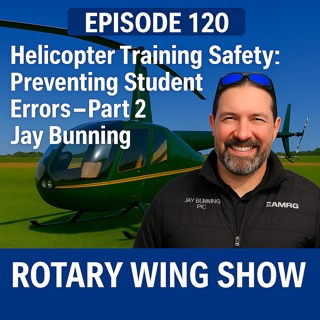

Helicopter Training Safety: Preventing Student Errors with Jay Bunning – Part 2

Helicopter Training Safety: Preventing Student Errors with Jay Bunning – Part 2

Max talks with Jay Bunning, CFI and creator of helicoptertrainingvideos.com, for Part 2 of their series on Helicopter Training Safety: Preventing Student Errors. Following up from Part 1, Jay brings real-world accident examples and practical strategies for instructors to manage common mistakes during training flights.

We need your help to improve the show! To do that, we need you to take our Rotary Wing Show Listener Survey. We have a new host and the show may change in some ways, and to guide those changes we need your feedback. So please take a few minutes and fill in the survey now.

Also, have you ever have you ever thought that you might like to have Internet service available when you’re flying in either a helicopter or a GA aircraft? To learn everything you need to know about how to set up and use Starlink in a small aircraft listen to episode 400 of the Aviation News Talk podcast. And click here to find the bits and pieces you need to make Starlink work.

Quick Stops / Rapid Decelerations

Jay begins with rapid deceleration or quick stop maneuvers, which require simultaneous control of cyclic, collective, and pedals. He explains why instructors must guard both pedals closely, since students often apply the wrong pedal or fail to add left pedal when raising collective. Improper collective inputs can also create conditions for vortex ring state (VRS), overspeed, or altitude loss. Jay notes the importance of sequencing training—avoiding quick stops immediately after autorotations to prevent negative transfer, since students sometimes confuse the two and roll off throttle. He also highlights an R44 accident where a CFI invented a non-standard rapid decel procedure that ended in rollover—reinforcing why instructors must stick to manufacturer guidance

Vortex Ring State (VRS)

The conversation moves to vortex ring state, also known as “settling with power.” Jay explains both the traditional recovery—lowering collective and pushing forward cyclic to gain airspeed—and the Vard (lateral) recovery, which uses collective, left pedal, and right cyclic to slide out of the recirculation. While the Vard technique can recover faster, Jay cautions against prolonged drifting, over-banking, or excessive collective input, which can cause yaw or RPM decay. He stresses training students to recognize the first indications of VRS—unusual vibrations, buffeting, or an increasing descent rate—and recover immediately. Riding a helicopter deep into VRS for demonstration purposes has caused accidents, including the in-flight breakup of an AS350 during training. Both Airbus and Robinson have issued safety advisories warning against prolonged or aggressive inputs during VRS demonstrations

Hover Autos

Finally, Jay addresses hover autorotations, calling them the most complex maneuver for instructors to teach. The challenge lies in managing throttle, pedals, cyclic, and collective inputs—all in under two seconds, especially in the R22. Instructors must guard against incorrect pedal use, premature collective pulls that balloon the aircraft, or students rolling throttle the wrong way. Jay explains how training should progress gradually, starting with throttle roll-offs on the ground, then introducing forward taxi hover autos before moving to stationary hovers. He also cites an R22 dynamic rollover accident caused by gusty winds and improper cyclic control, reinforcing the need to practice only in stable conditions.

Key Takeaways

Throughout the episode, Jay stresses several safety principles:

  • Sequence maneuvers wisely to avoid negative transfer.
  • Train students to recognize first symptoms and recover early.
  • Stick to proven, manufacturer-recommended procedures.
  • Instructors must “ghost” maneuvers—mentally flying along and guarding controls.
  • Simulators can safely replicate scenarios like VRS close to the ground.

This second part of Max’s conversation with Jay offers valuable insights for CFIs and students alike. By anticipating common errors and adopting safer training practices, instructors can reduce risk and help prevent accidents that still appear far too often in helicopter operations

Denne episoden er hentet fra en åpen RSS-feed og er ikke publisert av Podme. Den kan derfor inneholde annonser.

Episoder(126)

Helicopter Flying in New Zealand: Billy Watson on Milford Sound + Helicopter News

Helicopter Flying in New Zealand: Billy Watson on Milford Sound + Helicopter News

Max talks with New Zealand helicopter pilot Billy Watson about flying in some of the most dramatic terrain in the world, from Queenstown and Milford Sound to Papua New Guinea and the Western Pacific.B...

8 Mai 34min
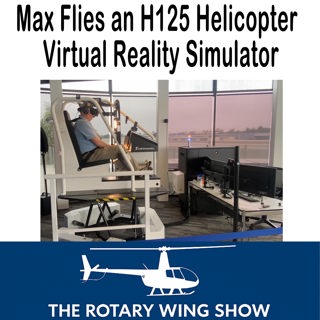
Helicopter VR Simulator: Loft Dynamics H125

Helicopter VR Simulator: Loft Dynamics H125

Max flies the Loft Dynamics H125 VR simulator and he talks about why he believes highly realistic virtual reality may become an important part of helicopter training.In this episode of The Rotary Wing...

7 Apr 48min
Helicopter VR Flight Simulator Training: Loft Dynamics with Fabi Riesen

Helicopter VR Flight Simulator Training: Loft Dynamics with Fabi Riesen

Max talks with Fabi Riesen, CEO of Loft Dynamics, about virtual reality helicopter simulator training and why VR may be a practical way to improve safety, proficiency, and standardization in rotorcraf...

26 Feb 43min
Mastering Auto-Rotations, Simulated Engine Failures, and Off-Airport Operations + Helicopter News

Mastering Auto-Rotations, Simulated Engine Failures, and Off-Airport Operations + Helicopter News

See Helicopter News headlines and link to listener survey below. In this episode, Max talks with helicopter instructor Jay Bunning to explore the maneuvers that most frequently injure or kill helicopt...

13 Nov 20251h 16min
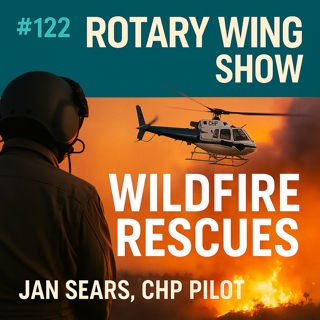
CHP Pilot Jan Sears: Wildfire Rescues in Hurricane-Force Winds

CHP Pilot Jan Sears: Wildfire Rescues in Hurricane-Force Winds

In this episode of the Rotary Wing Show, Max Trescott replays a powerful conversation from Aviation News Talk Episode 37, featuring California Highway Patrol pilot Jan Sears. Jan recounts the dramatic...

28 Okt 202558min
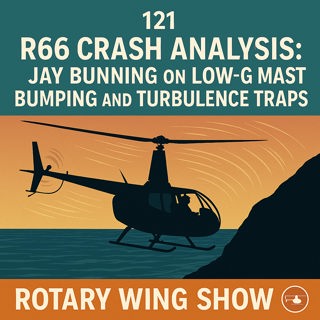
R66 Crash Analysis: Jay Bunning on Low-G Mast Bumping and Turbulence Traps

R66 Crash Analysis: Jay Bunning on Low-G Mast Bumping and Turbulence Traps

Max talks with Jay Bunning about the crash of a Robinson R66, VH-KFT, in Australia that claimed the life of its pilot on October 26, 2023. In addition to the final report, ATSB created a video about t...

20 Okt 202552min

Helicopter Training Safety: Preventing Student Errors with Jay Bunning – Part 1

Helicopter Training Safety: Preventing Student Errors with Jay Bunning – Part 1

Max welcomes Jay Bunning, flight instructor, FAA Safety Team representative, and founder of HelicopterTrainingVideos.com, for Part 1 of a two-part discussion on helicopter training safety and preventi...

9 Sep 20251h 6min

Populært innen Fritid

rss-spartsklubben
lydartikler-fra-aftenposten
interiorradet
mil-etter-mil-en-podcast-om-bil
nerdelandslaget
jegerpodden
livet-pa-veien-med-jan-erik-larssen
jakt-og-fiskepodden
rss-jegerpodden
villmarksliv
rss-avskiltet
level-backup
rss-var-forste-kaffe
fjellsportpodden
0-100-med-broom-mats-og-remi
menn-uten-midje-kan-ogsa-lese
hagespiren-podcast
rss-jenzki-pang-slenge-med-leppa
lordens-garasje
rss-gatebilpodden