David Epstein | Range: Why Generalists Triumph in Today's Specialized World
Hidden Forces6 Jan 2020

David Epstein | Range: Why Generalists Triumph in Today's Specialized World

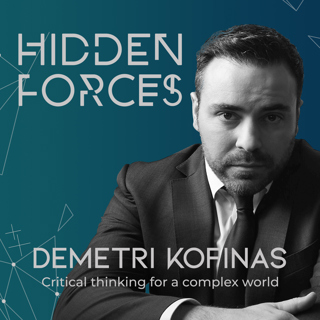
In Episode 117 of Hidden Forces, Demetri Kofinas speaks with author David Epstein about what the world's most successful people have in common. He discovers that in most fields—especially those that are complex and unpredictable—generalists, not specialists, are the ones primed for success. "As computers master more of the skills once reserved for highly focused humans," says David, "people who think broadly and embrace diverse experiences and perspectives will increasingly thrive."

David's conclusions run counter to the prevailing view among "experts" who argue that anyone who wants to develop a skill, play an instrument, or lead their field should start early, focus intensely, and rack up as many hours of deliberate practice as possible. "If you dabble or delay," they say "you'll never catch up to the people who got a head start." But a closer look at research on the world's top performers, from professional athletes to Nobel laureates, paints a very different picture. In fact, it shows that early specialization is actually the exception, not the rule.

In his research, David Epstein discovers that while generalists often do find their path late—juggling many interests rather than focusing on one—they arrive at their destination with a higher degree of "fit" after undergoing a prolonged sampling period. They're also more creative, more agile, and able to make connections their more specialized peers can't see.

In their conversation, David Epstein makes a compelling case for actively cultivating inefficiency. He explains why failing a test is the best way to learn and that frequent quitters end up with the most fulfilling careers. He gives example after example of how some of the most impactful inventors cross domains rather than deepening their knowledge in a single area. In a 21st century increasingly dominated by automation and the specter of artificial intelligence, David believes that people who think broadly and embrace diverse experiences and perspectives will increasingly thrive.

You can access the rundown to this week's episode, along with a transcript to Demetri's conversation with David through the Hidden Forces Patreon Page. All subscribers also gain access to our overtime feed, which can be easily be added to your favorite podcast application, allowing you to listen in on the rest of Demetri and David's conversation.

Producer & Host: Demetri Kofinas

Editor & Engineer: Stylianos Nicolaou

Subscribe & Support the Podcast at http://patreon.com/hiddenforces

Join the conversation on Facebook, Instagram, and Twitter at @hiddenforcespod

Episoder(503)

How China Is Winning the Iran War | Jon Alterman

How China Is Winning the Iran War | Jon Alterman

In Episode 478 of Hidden Forces, Demetri Kofinas speaks with Jon Alterman, the Zbigniew Brzezinski Chair in Global Security and Geostrategy at the Center for Strategic and International Studies, abou...

30 Apr 49min

US Grand Strategy & the Revenge of Geopolitics | Edward Luce

US Grand Strategy & the Revenge of Geopolitics | Edward Luce

In Episode 477 of Hidden Forces, Demetri Kofinas speaks with Edward Luce, columnist and US national editor at the Financial Times, about the history of American Grand Strategy and the revenge of geop...

20 Apr 57min

Why America Cannot Afford to Lose Another War | Marvin Barth

Why America Cannot Afford to Lose Another War | Marvin Barth

In Episode 476 of Hidden Forces, Demetri Kofinas speaks with Marvin Barth, founder of Thematic Markets and former head of FX and EM macro research at Barclays, and Chief Economist for International A...

16 Apr 49min

Who Wins and Who Loses in the AI Economy | John Burn-Murdoch

Who Wins and Who Loses in the AI Economy | John Burn-Murdoch

In Episode 475 of Hidden Forces, Demetri Kofinas speaks with John Burn-Murdoch, columnist and chief data reporter for the Financial Times, about AI's impact on the economy and jobs, the widening ideo...

13 Apr 57min

The Last Ship Out of Hormuz: Why the REAL Supply Shock Is About to Hit | Rory Johnston

The Last Ship Out of Hormuz: Why the REAL Supply Shock Is About to Hit | Rory Johnston

In Episode 474 of Hidden Forces, Demetri Kofinas speaks with commodity economist and energy market analyst Rory Johnston — founder of CommodityContext.com and host of the Oil Ground Up Podcast — abou...

2 Apr 51min

Here's Why Trump is in No Rush to Reopen the Strait of Hormuz | John Konrad

Here's Why Trump is in No Rush to Reopen the Strait of Hormuz | John Konrad

In Episode 473 of Hidden Forces, Demetri Kofinas speaks with Captain John Konrad — founder of gCaptain, the world's most-visited maritime and offshore news website, and one of the most influential vo...

1 Apr 58min

The God Machine: Demis Hassabis and the Quest for Superintelligence | Sebastian Mallaby

The God Machine: Demis Hassabis and the Quest for Superintelligence | Sebastian Mallaby

In Episode 472 of Hidden Forces, Demetri Kofinas speaks with Sebastian Mallaby about Demis Hassabis, the co-founder of DeepMind and the man widely regarded as the most consequential figure in the dev...

30 Mar 56min

Why There Are No Good Options Left in the US War Against Iran | Gregg Carlstrom

Why There Are No Good Options Left in the US War Against Iran | Gregg Carlstrom

In Episode 471 of Hidden Forces, Demetri Kofinas speaks with Gregg Carlstrom — Middle East correspondent for The Economist, based in Dubai and Riyadh, and a veteran reporter covering the region for f...

24 Mar 48min

Populært innen Business og økonomi

stopp-verden
lydartikler-fra-aftenposten
dine-penger-pengeradet
e24-podden
rss-pa-konto
rss-penger-polser-og-politikk
rss-borsmorgen-okonominyhetene
pengepodden-2
finansredaksjonen
rss-skravla-gar
pengesnakk
utbytte
stormkast-med-valebrokk-stordalen
morgenkaffen-med-finansavisen
tid-er-penger-en-podcast-med-peter-warren
liberal-halvtime
rss-sunn-okonomi
lederpodden
rss-politisk-preik
livet-pa-veien-med-jan-erik-larssen