Jim van Os - Towards Resilience and Possibilities and Away from Diseases and Symptoms

Jim van Os - Towards Resilience and Possibilities and Away from Diseases and Symptoms

This week on MIA Radio, we interview Professor Jim van Os. Professor van Os is Chairman of the Division of Neuroscience at Utrecht University Medical Centre, Utrecht, The Netherlands, and Visiting Professor of Psychiatric Epidemiology at King's College, Institute of Psychiatry in London. He trained in Psychiatry in Casablanca, Bordeaux and the Institute of Psychiatry and the Maudsley Royal Hospital in London.

We last spoke with Jim for the podcast in August 2017 and this time we focus on a recent paper written by Jim and co-authors that was published in the journal World Psychiatry in January 2019. The paper is entitled 'The diagnosis evidence-based group-level symptom-reduction model as organizing principle for mental health care. Time for change?'

In this episode we discuss:
  • What the diagnosis evidence-based group-level symptom-reduction model is and how it currently informs mainstream mental healthcare.
  • How mental health funding and mental health professional partners work together to monitor and assess the effects of current evidence-based interventions.
  • How this curative medical model is attractive, but often fails to work for patients.
  • That the focus on biological, brain-based diseases and symptoms conflicts with the experience of people who are attempting to develop a narrative view of their difficulties and suffering.
  • That the paper is an attempt to start a discussion about building a synthesis between the diagnosis, symptom-based medical world and the lived experience of individual people.
  • How the creation of specific and discrete diagnoses has reinforced the symptom-led approach to mental health and has also necessitated the stratification of doctors into silos of expertise.
  • How Jim favors a spectrum-based approach over a fixed diagnosis and that an example is autism spectrum disorder as described in DSM V.
  • The limitations of using 'target symptom reduction' as an outcome measure for mental health.
  • That symptom reduction can be beneficial in the short-term but is not a good long-term measure of recovery.
  • That the paper attempts to make clear how important individual experiences are and the need to be sensitive to the existential domain, saying "restoration of health is not the goal, it is the means to enable a person to find and pursue meaningful goals, accordingly, the person's existential values become central".
  • That the evidence suggests that any treatment effect or improvement is often down to meaningful interaction rather than the specific expertise of the treating professional.
  • That, in many countries, we still see a huge gulf between mental healthcare and social care which remain separate and remote from each other and that this separation is not how the person experiences their world.
  • The importance of including lived experience in the evidence base, particularly because randomized controlled trials, considered the gold standard of evidence, are often not conclusive in the field of mental health.
  • That, in mental health, evidence shows that 30% to 40% of the response is down to placebo and the expectation of being helped.
  • That the desire is to make the existential domain the primary lens through which to view human experience and to respond to mental or emotional suffering.
  • That, arguably, 'love is the most powerful evidence-based treatment in mental health'.

Relevant links:

Professor Jim van Os

The evidence-based group-level symptom-reduction model as the organizing principle for mental health care: time for change?

Tedx: Maastricht, Connecting to Madness

ISPS Liverpool Conference Jim Van Os Keynote Address

Schizophrenia does not exist

© Mad in America 2019

Episoder(292)

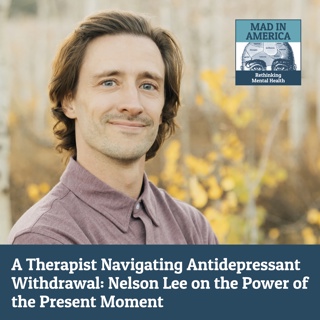
A Therapist Navigating Antidepressant Withdrawal: Nelson Lee on the Power of the Present Moment

A Therapist Navigating Antidepressant Withdrawal: Nelson Lee on the Power of the Present Moment

Nelson Lee is a therapist and mental skills coach with a master's degree in clinical mental health counseling and an MBA. In 2024, he attempted to get off antidepressants that he'd been on for 15 year...

11 Jun 202546min
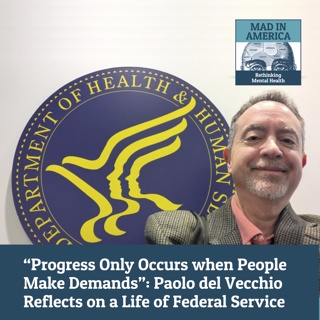
"Progress Only Occurs when People Make Demands" Paolo del Vecchio Reflects on a Life of Federal Service

"Progress Only Occurs when People Make Demands" Paolo del Vecchio Reflects on a Life of Federal Service

Paulo del Vecchio is a person in long-term recovery from mental health and addictions, who has been a leader in the peer recovery movement for 40 years. He recently completed a 30-year career at the U...

4 Jun 202539min
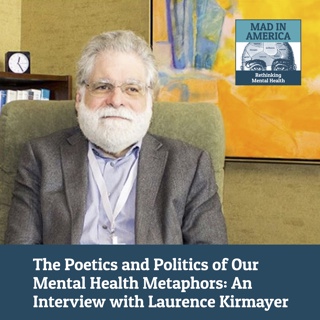
The Poetics and Politics of Our Mental Health Metaphors: An Interview with Laurence Kirmayer

The Poetics and Politics of Our Mental Health Metaphors: An Interview with Laurence Kirmayer

Laurence Kirmayer is one of the most influential figures in cultural psychiatry today. A psychiatrist, researcher, and theorist, he serves as James McGill Professor and Director of the Division of Soc...

21 Mai 202537min
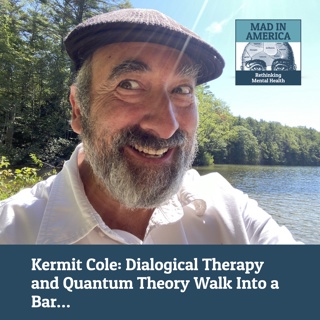
Kermit Cole: Dialogical Therapy and Quantum Theory Walk Into a Bar…

Kermit Cole: Dialogical Therapy and Quantum Theory Walk Into a Bar…

Hello, my name is Bob Whitaker, and today I have the pleasure of speaking with Kermit Cole. We'll be speaking about a philosophical enterprise that Kermit is now deeply engaged in. That is, broadly sp...

7 Mai 202536min
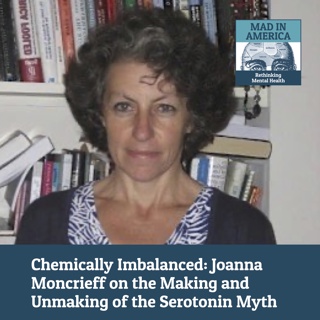
Chemically Imbalanced: Joanna Moncrieff on the Making and Unmaking of the Serotonin Myth

Chemically Imbalanced: Joanna Moncrieff on the Making and Unmaking of the Serotonin Myth

Welcome to this Mad in America podcast. My name is Robert Whitaker, and I'm happy today to have the pleasure of speaking with Joanna Moncrieff. Dr. Moncrieff is a psychiatrist who works in the Nationa...

30 Apr 202549min
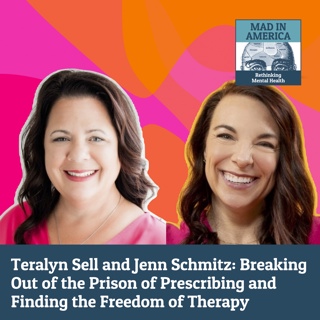
Teralyn Sell and Jenn Schmitz: Breaking Out of the Prison of Prescribing and Finding the Freedom of Therapy

Teralyn Sell and Jenn Schmitz: Breaking Out of the Prison of Prescribing and Finding the Freedom of Therapy

On the Mad in America podcast this week, Brooke Siem, author of May Cause Side Effects, talks with Teralyn Sell and Jenn Schmitz about their journey from working in the prison system to challenging co...

16 Apr 202548min
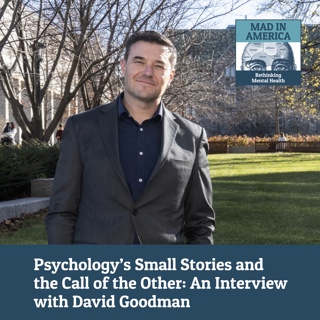
Psychology's Small Stories and the Call of the Other: An Interview with David Goodman

Psychology's Small Stories and the Call of the Other: An Interview with David Goodman

David Goodman is the Director of the Center for Psychological Humanities and Ethics and the Dean of the Woods College of Advancing Studies at Boston College, where he also teaches in the Department ...

9 Apr 202543min
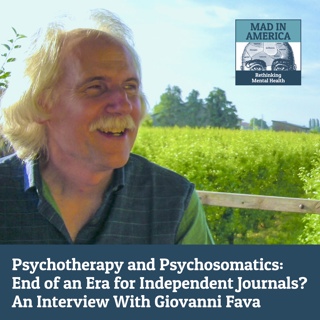
Psychotherapy and Psychosomatics: End of an Era for Independent Journals? An Interview With Giovanni Fava

Psychotherapy and Psychosomatics: End of an Era for Independent Journals? An Interview With Giovanni Fava

Welcome to Mad In America Radio. My name is Bob Whitaker, and today my guest is Italian psychiatrist, Giovanni Fava. From 1992 to 2022, Dr. Fava edited the journal Psychotherapy and Psychosomatics. We...

26 Mar 202540min

Populært innen Helse

fastlegen
lydartikler-fra-aftenposten
rss-gukild-johaug
hvordan-har-du-det-mann
psykodrama
relasjonspodden-med-dora-thorhallsdottir-kjersti-idem
leger-om-livet
rss-garne-damer
foreldreradet
hjernesterk
hormonelle-frida
morten-ramm-lar-kakla-ga-til-du-sovner
rss-lopedrommen
bak-fasaden-en-reise-i-livet-med-sykepleier-ine
klimaks
g-punktet
rss-kull
rss-sunn-okonomi
helsetipspodden
sinnsyn