
John Read and Irving Kirsch – Electroconvulsive Therapy (ECT) Does the Evidence From Clinical Trials Justify its Continued Use?

John Read and Irving Kirsch – Electroconvulsive Therapy (ECT) Does the Evidence From Clinical Trials Justify its Continued Use?

This week on MIA Radio we turn our attention to electroconvulsive therapy (known as electroshock in the US). It's fair to say that ECT remains a controversial subject with proponents and detractors regularly disagreeing on its safety and efficacy. The number of psychiatrists willing to administer ECT, particularly in the UK, is in decline but we are still using it to administer electric shocks to the brains of an estimated 2,000 people each year.

In this interview, we discuss a recent paper from the journal Ethical Human Psychology and Psychiatry. The title is 'Electroconvulsive Therapy for Depression: A Review of the Quality of ECT versus Sham ECT Trials and Meta-Analyses' and it is written by John Read, Irving Kirsch and Laura McGrath. On MIA we have previously written about the study and its findings.

We hear from two of the authors, Professor of Psychology John Read from the University of East London and Professor of Psychology Irving Kirsch from Harvard Medical School.

We discuss:
  • That the work aimed to review the quality of meta-analyses and any relevant clinical studies of ECT.
  • How there have only ever been 11 studies that have compared ECT with sham ECT (SECT).
  • Sham ECT is when the anaesthetic is administered but not followed by shocks to the brain.
  • That in addition to reviewing the quality of the studies, the paper went on to consider the effect of placebo in the administration of ECT.
  • That when reviewing the quality of studies, a 24-point scale was used and that the scorers were blinded to each other's ratings.
  • The 24-point scale included 5 basic Cochrane Collaboration criteria and an additional 19 quality indicators, some of which were specific to ECT procedures.
  • The average quality score across all the studies was 12.3 out of a 24 maximum.
  • One of the most important findings was that none of the studies reviewed were double-blind.
  • The reason for this is that the patients can't be blinded to the procedure because the adverse after-effects are very obvious.
  • In reviewing the studies it was sometimes the case that only the treating psychiatrist was rating the effectiveness of the procedure, not the patient.
  • The 5 meta-analyses themselves only contained between 1 and 7 of the eleven available studies.
  • The recommendation from the paper is that the use of ECT should be suspended pending a properly controlled, rigorous clinical trial.
  • That the UK's National Institute for Health and Clinical Excellence (NICE) has decided to review their ECT recommendations in their depression guidelines, considering the review.
  • That the Royal College of Psychiatrists has indicated that they will update their ECT position statement in light of the review.
  • It has come to light recently that NHS Trusts in the UK are sometimes using out of date or incorrect information in their ECT guidance leaflets, an example of this is referring to ECT correcting a 'chemical imbalance in the brain'.
  • How the expectations of the treating doctor can influence the condition of the person undergoing the treatment.
  • That the placebo effect can be large and long-lasting and that the more invasive the procedure, the larger the effect.
  • That one of the characteristics of depression is the feeling of hopelessness and that when you are given a new treatment, it can instil a sense of hope which counters the hopelessness.
  • That the call to prohibit ECT is because the negative effects of ECT are so strong, the fact that the evidence supporting it is so weak (especially in the long-term and beyond the improvement due to placebo) and that there are other means of addressing the difficulties that the person is dealing with.
  • That placebos are, in essence, a type of psychological therapy.
Links and further reading:

Electroconvulsive Therapy for Depression: A Review of the Quality of ECT versus Sham ECT Trials and Meta-Analyses

Richard P. Bentall: ECT is a classic failure of evidence-based medicine

NICE guidance on the use of electroconvulsive therapy

Episoder(291)

The Fight for the Soul of Psychotherapy: An Interview with Linda Michaels

The Fight for the Soul of Psychotherapy: An Interview with Linda Michaels

Linda Michaels is a psychologist in private practice in Chicago and a co-founder of the Psychotherapy Action Network (PsiAN). She trained at the Illinois School of Professional Psychology and complete...

8 Apr 1h 11min
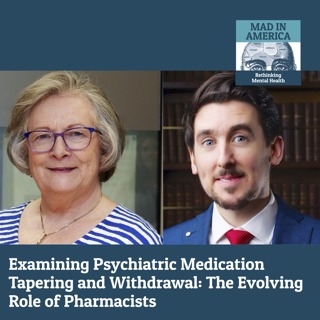
Examining Psychiatric Medication Tapering and Withdrawal: The Evolving Role of Pharmacists — A Conversation with Agnes Higgins and Cathal Cadogan

Examining Psychiatric Medication Tapering and Withdrawal: The Evolving Role of Pharmacists — A Conversation with Agnes Higgins and Cathal Cadogan

Welcome to the Mad in America podcast, my name is James. Today, we are discussing the experiences of people who have attempted to stop taking psychiatric drugs. These experiences are captured in a sur...

1 Apr 32min
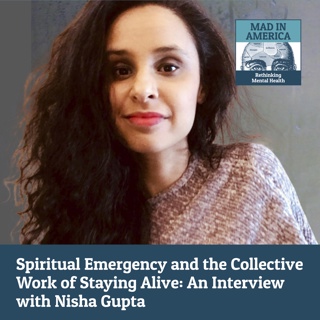
Spiritual Emergency and the Collective Work of Staying Alive: An Interview with Nisha Gupta

Spiritual Emergency and the Collective Work of Staying Alive: An Interview with Nisha Gupta

Nisha Gupta is an existential phenomenologist, a depth psychotherapist, a creativity scholar, and an artist. She's an Associate Professor of Psychology at the University of West Georgia and earned her...

25 Mar 48min

The Political Systems Driving Abuse in Psychiatry: An Interview with Human Rights Lawyer Alicia Ely Yamin

The Political Systems Driving Abuse in Psychiatry: An Interview with Human Rights Lawyer Alicia Ely Yamin

Alicia Ely Yamin is the Director of the Global Health and Rights Project and a lecturer at Harvard Law School. She's also an adjunct senior lecturer on health policy and management at the Harvard T.H....

18 Mar 45min
History, Eugenics, and an Inquiry into Mad Consciousness: A Conversation With Susanne Paola Antonetta

History, Eugenics, and an Inquiry into Mad Consciousness: A Conversation With Susanne Paola Antonetta

Susanne Paola Antonetta is an accomplished writer and poet, the author of numerous books, and in 2001 her book Body Toxic: An Environmental Memoir, won a prestigious American Book Award. Her latest bo...

11 Mar 49min
How Our Blindness to Context Harms Patients and Breaks Practitioners: A Conversation With Kamaldeep Bhui

How Our Blindness to Context Harms Patients and Breaks Practitioners: A Conversation With Kamaldeep Bhui

Kamaldeep Bhui is Professor of Psychiatry at the University of Oxford and Honorary Professor at Queen Mary University of London. He is internationally recognized for his groundbreaking work on cultura...

4 Mar 51min

UberTherapy and the Enshittification of our Relational Lives: Part 2 of our Interview with Elizabeth Cotton

UberTherapy and the Enshittification of our Relational Lives: Part 2 of our Interview with Elizabeth Cotton

Elizabeth Cotton is Associate Professor of Responsible Business at the University of Leicester and the founder of Surviving Work, which carries out socially engaged research on mental health and work....

18 Feb 39min

UberTherapy and the Enshittification of our Relational Lives: Part 1 of our Interview with Elizabeth Cotton

UberTherapy and the Enshittification of our Relational Lives: Part 1 of our Interview with Elizabeth Cotton

Elizabeth Cotton is Associate Professor of Responsible Business at the University of Leicester and the founder of Surviving Work, which carries out socially engaged research on mental health and work....

11 Feb 46min

Populært innen Helse

fastlegen
lydartikler-fra-aftenposten
rss-gukild-johaug
hvordan-har-du-det-mann
psykodrama
leger-om-livet
rss-garne-damer
relasjonspodden-med-dora-thorhallsdottir-kjersti-idem
foreldreradet
morten-ramm-lar-kakla-ga-til-du-sovner
hjernesterk
rss-lopedrommen
klimaks
g-punktet
hormonelle-frida
bak-fasaden-en-reise-i-livet-med-sykepleier-ine
hverdagspsyken
sinnsyn
rss-kull
helsetipspodden