John Read and Irving Kirsch – Electroconvulsive Therapy (ECT) Does the Evidence From Clinical Trials Justify its Continued Use?

John Read and Irving Kirsch – Electroconvulsive Therapy (ECT) Does the Evidence From Clinical Trials Justify its Continued Use?

This week on MIA Radio we turn our attention to electroconvulsive therapy (known as electroshock in the US). It's fair to say that ECT remains a controversial subject with proponents and detractors regularly disagreeing on its safety and efficacy. The number of psychiatrists willing to administer ECT, particularly in the UK, is in decline but we are still using it to administer electric shocks to the brains of an estimated 2,000 people each year.

In this interview, we discuss a recent paper from the journal Ethical Human Psychology and Psychiatry. The title is 'Electroconvulsive Therapy for Depression: A Review of the Quality of ECT versus Sham ECT Trials and Meta-Analyses' and it is written by John Read, Irving Kirsch and Laura McGrath. On MIA we have previously written about the study and its findings.

We hear from two of the authors, Professor of Psychology John Read from the University of East London and Professor of Psychology Irving Kirsch from Harvard Medical School.

We discuss:
  • That the work aimed to review the quality of meta-analyses and any relevant clinical studies of ECT.
  • How there have only ever been 11 studies that have compared ECT with sham ECT (SECT).
  • Sham ECT is when the anaesthetic is administered but not followed by shocks to the brain.
  • That in addition to reviewing the quality of the studies, the paper went on to consider the effect of placebo in the administration of ECT.
  • That when reviewing the quality of studies, a 24-point scale was used and that the scorers were blinded to each other's ratings.
  • The 24-point scale included 5 basic Cochrane Collaboration criteria and an additional 19 quality indicators, some of which were specific to ECT procedures.
  • The average quality score across all the studies was 12.3 out of a 24 maximum.
  • One of the most important findings was that none of the studies reviewed were double-blind.
  • The reason for this is that the patients can't be blinded to the procedure because the adverse after-effects are very obvious.
  • In reviewing the studies it was sometimes the case that only the treating psychiatrist was rating the effectiveness of the procedure, not the patient.
  • The 5 meta-analyses themselves only contained between 1 and 7 of the eleven available studies.
  • The recommendation from the paper is that the use of ECT should be suspended pending a properly controlled, rigorous clinical trial.
  • That the UK's National Institute for Health and Clinical Excellence (NICE) has decided to review their ECT recommendations in their depression guidelines, considering the review.
  • That the Royal College of Psychiatrists has indicated that they will update their ECT position statement in light of the review.
  • It has come to light recently that NHS Trusts in the UK are sometimes using out of date or incorrect information in their ECT guidance leaflets, an example of this is referring to ECT correcting a 'chemical imbalance in the brain'.
  • How the expectations of the treating doctor can influence the condition of the person undergoing the treatment.
  • That the placebo effect can be large and long-lasting and that the more invasive the procedure, the larger the effect.
  • That one of the characteristics of depression is the feeling of hopelessness and that when you are given a new treatment, it can instil a sense of hope which counters the hopelessness.
  • That the call to prohibit ECT is because the negative effects of ECT are so strong, the fact that the evidence supporting it is so weak (especially in the long-term and beyond the improvement due to placebo) and that there are other means of addressing the difficulties that the person is dealing with.
  • That placebos are, in essence, a type of psychological therapy.
Links and further reading:

Electroconvulsive Therapy for Depression: A Review of the Quality of ECT versus Sham ECT Trials and Meta-Analyses

Richard P. Bentall: ECT is a classic failure of evidence-based medicine

NICE guidance on the use of electroconvulsive therapy

Denne episoden er hentet fra en åpen RSS-feed og er ikke publisert av Podme. Den kan derfor inneholde annonser.

Episoder(308)

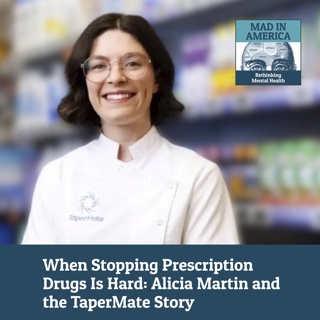
When Stopping Prescription Drugs Isn't Simple: Alicia Martin and the TaperMate Story

When Stopping Prescription Drugs Isn't Simple: Alicia Martin and the TaperMate Story

Alicia Martin is an Australian community pharmacist, a member of the Not Broken Project and founder of TaperMate. Through her work in pharmacy, Alicia saw patients struggling with unusual and severe s...

16 Sep 34min
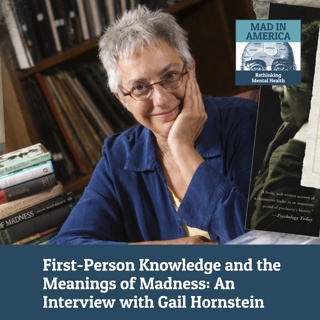
First-Person Knowledge and the Meanings of Madness: An Interview with Gail Hornstein

First-Person Knowledge and the Meanings of Madness: An Interview with Gail Hornstein

Gail Hornstein is Professor Emerita of Psychology at Mount Holyoke College. Across a long and influential career, her work has moved between psychology, psychoanalysis, history, qualitative research, ...

2 Sep 1h 8min
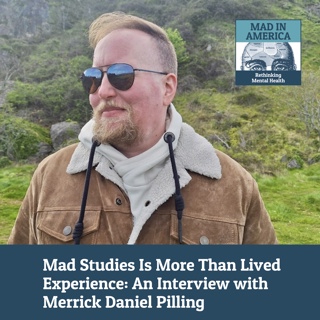
Mad Studies Is More Than Lived Experience: An Interview with Merrick Daniel Pilling

Mad Studies Is More Than Lived Experience: An Interview with Merrick Daniel Pilling

Merrick Daniel Pilling is an Associate Professor and Interim Co-Director of the School of Disability Studies at Toronto Metropolitan University. He is the author of Queer and Trans Madness: Struggles ...

19 Aug 49min

The West Doesn't Have All the Answers: An Interview with Dinesh Bhugra

The West Doesn't Have All the Answers: An Interview with Dinesh Bhugra

Dinesh Bhugra is a leading voice in social and cultural psychiatry. He is Emeritus Professor of Mental Health and Cultural Diversity at King's College London and has served as president of the Royal ...

12 Aug 36min
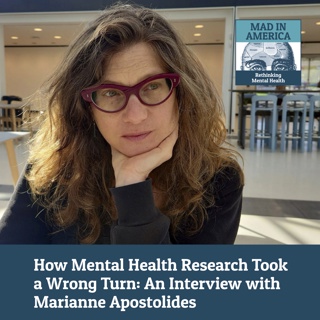
Go/No Go - How Mental Health Research Took a Wrong Turn: An Interview with Marianne Apostolides

Go/No Go - How Mental Health Research Took a Wrong Turn: An Interview with Marianne Apostolides

Marianne Apostolides is the award-winning author of eight books, four of which have been translated and published internationally. She is a two-time recipient of the Chalmers Arts Fellowship and winne...

29 Jul 48min
Unlearn Your Pain: Harnessing the Power of Neuroplasticity – A Conversation With Howard Schubiner

Unlearn Your Pain: Harnessing the Power of Neuroplasticity – A Conversation With Howard Schubiner

Welcome to the Mad in America podcast. My name is Brooke Siem, and I am the author of the award-winning memoir on antidepressant withdrawal, May Cause Side Effects. Today, I'm excited to have Dr. Howa...

15 Jul 41min
The Empire of Madness: Why Psychiatry Must Rethink Human Suffering - An Interview with Khameer Kidia

The Empire of Madness: Why Psychiatry Must Rethink Human Suffering - An Interview with Khameer Kidia

Khameer Kidia is a physician and an anthropologist, works at Harvard Medical School and the University of Zimbabwe, and spends his life between Washington DC and Harare. Kidia has many accolades to hi...

8 Jul 48min
A Mother's Journey Through Psychiatric Drug Harm and Healing

A Mother's Journey Through Psychiatric Drug Harm and Healing

Chelsea McVeigh began her journey with psychiatric medications at 16, never imagining where it would lead. At 31, during a new pregnancy, she suffered a severe adverse reaction that turned her world u...

1 Jul 24min

Populært innen Helse

fastlegen
rss-gukild-johaug
psykodrama
hvordan-har-du-det-mann
relasjonspodden-med-dora-thorhallsdottir-kjersti-idem
leger-om-livet
rss-skravla-gar
foreldreradet
g-punktet
morten-ramm-lar-kakla-ga-til-du-sovner
rss-loping-for-nybegynnere
klimaks
bak-fasaden-en-reise-i-livet-med-sykepleier-ine
rss-dagen-for-dagen
treningsprat
rss-lopedrommen
hjernesterk
kjed-deg-i-sovn-verdens-kjedeligste-podcast
rss-kunsten-a-leve
helsetipspodden