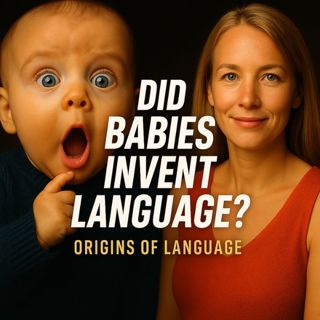

E164: The Real Reason You Can Speak: Explained by Evolutionary Biologist - Dr. Madeleine Beekman
El Podcast29 Okt 2025

E164: The Real Reason You Can Speak: Explained by Evolutionary Biologist - Dr. Madeleine Beekman

How human babies, big brains, and social life likely forced Homo sapiens to invent precise speech ~150–200k years ago—and what that means for learning, tech, and today’s kids. Guest Bio: Madeleine Beekman is a professor emerita of evolutionary biology and behavioral ecology at the University of Sydney and author of Origin of Language: How We Learned to Speak and Why. She studies social insects, collective decisions, and the evolution of communication. Topics Discussed: Why soft tissues don’t fossilize; language origins rely on circumstantial evidence Three clocks for timing (~150–200k years): anatomy; trade/complex tech/art; phoneme “bottleneck” Why Homo sapiens (not Neanderthals) likely had full speech Language as a “virus” tuned to children; pidgin → creole via kids Second-language learning: immersion over translation Bees/ants show precision scales with ecological stakes Evolutionary chain: bipedalism → narrow pelvis + big brains → helpless infants → precise speech Ongoing human evolution (archaic DNA, altitude, Inuit lipid adaptations) Flynn effect reversal, screens, AI reliance, anthropomorphism risks Reading, early interaction, and the Regent honeyeater “lost song” lesson Universities, online classes, and “degree over learning” Main Points: Multiple evidence lines converge on speech emerging with anatomically modern humans ~150–200k years ago. Anatomical and epigenetic clues suggest only Homo sapiens achieved full vocal speech. Extremely dependent infants created strong selection for precise, teachable communication. Children’s brains shape languages; kids regularize grammar. Communication precision rises when mistakes are costly (bee-dance analogy). Humans continue to evolve; genomes show selected archaic introgression and local adaptations. Tech-driven habits may erode cognition and language skill; reading matters. AI is a tool that imitates human output; humanizing it can mislead and harm, especially for teens. Start early: talk, read, and interact face-to-face from birth. Top Quotes: “Only Homo sapiens was ever able to speak.” “Language will go extinct if it can’t be transmitted from brain to brain—the best host is a child.” “The precision of communication is shaped by how important it is to be precise.” 🎙 The Pod is hosted by Jesse Wright 💬 For guest suggestions, questions, or media inquiries, reach out at https://elpodcast.media/ 📬 Never miss an episode – subscribe and follow wherever you get your podcasts. ⭐️ If you enjoyed this episode, please rate and review the show. It helps others find us. Thanks for listening!

Denne episoden er hentet fra en åpen RSS-feed og er ikke publisert av Podme. Den kan derfor inneholde annonser.

Episoder(225)

The AI Bubble Is Already Bursting — Dr. Jeffrey Funk

The AI Bubble Is Already Bursting — Dr. Jeffrey Funk

Dr. Jeff Funk is a former professor at the National University of Singapore and an independent technology consultant specializing in the economics of new technologies. Funk believes the AI bubble is ...

5 Nov 1h 34min

The System Is Rigged Against Men

The System Is Rigged Against Men

George from TheTinMen is a content creator, pro-men’s advocate, and researcher. In this conversation, he explores the challenges facing men and boys—from child custody and paternity fraud to education...

3 Nov 1h 24min
Status Over Intelligence

Status Over Intelligence

Has the college degree become less about knowledge and more about social status? And are America's elite universities still rewarding intelligence and ability, or simply reproducing an increasingly cr...

27 Okt 1h 14min
Are We Now Discriminating Against Men?

Are We Now Discriminating Against Men?

Evolutionary psychologist and psychology professor Steve Stewart-Williams joins Jesse to discuss sex differences, discrimination against men, and the double standards shaping how we treat men and wome...

20 Okt 1h 14min

College Professor: We’ve Oversold the College Dream

College Professor: We’ve Oversold the College Dream

Is college still worth it? Political science professor Kevin Wallsten examines the gap between what students pay, what universities promise, and what a degree actually delivers. From student debt and...

13 Okt 1h 25min
What Happened to Sociology?

What Happened to Sociology?

Is sociology becoming too political to function as a serious academic discipline? Professor Ashley T. Rubin discusses her new report for the Vanderbilt–WashU Commission on Scholarly Standards, which e...

6 Okt 1h 3min

Canada’s Breaking Point Has Arrived (E220) - Darrell Bricker

Canada’s Breaking Point Has Arrived (E220) - Darrell Bricker

Darrell Bricker explains why Canada is approaching a potential breaking point as soaring housing costs, immigration pressures, generational divides, regional tensions, demographic decline, and a chang...

29 Sep 58min

Forget Biohacking: What Actually Helps You Live Longer  (E219)

Forget Biohacking: What Actually Helps You Live Longer (E219)

Bill Gifford, co-author of Outlive, explores why Americans are living less healthy lives despite spending more on healthcare, the surprising benefits of heat, and why relationships, purpose, and every...

22 Sep 1h 16min

Populært innen Business og økonomi

stopp-verden
lydartikler-fra-aftenposten
dine-penger-pengeradet
e24-podden
rss-borsmorgen-okonominyhetene
rss-penger-polser-og-politikk
rss-skravla-gar
rss-pa-konto
utbytte
livet-pa-veien-med-jan-erik-larssen
lederpodden
pengepodden-2
finansredaksjonen
liberal-halvtime
rss-neste-generasjon-med-emilie-stordalen
stormkast-med-valebrokk-stordalen
tid-er-penger-en-podcast-med-peter-warren
okonomiamatorene
rss-markedspuls-2
morgenkaffen-med-finansavisen