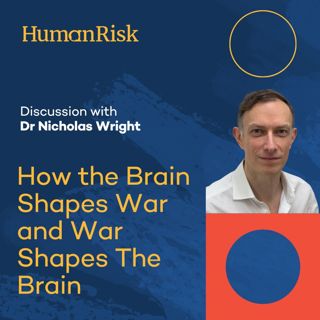

Dr Nicholas Wright on How the Brain Shapes War and War Shapes The Brain

Dr Nicholas Wright on How the Brain Shapes War and War Shapes The Brain

What can war teach us about how the human brain really works? And why is human decision-making a more significant factor than military strength in wars?

Episode Summary
On this episode, I'm exploring how the human brain truly manifests in conflict—and what that reveals about everyday decision-making. Dr Nicholas Wright, a neurologist-turned-neuroscientist who advises the Pentagon Joint Staff, joins me to discuss his new book Warhead: How the Brain Shapes War and War Shapes the Brain.

In our conversation, Nick explains why fear is functional, how “will to fight” can outweigh superior force, and why democracies remain capable of catastrophic decisions. He also explains how perception operates as a controlled hallucination anchored to reality rather than a simple sensory feed, and why that distinction matters for strategy, leadership, and risk.

Moving from fruit flies to front lines, Nick shows how simple neural chemicals regulate aggression, how the brain’s grid cells create literal maps to navigate danger and opportunity, and how both biological and organisational models can mislead when mistaken for reality. The discussion ranges from 1940 France to Kyiv, from Stalingrad to Gaza, and from deception as a vice to deception as a civic virtue.

Nick makes a compelling case for metacognition — the ability to think about one’s own thinking— as the conductor of the brain’s internal orchestra and argues that wisdom—not merely cleverness — must be deliberately designed into leaders and into the next generation of artificial intelligence.

We end with practical insights: cultivating “better ignorance,” inviting real dissent in the spirit of Churchill, and creating deliberate spaces for reflection like (I'm delighted to report) long train journeys.

Guest Biography
Dr Nicholas Wright, MRCP, PhD, is a neuroscientist researching the intersections of the brain, technology, and security at University College London, Georgetown University, and the Center for Strategic & International Studies in Washington, DC. He also serves as an adviser to the Pentagon Joint Staff. Beyond academia, Wright leads projects connecting neuroscience, artificial intelligence, and strategy, and has advised the Pentagon Joint Staff for more than a decade.

He consults on AI for SAP and edited Artificial Intelligence, China, Russia, and the Global Order (Air University Press, 2019).

His latest book, Warhead: How the Brain Shapes War and War Shapes the Brain, is published by St. Martin’s Press (US) and Pan Macmillan (UK).

AI_Generated Time-stamped Summary
[00:00:00] Introduction
[00:01:00] Nick Wright’s journey from neurologist to defense advisor, applying neuroscience to strategy and AI.
[00:04:29] How evolution shaped the human brain for survival and combat — we’re “built to win or survive a fight.”
[00:05:59] Fear as a vital yet double-edged emotion; anxiety as a side effect of peace.
[00:08:26] Origins of the book Warhead and cultural perceptions of its title.
[00:09:39] Why war remains relevant; critique of overconfidence in peace and Pinker’s “Better Angels” thesis.
[00:12:01] Lessons from France’s WWII defeat — cognition and morale outweigh material strength.
[00:14:41] Ukraine’s resistance as an example of will to fight; psychology as a decisive factor.
[00:15:42] Creativity and emotion as essential tools in decision-making; the brain as an orchestra balancing logic and instinct.
[00:18:10] What fruit flies reveal about aggression and shared neural circuitry with humans.
[00:21:13] Structure of Warhead — using neuroscience to reinterpret history and warfare.
[00:26:37] Mental models and how the brain simulates reality to guide choices.
[00:30:37] Perception vs. reality — the brain generates, not records, the world we see.
[00:35:31] The “uncanny valley” and prediction errors — why imperfect mimicry unsettles us.
[00:36:17] Moral symmetry in conflict — both sides perceive their cause as just.
[00:38:00] Deception and fog of war — manipulating human perception as a timeless weapon.
[00:41:00] WWII story of René Carmille — lying as moral resistance.
[00:43:59] Social media, attention, and the loss of reflection — the modern “disease of abundance.”
[00:45:41] Wisdom versus cleverness — Churchill’s reflective habits and valuing dissent.
[00:48:11] “Better ignorance” and intellectual humility as foundations of wise leadership.
[00:51:26] Cognitive diversity, AI, and the need to embed wisdom—not just intelligence—into machines.
[00:58:28] From WWII to China today — the enduring need for wisdom in navigating global conflict.

Links
Nick's website -
https://www.intelligentbiology.co.uk/

WarHead Nick's book -
https://www.intelligentbiology.co.uk/books

Nick on LinkedIn -
https://www.linkedin.com/in/nicholas-d-wright-bba3a065/

If you liked this episode, you might also like my discussion with Dr Mike Martin - https://www.humanriskpodcast.com/dr-mike-martin-on-war-politics/

Denne episoden er hentet fra en åpen RSS-feed og er ikke publisert av Podme. Den kan derfor inneholde annonser.

Episoder(368)

Professor Anu Bradford on The 'Brussels Effect' & Regulating The Internet

Professor Anu Bradford on The 'Brussels Effect' & Regulating The Internet

On this episode, I speak with Professor Anu Bradford of Columbia Law School about the subject of her new book, The Brussels Effect. This is the idea that the EU wields far more influence on global af...

7 Jul 20201h

Dr Sarah Eaton on Ethics In Academia

Dr Sarah Eaton on Ethics In Academia

On this episode, I speak to Dr Sarah Eaton, an Assistant Professor at the Werklund School of Education at the University of Calgary. She specialises in educational leadership, academic integrity, lan...

3 Jul 202052min

Ben Cohen on the 'Hot Hand': the Mystery & Science of Streaks

Ben Cohen on the 'Hot Hand': the Mystery & Science of Streaks

Have you ever found yourself 'on fire' — not literally (I hope!) — but in terms of being on good form? On this episode, I speak to Ben Cohen, the author of "The Hot Hand: The Mystery and Science of St...

1 Jul 202050min

Gerald Ashley on Uncertainty & how it impacts our decision-making

Gerald Ashley on Uncertainty & how it impacts our decision-making

On this episode, I'm speaking to Gerald Ashley who specialises in Business Risk and Decision Making. His work concentrates on trying to understand decision making, risk-taking and human behaviour, in...

28 Jun 202054min

Dr Amy Bucher on using design to help change behaviour

Dr Amy Bucher on using design to help change behaviour

How can Behavioural Science help with design? On this episode, I speak with Dr Amy Bucher who is the VP of Behavior Change Design at Mad*Pow, a purpose–driven strategic design agency in Boston She's ...

26 Jun 202048min

Professor Charles Spence on Sensory Perception

Professor Charles Spence on Sensory Perception

On this, the 50th episode of the podcast, I'm speaking with Professor Charles Spence who heads the Crossmodal Research Laboratory at Oxford University. He is interested in how people perceive the worl...

18 Jun 20201h 1min

Dr Nick Hobson on Behavioural Science:  what is it? Is it just BS?  Why does it matter?

Dr Nick Hobson on Behavioural Science: what is it? Is it just BS? Why does it matter?

On this episode, I speak with Dr. Nick Hobson of The Behaviorist. Not only does he hold a PhD in Behavioral Science, but he's also the host of a wonderful podcast. In our discussion, we explore (to ...

12 Jun 202057min

Melina Palmer on using Behavioural Science for better business

Melina Palmer on using Behavioural Science for better business

On this episode, I speak with Melina Palmer, host of The Brainy Business podcast.Melina uses Behavioural Science to help everyone from global corporations to entrepreneurs understand the psychology of...

10 Jun 202052min

Populært innen Vitenskap

fastlegen
tingenes-tilstand
jss
rss-zahid-ali-hjelper-deg
rekommandert
sinnsyn
rss-paradigmepodden
liberal-halvtime
vett-og-vitenskap-med-gaute-einevoll
forskningno
rss-overskuddsliv
villmarksliv
kvinnehelsepodden
nordnorsk-historie
grunnstoffene
tidlose-historier
rss-inn-til-kjernen-med-sunniva-rose
nevropodden
dekodet-2
rss-rekommandert