Constraining Gamma-Ray Burst Parameters with the first Ultra-High Energy Neutrino Event KM3-230213A

Constraining Gamma-Ray Burst Parameters with the first Ultra-High Energy Neutrino Event KM3-230213A

This week, we dive into the cosmic puzzle posed by ultra-high-energy (UHE) neutrinos. The conversation centers on the **KM3-230213A event**, detected by the KM3NeT/ARCA detector, which is the **highest-energy neutrino observed to date**, estimated at $220^{+570}_{-110}$ PeV. This detection marks the first observation of a presumed astrophysical neutrino in the UHE regime.


We explore the longstanding candidates for these UHE neutrinos: **Gamma-Ray Bursts (GRBs)**. GRBs are the most energetic transient events observed and are theorized to produce high-energy neutrinos when their powerful blastwaves interact with the surrounding matter and radiation fields.


The study uses the KM3-230213A event, combined with the non-detections from IceCube and Pierre Auger, to constrain the relevant model parameters of long-duration GRBs (lGRBs).


**Key Takeaways:**

  • Researchers investigated two primary models for GRB blastwaves: expanding in a constant density **Interstellar Medium (ISM)** or developing in a **wind-like environment (WIND)** with radially decreasing density.
  • The study derived constraints on **baryon loading** ($f_b$), which is the ratio of energy between protons and electrons.
  • For the **ISM model**, the baryon loading is constrained, for example, to $f_b \le 392$ at 90% confidence level if the interstellar medium particle density is $1 \text{ cm}^{-3}$. For $3 \text{ cm}^{-3}$, $f_b \le 131$.
  • For the **WIND model**, constraints on $f_b$ vary, such as $f_b \le 50$ at 90% confidence for a density parameter $A^* = 0.06$.
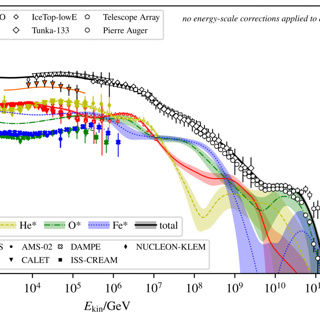
  • The results demonstrate that a large population of lGRBs evolving in blastwaves **can give rise to the diffuse UHE neutrino flux associated with KM3-230213A**. Furthermore, because GRBs are transient sources, they evade the strong constraints placed on steady neutrino sources (like blazars/AGN) by measurements of the diffuse gamma-ray sky.


**Reference to the Article:**

The findings discussed are based on the paper: **"Constraining gamma-ray burst parameters with the first ultra-high energy neutrino event KM3-230213A"** by The KM3NeT Collaboration. (Preprint reference: 2509.14895v1.pdf).


Acknowledements: Podcast prepared with Google/NotebookLM. Illustration credits: KM3NeT Collaboration

Denne episoden er hentet fra en åpen RSS-feed og er ikke publisert av Podme. Den kan derfor inneholde annonser.

Episoder(101)

Record-Breaker: Catching Gamma Rays from the Distant Quasar OP 313

Record-Breaker: Catching Gamma Rays from the Distant Quasar OP 313

In this episode, we dive into a groundbreaking astronomical discovery: the detection of very-high-energy (VHE) gamma rays from the quasar OP 313. Located at a redshift of $z = 0.997$, OP 313 has shatt...

1 Jun 20min

Ripples in Spacetime: Unpacking the GWTC-5.0 Catalog

Ripples in Spacetime: Unpacking the GWTC-5.0 Catalog

In this episode, we dive into the monumental release of the Gravitational-Wave Transient Catalog version 5.0 (GWTC-5.0) and the open data from the second part of the fourth observing run (O4b) by the ...

29 Mai 21min

SN 2017egm : Fermi-LAT's Breakthrough Gamma-Ray Detection

SN 2017egm : Fermi-LAT's Breakthrough Gamma-Ray Detection

In today’s episode, we dive into the mystery of superluminous supernovae (SLSNe)—rare, extreme astronomical events that shine 10 to 100 times brighter than standard core-collapse supernovae. For years...

22 Mai 23min

Supernovae on the RISE: Why Dead Stars Wake Up Decades Later

Supernovae on the RISE: Why Dead Stars Wake Up Decades Later

In this episode, we explore the fascinating phenomenon of core-collapse supernovae that refuse to fade away quietly. Years, or even decades, after their initial explosion, some of these stellar deaths...

20 Mai 17min

The SVOM Satellite: A New Era in Multi-Messenger Astronomy

The SVOM Satellite: A New Era in Multi-Messenger Astronomy

In this episode, we dive into the fascinating world of gamma-ray bursts (GRBs) and high-energy transients through the lens of the SVOM (Space-based Multi-band Variable Object Monitor) mission. Launche...

29 Apr 24min

Chasing the Flash: Hunting Neutron Star Mergers with CTAO

Chasing the Flash: Hunting Neutron Star Mergers with CTAO

In this episode, we dive into the thrilling world of multi-messenger astronomy! Ever since the historic detection of GW170817, scientists have known that binary neutron star (BNS) mergers can produce ...

14 Apr 19min

Tiling the Sky: A New Strategy for Finding Elusive GRBs

Tiling the Sky: A New Strategy for Finding Elusive GRBs

In this episode, we dive into the intense and fast-paced world of **Gamma-ray bursts (GRBs)—the most luminous and rapidly evolving transients in the Universe**. While space-based instruments like the ...

13 Apr 19min

Fast Radio Bursts & Magnetar X-Rays: A Peculiar Discovery

Fast Radio Bursts & Magnetar X-Rays: A Peculiar Discovery

In this episode, we dive into the deep cosmos to explore a recent astronomical breakthrough linking Fast Radio Bursts (FRBs)—enigmatic, millisecond-long cosmic transients—to extreme stellar objects kn...

7 Apr 22min

Populært innen Vitenskap

fastlegen
tingenes-tilstand
jss
rekommandert
liberal-halvtime
sinnsyn
forskningno
tomprat-med-gunnar-tjomlid
villmarksliv
rss-paradigmepodden
fjellsportpodden
kvinnehelsepodden
tidlose-historier
dekodet-2
rss-zahid-ali-hjelper-deg
rss-overskuddsliv
hva-er-greia-med
rss-rekommandert
rss-inn-til-kjernen-med-sunniva-rose
grunnstoffene