NGC1068 and Its Kin: New Evidence for Neutrino Production in Galactic Cores.

NGC1068 and Its Kin: New Evidence for Neutrino Production in Galactic Cores.

Join us as we discuss the latest results from the IceCube Neutrino Observatory, utilizing 13.1 years of data, that further link high-energy neutrinos to powerful cosmic sources.


### Episode Highlights

* **The Extragalactic Neutrino Puzzle:** The IceCube Neutrino Observatory consistently detects a diffuse flux of high-energy cosmic neutrinos, the majority of which are extragalactic in origin. These neutrinos are expected to be produced in hadronic interactions, which also generate gamma rays.

* **Revisiting NGC1068:** The Seyfert galaxy **NGC1068** remains the most significant neutrino source identified in searches across the northern sky. Notably, the observed neutrino flux from NGC1068 exceeds its gamma-ray counterpart by at least two orders of magnitude. Using $13.1$ years of data, NGC1068's emission is characterized by a soft, unbroken power-law spectrum with a spectral index $\gamma = 3.4 \pm 0.2$.

* **Focusing on X-ray Bright AGN:** The X-ray bright nature of NGC1068 motivated a new search focusing on $\mathbf{47}$ X-ray bright Seyfert galaxies, selected from the Swift/BAT spectroscopic survey based on their hard X-ray fluxes (20–50 keV). This hard X-ray band is chosen because it is more robust against obscuration compared to softer X-ray bands.

* **A Collective Signal:** This dedicated search revealed a significant $\mathbf{3.3\sigma}$ excess from an ensemble of $\mathbf{11}$ X-ray bright AGN (excluding NGC 1068). These results significantly strengthen the evidence that $\mathbf{X-ray}$ **bright cores of active galactic nuclei are neutrino emitters**.

* **Diversity in Emission:** The population of contributing AGN includes both Seyfert I and Seyfert II galaxies, suggesting that the level of nuclear obscuration does not significantly impact the likelihood of neutrino emission. However, the individual sources show diverse characteristics: while NGC1068 exhibits a soft spectrum dominated by lower-energy events, the second most significant source, NGC7469, has an excess driven by only two very high-energy events ($E_{\nu} > 100\text{ TeV}$). This suggests that not all X-ray bright AGN share the same neutrino production mechanisms.

* **The Physics Connection:** The neutrino emission is likely produced in the immediate vicinity of the supermassive black hole (SMBH), plausibly within the AGN's $\mathbf{corona}$. In this environment, coronal X-ray photons interact with high-energy protons (photomeson production), generating the 1–10 TeV neutrinos observed by IceCube.


***


### Reference Article

The data and findings discussed are presented in the research paper titled:

* **"Evidence for Neutrino Emission from X-ray Bright Active Galactic Nuclei with IceCube"**.

* *Draft Version Date:* October 16, 2025.


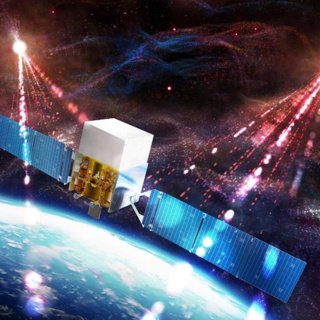
Acknowledements: Podcast prepared with Google/NotebookLM. Illustration credits: IceCube, Georgia Tech

Denne episoden er hentet fra en åpen RSS-feed og er ikke publisert av Podme. Den kan derfor inneholde annonser.

Episoder(101)

Record-Breaker: Catching Gamma Rays from the Distant Quasar OP 313

Record-Breaker: Catching Gamma Rays from the Distant Quasar OP 313

In this episode, we dive into a groundbreaking astronomical discovery: the detection of very-high-energy (VHE) gamma rays from the quasar OP 313. Located at a redshift of $z = 0.997$, OP 313 has shatt...

1 Jun 20min

Ripples in Spacetime: Unpacking the GWTC-5.0 Catalog

Ripples in Spacetime: Unpacking the GWTC-5.0 Catalog

In this episode, we dive into the monumental release of the Gravitational-Wave Transient Catalog version 5.0 (GWTC-5.0) and the open data from the second part of the fourth observing run (O4b) by the ...

29 Mai 21min

SN 2017egm : Fermi-LAT's Breakthrough Gamma-Ray Detection

SN 2017egm : Fermi-LAT's Breakthrough Gamma-Ray Detection

In today’s episode, we dive into the mystery of superluminous supernovae (SLSNe)—rare, extreme astronomical events that shine 10 to 100 times brighter than standard core-collapse supernovae. For years...

22 Mai 23min

Supernovae on the RISE: Why Dead Stars Wake Up Decades Later

Supernovae on the RISE: Why Dead Stars Wake Up Decades Later

In this episode, we explore the fascinating phenomenon of core-collapse supernovae that refuse to fade away quietly. Years, or even decades, after their initial explosion, some of these stellar deaths...

20 Mai 17min

The SVOM Satellite: A New Era in Multi-Messenger Astronomy

The SVOM Satellite: A New Era in Multi-Messenger Astronomy

In this episode, we dive into the fascinating world of gamma-ray bursts (GRBs) and high-energy transients through the lens of the SVOM (Space-based Multi-band Variable Object Monitor) mission. Launche...

29 Apr 24min

Chasing the Flash: Hunting Neutron Star Mergers with CTAO

Chasing the Flash: Hunting Neutron Star Mergers with CTAO

In this episode, we dive into the thrilling world of multi-messenger astronomy! Ever since the historic detection of GW170817, scientists have known that binary neutron star (BNS) mergers can produce ...

14 Apr 19min

Tiling the Sky: A New Strategy for Finding Elusive GRBs

Tiling the Sky: A New Strategy for Finding Elusive GRBs

In this episode, we dive into the intense and fast-paced world of **Gamma-ray bursts (GRBs)—the most luminous and rapidly evolving transients in the Universe**. While space-based instruments like the ...

13 Apr 19min

Fast Radio Bursts & Magnetar X-Rays: A Peculiar Discovery

Fast Radio Bursts & Magnetar X-Rays: A Peculiar Discovery

In this episode, we dive into the deep cosmos to explore a recent astronomical breakthrough linking Fast Radio Bursts (FRBs)—enigmatic, millisecond-long cosmic transients—to extreme stellar objects kn...

7 Apr 22min

Populært innen Vitenskap

fastlegen
tingenes-tilstand
jss
rekommandert
liberal-halvtime
sinnsyn
forskningno
tomprat-med-gunnar-tjomlid
villmarksliv
rss-paradigmepodden
fjellsportpodden
kvinnehelsepodden
tidlose-historier
dekodet-2
rss-zahid-ali-hjelper-deg
rss-overskuddsliv
hva-er-greia-med
rss-rekommandert
rss-inn-til-kjernen-med-sunniva-rose
grunnstoffene