OpenAI: The nonprofit refuses to be killed (with Tyler Whitmer)

OpenAI: The nonprofit refuses to be killed (with Tyler Whitmer)

Last December, the OpenAI business put forward a plan to completely sideline its nonprofit board. But two state attorneys general have now blocked that effort and kept that board very much alive and kicking.

The for-profit’s trouble was that the entire operation was founded on the premise of — and legally pledged to — the purpose of ensuring that “artificial general intelligence benefits all of humanity.” So to get its restructure past regulators, the business entity has had to agree to 20 serious requirements designed to ensure it continues to serve that goal.

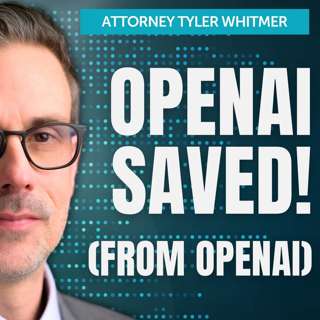
Attorney Tyler Whitmer, as part of his work with Legal Advocates for Safe Science and Technology, has been a vocal critic of OpenAI’s original restructure plan. In today’s conversation, he lays out all the changes and whether they will ultimately matter.

Full transcript, video, and links to learn more: https://80k.info/tw2

After months of public pressure and scrutiny from the attorneys general (AGs) of California and Delaware, the December proposal itself was sidelined — and what replaced it is far more complex and goes a fair way towards protecting the original mission:

  • The nonprofit’s charitable purpose — “ensure that artificial general intelligence benefits all of humanity” — now legally controls all safety and security decisions at the company. The four people appointed to the new Safety and Security Committee can block model releases worth tens of billions.
  • The AGs retain ongoing oversight, meeting quarterly with staff and requiring advance notice of any changes that might undermine their authority.
  • OpenAI’s original charter, including the remarkable “stop and assist” commitment, remains binding.

But significant concessions were made. The nonprofit lost exclusive control of AGI once developed — Microsoft can commercialise it through 2032. And transforming from complete control to this hybrid model represents, as Tyler puts it, “a bad deal compared to what OpenAI should have been.”

The real question now: will the Safety and Security Committee use its powers? It currently has four part-time volunteer members and no permanent staff, yet they’re expected to oversee a company racing to build AGI while managing commercial pressures in the hundreds of billions.

Tyler calls on OpenAI to prove they’re serious about following the agreement:

  • Hire management for the SSC.
  • Add more independent directors with AI safety expertise.
  • Maximise transparency about mission compliance.

"There’s a real opportunity for this to go well. A lot … depends on the boards, so I really hope that they … step into this role … and do a great job. … I will hope for the best and prepare for the worst, and stay vigilant throughout."

Chapters:

  • We’re hiring (00:00:00)
  • Cold open (00:00:40)
  • Tyler Whitmer is back to explain the latest OpenAI developments (00:01:46)
  • The original radical plan (00:02:39)
  • What the AGs forced on the for-profit (00:05:47)
  • Scrappy resistance probably worked (00:37:24)
  • The Safety and Security Committee has teeth — will it use them? (00:41:48)
  • Overall, is this a good deal or a bad deal? (00:52:06)
  • The nonprofit and PBC boards are almost the same. Is that good or bad or what? (01:13:29)
  • Board members’ “independence” (01:19:40)
  • Could the deal still be challenged? (01:25:32)
  • Will the deal satisfy OpenAI investors? (01:31:41)
  • The SSC and philanthropy need serious staff (01:33:13)
  • Outside advocacy on this issue, and the impact of LASST (01:38:09)
  • What to track to tell if it's working out (01:44:28)


This episode was recorded on November 4, 2025.

Video editing: Milo McGuire, Dominic Armstrong, and Simon Monsour
Audio engineering: Milo McGuire, Simon Monsour, and Dominic Armstrong
Music: CORBIT
Coordination, transcriptions, and web: Katy Moore

Episoder(319)

#227 – Helen Toner on the geopolitics of AGI in China and the Middle East

#227 – Helen Toner on the geopolitics of AGI in China and the Middle East

With the US racing to develop AGI and superintelligence ahead of China, you might expect the two countries to be negotiating how they’ll deploy AI, including in the military, without coming to blows. ...

5 Nov 20252h 20min

#226 – Holden Karnofsky on unexploited opportunities to make AI safer — and all his AGI takes

#226 – Holden Karnofsky on unexploited opportunities to make AI safer — and all his AGI takes

For years, working on AI safety usually meant theorising about the ‘alignment problem’ or trying to convince other people to give a damn. If you could find any way to help, the work was frustrating an...

30 Okt 20254h 30min

#225 – Daniel Kokotajlo on what a hyperspeed robot economy might look like

#225 – Daniel Kokotajlo on what a hyperspeed robot economy might look like

When Daniel Kokotajlo talks to security experts at major AI labs, they tell him something chilling: “Of course we’re probably penetrated by the CCP already, and if they really wanted something, they c...

27 Okt 20252h 12min

#224 – There's a cheap and low-tech way to save humanity from any engineered disease | Andrew Snyder-Beattie

#224 – There's a cheap and low-tech way to save humanity from any engineered disease | Andrew Snyder-Beattie

Conventional wisdom is that safeguarding humanity from the worst biological risks — microbes optimised to kill as many as possible — is difficult bordering on impossible, making bioweapons humanity’s ...

2 Okt 20252h 31min

Inside the Biden admin’s AI policy approach | Jake Sullivan, Biden’s NSA | via The Cognitive Revolution

Inside the Biden admin’s AI policy approach | Jake Sullivan, Biden’s NSA | via The Cognitive Revolution

Jake Sullivan was the US National Security Advisor from 2021-2025. He joined our friends on The Cognitive Revolution podcast in August to discuss AI as a critical national security issue. We thought i...

26 Sep 20251h 5min

#223 – Neel Nanda on leading a Google DeepMind team at 26 – and advice if you want to work at an AI company (part 2)

#223 – Neel Nanda on leading a Google DeepMind team at 26 – and advice if you want to work at an AI company (part 2)

At 26, Neel Nanda leads an AI safety team at Google DeepMind, has published dozens of influential papers, and mentored 50 junior researchers — seven of whom now work at major AI companies. His secret?...

15 Sep 20251h 46min

#222 – Can we tell if an AI is loyal by reading its mind? DeepMind's Neel Nanda (part 1)

#222 – Can we tell if an AI is loyal by reading its mind? DeepMind's Neel Nanda (part 1)

We don’t know how AIs think or why they do what they do. Or at least, we don’t know much. That fact is only becoming more troubling as AIs grow more capable and appear on track to wield enormous cultu...

8 Sep 20253h 1min

#221 – Kyle Fish on the most bizarre findings from 5 AI welfare experiments

#221 – Kyle Fish on the most bizarre findings from 5 AI welfare experiments

What happens when you lock two AI systems in a room together and tell them they can discuss anything they want?According to experiments run by Kyle Fish — Anthropic’s first AI welfare researcher — som...

28 Aug 20252h 28min

Populært innen Fakta

fastlegen
dine-penger-pengeradet
relasjonspodden-med-dora-thorhallsdottir-kjersti-idem
treningspodden
rss-strid-de-norske-borgerkrigene
jakt-og-fiskepodden
foreldreradet
tomprat-med-gunnar-tjomlid
rss-sunn-okonomi
merry-quizmas
sinnsyn
smart-forklart
dopet
hverdagspsyken
gravid-uke-for-uke
podme-bio-3
rss-var-forste-kaffe
sovnlos
rss-kunsten-a-leve
rss-kull