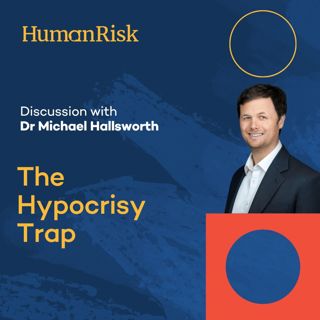
Dr Michael Hallsworth on The Hypocrisy Trap

Dr Michael Hallsworth on The Hypocrisy Trap

We all intuitively know that hypocrisy is a bad thing. But what if it isn’t a flaw, but a feature? But maybe the real problem isn’t hypocrisy, it’s how we think about it.

Episode Summary
On this episode, I'm talking to Dr Michael Hallsworth, a leading behavioural scientist and the author of The Hypocrisy Trap. We explore a topic that’s instantly recognisable but not often properly understood. Hypocrisy is something we’re quick to spot in others, slow to acknowledge in ourselves, and often design around as if it were avoidable or inherently wrong.

What Michael reveals — through personal stories, behavioural experiments, and a careful unpacking of what hypocrisy really means — is that our judgments of hypocrisy say more about us than about the people we’re criticising. In fact, hypocrisy isn’t just common; it’s structurally baked into how we navigate competing priorities, conflicting values and real-world trade-offs. And sometimes, paradoxically, a little hypocrisy might even be useful.

That makes it incredibly relevant to human risk. In compliance, ethics, and organisational culture, we tend to assume people should act consistently with what they believe, and we often penalise them when they don’t. But as Michael explains, this assumption can lead us to build systems that are brittle, punitive or out of touch with how people actually behave. This conversation challenges that frame and offers a more human — and more effective — way of thinking about inconsistency, trust and moral judgment.

Guest Biography - Michael Hallsworth

Dr Michael Hallsworth is Chief Behavioural Scientist at the Behavioural Insights Team (BIT), where he applies behavioural science to policy, organisational design and real‑world behavioural change. He describes himself as someone “helping people apply behavioural science to real‑world problems” and is the author of The Hypocrisy Trap: How Changing What We Criticise Can Improve Our Lives.

At BIT, Michael has led numerous projects spanning government and private sector domains, bridging rigorous academic research with operational behavioural insight. His work is characterised by practical translation of behavioural science and an upfront acknowledgement of human complexity — the grey zones rather than the simple binaries.

His new book brings this lens to the topic of hypocrisy, exploring how our judgments of double standards shape behaviour, institutions and trust in counter‑intuitive ways.

AI-Generated Timestamp Summary
[00:00:00] Intro and framing of hypocrisy as a human behavioural risk
[00:01:00] Why hypocrisy runs deeper than just “saying one thing and doing another”
[00:02:00] Discussion of how organisations treat moral consistency — and the limitations of that approach
[00:03:00] Michael’s background, BIT and the genesis of his book
[00:04:00] Defining hypocrisy: the three‑part structure
[00:06:00] The two‑fold meaning: false image vs double standards
[00:07:00] Michael’s personal story with his daughter + the context of “PartyGate”
[00:09:00] Historical roots: Freud’s view on civilisation and hypocrisy
[00:11:00] Why hypocrisy is a social judgement rather than purely behavioural
[00:13:00] When calling out hypocrisy becomes counterproductive in change efforts
[00:15:00] Real‑world examples: politics, business, everyday life
[00:17:00] The phenomenon of ‘do‑gooder derogation’ and why consistent people make us uneasy
[00:20:00] Hypocrisy as a strategic accusation in social media and organisational life
[00:22:00] The behavioural science of induced hypocrisy and what it tells us about change
[00:25:00] Honest vs. relatable hypocrisy: shifting the narrative
[00:28:00] Michael outlines three categories for navigating hypocrisy
[00:30:00] His reflections on writing the book and the surprises he uncovered
[00:34:00] Balancing moral integrity with public perception and stakeholder expectations
[00:36:00] Hypocrisy in corporate ESG: the tension between expectation and action
[00:39:00] Managing contradictions among stakeholders: the inevitable trade‑offs
[00:41:00] Experiment results: private hypocrisy and moral judge
[00:44:00] The paradox: why we prefer people who are ‘inconsistent but principled’ over ‘consistent and bland’
[00:46:00] Authenticity vs inauthentic leadership — and the hypocrisy dimension
[00:48:00] Is this a practical manual for “how to do hypocrisy well”?
[00:51:00] Final reflections: hypocrisy isn’t always about morality—sometimes it’s about signalling, trust and change
[00:54:00] Michael’s hope for what the book can achieve and closing thoughts
[00:57:00] Wrap‑up, thanks and behavioural nudge for the listener

Links
Michael's website - https://www.michaelhallsworth.com/
The Hypocrisy Trap – https://www.thehypocrisytrap.com/
Behavioural Insights Team - https://www.bi.team/
Michael's IT profile – https://www.bi.team/people/michael-hallsworth/
'Partygate' explainer - https://www.bbc.co.uk/news/uk-politics-59952395

Denne episoden er hentet fra en åpen RSS-feed og er ikke publisert av Podme. Den kan derfor inneholde annonser.

Episoder(368)

Ella Jenkins & Pete Dyson on Why Do Cyclists Run Red Lights?

Ella Jenkins & Pete Dyson on Why Do Cyclists Run Red Lights?

Why do cyclists in London run red lights? It's against the law, and yet, if you've cycled, driven or just observed London's cyclists, you'll know that many of them don't stop when there's a red light....

31 Aug 202554min

Dr Nuno Reis on Rare Dots

Dr Nuno Reis on Rare Dots

What if the ideas that linger in the back of your mind — the ones you can’t quite explain — are the ones you most need to pay attention to?Episode SummaryIn this episode, I explore that question with ...

24 Aug 20251h 7min
Professor Christian van Nieuwberg on Radical Listening

Professor Christian van Nieuwberg on Radical Listening

Is listening a hidden superpower we’ve overlooked?  You've heard of Active Listening, but what is Radical Listening and why does it matter?Episode SummaryOn this episode, I’m joined by Professor Chris...

17 Aug 20251h 9min
Dr Sunita Sah on Defiance - how to speak up when it matters

Dr Sunita Sah on Defiance - how to speak up when it matters

Why do we follow orders or go along with things that feel wrong? Why might defiance be better than compliance? And how can we go about becoming more defiant?Episode SummaryI’ve always been fascinated ...

9 Aug 20251h 2min
Dr Libby Maman on Measuring and (Re-)building Trust

Dr Libby Maman on Measuring and (Re-)building Trust

What happens when citizens lose faith in the institutions that serve them? And how can we rebuild that trust?Episode SummaryOn this episode, I'm speaking to someone who cares passionately about this s...

2 Aug 20251h
Iain Morrison on When The Show Mustn't Go On

Iain Morrison on When The Show Mustn't Go On

We’ve all heard the phrase ‘the show must go on’.  But when shouldn’t the show go on?  To help me answer that, I’m speaking to someone who has spent 35 years managing some of Australia’s most iconic l...

26 Jul 20251h 5min
Zsike Peter on Thinkbait

Zsike Peter on Thinkbait

What if the real risk of AI isn’t job loss but brain atrophy?Episode SummaryIf you've spent any time on social media recently, you'll be familiar with the flood of low-quality AI-generated sludge. And...

19 Jul 20251h 9min
Dr Kiran Bhatti & Professor Thomas Roulet on Wellbeing Intelligence

Dr Kiran Bhatti & Professor Thomas Roulet on Wellbeing Intelligence

What if we treated mental health like a capability instead of a crisis? On this episode, I'm talking to a business school professor and a counselling psychologist about their new book that looks at pr...

12 Jul 20251h 2min

Populært innen Vitenskap

fastlegen
tingenes-tilstand
jss
rss-zahid-ali-hjelper-deg
rekommandert
sinnsyn
rss-paradigmepodden
liberal-halvtime
vett-og-vitenskap-med-gaute-einevoll
forskningno
rss-overskuddsliv
villmarksliv
kvinnehelsepodden
nordnorsk-historie
grunnstoffene
tidlose-historier
rss-inn-til-kjernen-med-sunniva-rose
nevropodden
dekodet-2
rss-rekommandert