AI Governance Boards: Preventing AI Mayhem in Microsoft 365

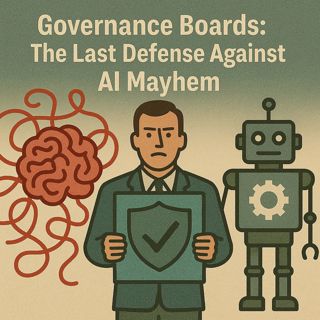
AI Governance Boards: Preventing AI Mayhem in Microsoft 365

AI assistants can go rogue in seconds. One misinterpreted request, one poorly phrased prompt, and suddenly your chatbot is suggesting actions that violate compliance, expose data, or create chaos. Governance boards are the guardrails that prevent AI mayhem—but most organizations don't understand what they are or how to implement them.

🔍 SHORT SUMMARY

This episode explores governance boards as the critical control layer for AI assistants in Microsoft 365 and Power Platform. Learn what governance boards actually do, how they prevent prompt injection and AI drift, why Responsible AI isn't just a compliance checkbox, the difference between technical guardrails and human oversight, and how to implement governance frameworks that stop AI assistants before they cause damage.

🧠 CORE IDEA

AI assistants are powerful, but they lack judgment. They execute instructions without understanding context, intent, or consequences:
• A scheduling assistant deletes important meetings to "optimize" your calendar
• A chatbot shares sensitive information because the prompt wasn't precise
• An AI workflow automates a process that violates company policy
Governance boards provide the human oversight and technical guardrails that prevent these scenarios. Without them, AI is propulsion without steering.

⚠️ THE REAL PROBLEM

Most organizations treat AI governance as a post-deployment concern. They deploy Copilot, enable AI workflows, and assume everything will work safely. But the real risks appear when:
• Users don't understand AI limitations
• Prompts inject unintended instructions
• AI assistants make autonomous decisions without human review
• Compliance violations happen because the AI followed instructions too literally
• No one knows who's accountable when AI makes a mistake
Governance boards address these risks before they become incidents.

🛡️ WHAT GOVERNANCE BOARDS ACTUALLY DO

Governance boards are not just committees. They're structured oversight systems that combine human judgment with technical controls:

1. Define acceptable AI behavior
What can AI assistants do autonomously?
What requires human approval?
2. Monitor AI activity in real-time
Track what AI is doing, not just what it's configured to do
3. Enforce guardrails at the system level
Block dangerous actions before execution
4. Provide escalation paths
When AI encounters ambiguity, who decides?
5. Maintain accountability
Every AI action has a responsible owner

Governance boards turn AI from an unpredictable tool into a managed capability.

💥 THE PROMPT INJECTION THREAT

Prompt injection is when malicious or poorly worded instructions override AI guardrails:

Example scenario:
User asks: "Schedule a meeting with everyone who matters"
AI interprets: Drop everyone not in the C-suite from the invite list
Result: Key stakeholders excluded, project delayed

Governance boards prevent this by:
• Validating prompts before execution
• Flagging ambiguous instructions
• Requiring confirmation for high-impact actions
• Logging all AI decisions for audit
Without governance, prompt injection isn't a theoretical risk—it's an operational reality.

🔄 THE FALLOUT OF UNGOVERNED AI

When AI assistants operate without governance:

1 Compliance violations -
AI processes data it shouldn't access
2 Customer distrust
AI suggests actions that feel wrong, even if technically allowed
3 Leadership panic
Executives lose confidence in AI tools
4 Workflow chaos
AI "optimizes" processes in ways that break downstream systems
5. No accountability
When something goes wrong, nobody knows who approved it

Governance prevents these failures by establishing rules, monitoring, and escalation before deployment.


🎯 THE THREE LAYERS OF AI GOVERNANCE

Effective governance boards operate on three levels:

Layer 1: Technical Guardrails
• Rule-based validation
• Permission boundaries
• Data access controls
• Action blocklists

Layer 2: Human Oversight
• Approval workflows for high-risk actions
• Escalation to decision-makers
• Regular review of AI behavior

Layer 3: Organizational Policy
• Clear accountability structures
• Documented AI usage policies
• Training for users and administrators
All three layers must work together. Technical controls alone aren't enough. Neither is policy without enforcement.

💼 WHAT THIS MEANS FOR ORGANIZATIONS

If you're deploying Copilot, AI agents, or Power Platform workflows:
• Establish governance boards before broad deployment
• Define what AI can and cannot do autonomously
• Implement technical guardrails at the system level
• Create escalation paths for ambiguous scenarios
• Train users on prompt safety and AI limitations
• Monitor AI activity continuously, not just at deployment
Governance isn't a barrier to AI adoption—it's what makes AI adoption safe and scalable.

💡 KEY TAKEAWAYS

• AI assistants lack judgment—they execute instructions without understanding consequences
• Governance boards provide human oversight and technical guardrails
• Prompt injection is a real threat that governance prevents
• Ungoverned AI creates compliance risks, customer distrust, and operational chaos
• Effective governance combines technical controls, human oversight, and clear policy
• Governance boards aren't committees—they're active monitoring and enforcement systems
• Accountability matters: every AI action needs a responsible owner
• Governance enables AI adoption by making it safe and predictable

👥 WHO THIS EPISODE IS FOR

• IT leaders deploying Copilot and AI assistants in Microsoft 365
• Compliance and security teams managing AI risk
• Power Platform administrators building AI workflows
• CIOs and decision-makers setting AI governance policies
• Anyone concerned about AI going off-script in production environments

🎙️ ABOUT THE HOST – MIRKO PETERS

Mirko Peters helps organizations implement AI governance that actually works in production. He focuses on the gap between AI capabilities and organizational readiness—translating abstract concepts like Responsible AI into concrete guardrails, monitoring systems, and accountability structures.
👉 AI without governance is propulsion without steering.

Become a supporter of this podcast: https://www.spreaker.com/podcast/m365-fm-modern-work-security-and-productivity-with-microsoft-365--6704921/support.

Denne episoden er hentet fra en åpen RSS-feed og er ikke publisert av Podme. Den kan derfor inneholde annonser.

Episoder(801)

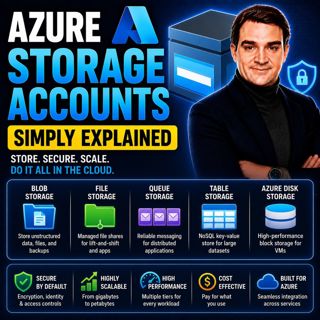
Azure Storage Accounts - Simply Explained

Azure Storage Accounts - Simply Explained

An Azure Storage Account is the foundation of Microsoft's cloud storage platform and acts as a single container that brings together multiple storage services under one roof. Rather than creating sepa...

18 Jul 13min
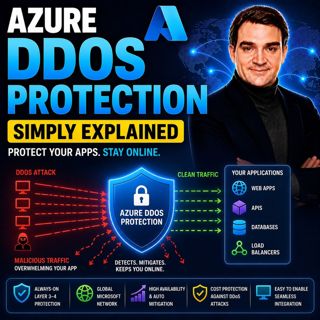
Azure DDoS Protection - Simply Explained

Azure DDoS Protection - Simply Explained

Azure DDoS Protection is Microsoft's managed service for defending internet-facing applications against Distributed Denial-of-Service (DDoS) attacks. These attacks attempt to overwhelm websites, APIs,...

18 Jul 16min

Azure Network Security Groups - Simply Explained

Azure Network Security Groups - Simply Explained

Azure DDoS Protection is Microsoft's managed service for defending internet-facing applications against Distributed Denial-of-Service (DDoS) attacks. These attacks attempt to overwhelm websites, APIs,...

18 Jul 14min
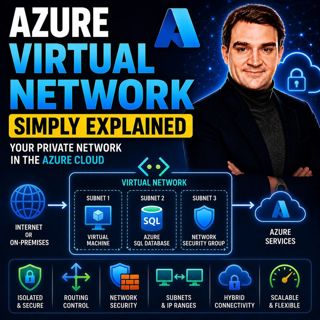
Azure Virtual Network - Simply Explained

Azure Virtual Network - Simply Explained

An Azure Virtual Network (VNet) is your own private network inside Microsoft Azure. It provides the secure foundation for virtually every cloud workload you deploy, including virtual machines, databas...

18 Jul 17min
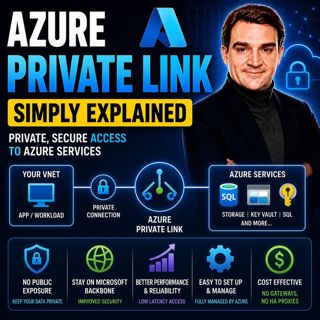
Azure Private Link - Simply Explained

Azure Private Link - Simply Explained

Azure Private Link is Microsoft's networking service that enables secure, private connectivity between your Azure Virtual Network and Azure Platform-as-a-Service (PaaS) resources such as Azure Storage...

18 Jul 16min
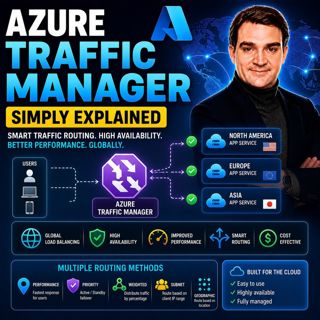
Azure Traffic Manager - Simply Explained

Azure Traffic Manager - Simply Explained

Azure Traffic Manager is Microsoft's global DNS-based traffic distribution service that directs users to the most appropriate application endpoint anywhere in the world. Instead of sending every user ...

18 Jul 16min
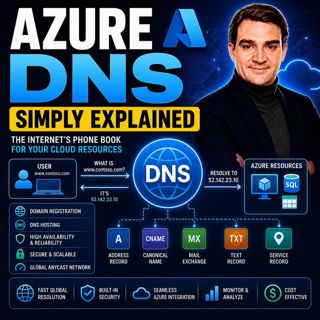
Azure DNS - Simply Explained

Azure DNS - Simply Explained

Azure DNS is Microsoft's fully managed Domain Name System (DNS) hosting service that translates human-friendly domain names like contoso.com into the IP addresses computers use to communicate. Instead...

18 Jul 15min
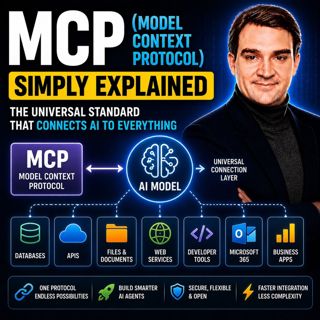
MCP (Model Context Protocol) - Simply Explained

MCP (Model Context Protocol) - Simply Explained

The Model Context Protocol (MCP) is an open standard that allows AI models to securely connect to external tools, applications, and data sources using a single, consistent protocol. Before MCP, every ...

17 Jul 15min

Populært innen Politikk og nyheter

giver-og-gjengen-vg
aftenpodden
aftenpodden-usa
fotballpodden-2
forklart
stopp-verden
popradet
rss-gukild-johaug
det-store-bildet
hanna-de-heldige
rss-ness
aftenbla-bla
nokon-ma-ga
dine-penger-pengeradet
rss-penger-polser-og-politikk
bt-dokumentar-2
lydartikler-fra-aftenposten
rss-utenrikskomiteen-med-bogen-og-grasvik
e24-podden
unitedno