#228 – Eileen Yam on how we're completely out of touch with what the public thinks about AI

#228 – Eileen Yam on how we're completely out of touch with what the public thinks about AI

If you work in AI, you probably think it’s going to boost productivity, create wealth, advance science, and improve your life. If you’re a member of the American public, you probably strongly disagree.

In three major reports released over the last year, the Pew Research Center surveyed over 5,000 US adults and 1,000 AI experts. They found that the general public holds many beliefs about AI that are virtually nonexistent in Silicon Valley, and that the tech industry’s pitch about the likely benefits of their work has thus far failed to convince many people at all. AI is, in fact, a rare topic that mostly unites Americans — regardless of politics, race, age, or gender.

Links to learn more, video, and full transcript: https://80k.info/ey

Today’s guest, Eileen Yam, director of science and society research at Pew, walks us through some of the eye-watering gaps in perception:

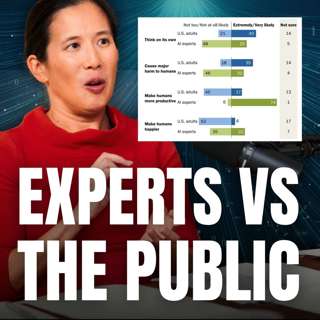
  • Jobs: 73% of AI experts see a positive impact on how people do their jobs. Only 23% of the public agrees.
  • Productivity: 74% of experts say AI is very likely to make humans more productive. Just 17% of the public agrees.
  • Personal benefit: 76% of experts expect AI to benefit them personally. Only 24% of the public expects the same (while 43% expect it to harm them).
  • Happiness: 22% of experts think AI is very likely to make humans happier, which is already surprisingly low — but a mere 6% of the public expects the same.

For the experts building these systems, the vision is one of human empowerment and efficiency. But outside the Silicon Valley bubble, the mood is more one of anxiety — not only about Terminator scenarios, but about AI denying their children “curiosity, problem-solving skills, critical thinking skills and creativity,” while they themselves are replaced and devalued:

  • 53% of Americans say AI will worsen people’s ability to think creatively.
  • 50% believe it will hurt our ability to form meaningful relationships.
  • 38% think it will worsen our ability to solve problems.

Open-ended responses to the surveys reveal a poignant fear: that by offloading cognitive work to algorithms we are changing childhood to a point we no longer know what adults will result. As one teacher quoted in the study noted, we risk raising a generation that relies on AI so much it never “grows its own curiosity, problem-solving skills, critical thinking skills and creativity.”

If the people building the future are this out of sync with the people living in it, the impending “techlash” might be more severe than industry anticipates.

In this episode, Eileen and host Rob Wiblin break down the data on where these groups disagree, where they actually align (nobody trusts the government or companies to regulate this), and why the “digital natives” might actually be the most worried of all.

This episode was recorded on September 25, 2025.

Chapters:

  • Cold open (00:00:00)
  • Who’s Eileen Yam? (00:01:30)
  • Is it premature to care what the public says about AI? (00:02:26)
  • The top few feelings the US public has about AI (00:06:34)
  • The public and AI insiders disagree enormously on some things (00:16:25)
  • Fear #1: Erosion of human abilities and connections (00:20:03)
  • Fear #2: Loss of control of AI (00:28:50)
  • Americans don't want AI in their personal lives (00:33:13)
  • AI at work and job loss (00:40:56)
  • Does the public always feel this way about new things? (00:44:52)
  • The public doesn't think AI is overhyped (00:51:49)
  • The AI industry seems on a collision course with the public (00:58:16)
  • Is the survey methodology good? (01:05:26)
  • Where people are positive about AI: saving time, policing, and science (01:12:51)
  • Biggest gaps between experts and the general public, and where they agree (01:18:44)
  • Demographic groups agree to a surprising degree (01:28:58)
  • Eileen’s favourite bits of the survey and what Pew will ask next (01:37:29)

Video and audio editing: Dominic Armstrong, Milo McGuire, Luke Monsour, and Simon Monsour
Music: CORBIT
Coordination, transcripts, and web: Katy Moore

Episoder(321)

#222 – Can we tell if an AI is loyal by reading its mind? DeepMind's Neel Nanda (part 1)

#222 – Can we tell if an AI is loyal by reading its mind? DeepMind's Neel Nanda (part 1)

We don’t know how AIs think or why they do what they do. Or at least, we don’t know much. That fact is only becoming more troubling as AIs grow more capable and appear on track to wield enormous cultu...

8 Sep 20253h 1min

#221 – Kyle Fish on the most bizarre findings from 5 AI welfare experiments

#221 – Kyle Fish on the most bizarre findings from 5 AI welfare experiments

What happens when you lock two AI systems in a room together and tell them they can discuss anything they want?According to experiments run by Kyle Fish — Anthropic’s first AI welfare researcher — som...

28 Aug 20252h 28min

How not to lose your job to AI (article by Benjamin Todd)

How not to lose your job to AI (article by Benjamin Todd)

About half of people are worried they’ll lose their job to AI. They’re right to be concerned: AI can now complete real-world coding tasks on GitHub, generate photorealistic video, drive a taxi more sa...

31 Jul 202551min

Rebuilding after apocalypse: What 13 experts say about bouncing back

Rebuilding after apocalypse: What 13 experts say about bouncing back

What happens when civilisation faces its greatest tests?This compilation brings together insights from researchers, defence experts, philosophers, and policymakers on humanity’s ability to survive and...

15 Jul 20254h 26min
#220 – Ryan Greenblatt on the 4 most likely ways for AI to take over, and the case for and against AGI in <8 years

#220 – Ryan Greenblatt on the 4 most likely ways for AI to take over, and the case for and against AGI in <8 years

Ryan Greenblatt — lead author on the explosive paper “Alignment faking in large language models” and chief scientist at Redwood Research — thinks there’s a 25% chance that within four years, AI will b...

8 Jul 20252h 50min
#219 – Toby Ord on graphs AI companies would prefer you didn't (fully) understand

#219 – Toby Ord on graphs AI companies would prefer you didn't (fully) understand

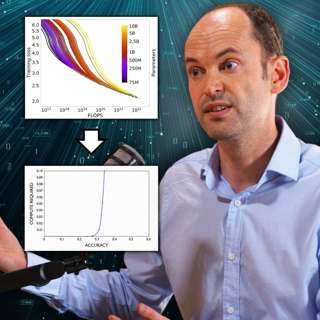
The era of making AI smarter just by making it bigger is ending. But that doesn’t mean progress is slowing down — far from it. AI models continue to get much more powerful, just using very different m...

24 Jun 20252h 48min
#218 – Hugh White on why Trump is abandoning US hegemony – and that’s probably good

#218 – Hugh White on why Trump is abandoning US hegemony – and that’s probably good

For decades, US allies have slept soundly under the protection of America’s overwhelming military might. Donald Trump — with his threats to ditch NATO, seize Greenland, and abandon Taiwan — seems hell...

12 Jun 20252h 48min

#217 – Beth Barnes on the most important graph in AI right now — and the 7-month rule that governs its progress

#217 – Beth Barnes on the most important graph in AI right now — and the 7-month rule that governs its progress

AI models today have a 50% chance of successfully completing a task that would take an expert human one hour. Seven months ago, that number was roughly 30 minutes — and seven months before that, 15 mi...

2 Jun 20253h 47min

Populært innen Fakta

fastlegen
dine-penger-pengeradet
relasjonspodden-med-dora-thorhallsdottir-kjersti-idem
treningspodden
rss-strid-de-norske-borgerkrigene
foreldreradet
jakt-og-fiskepodden
rss-sunn-okonomi
merry-quizmas
hverdagspsyken
rss-mann-i-krise-med-sagen
gravid-uke-for-uke
generasjonspodden
sinnsyn
fryktlos
rss-impressions-2
rss-kunsten-a-leve
hagespiren-podcast
rss-kull
rss-ifengsel-podden