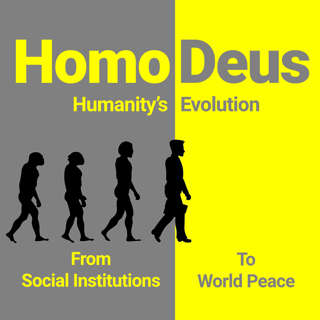
Homo Deus: Humanity’s Evolution from Social Institutions to World Peace

Homo Deus: Humanity’s Evolution from Social Institutions to World Peace

We are living in times of unprecedented technological development. Many of the tools and devices we invented 20 years ago are obsolete today. In his internationally best selling book, "Homo Deus: A Brief History of Tomorrow", Yuval Noah Harari observes that this development is continuing in important fields such as genetic engineering, regenerative medicine and nanotechnology. Harari predicts that developments in these fields will transform us into super-humans. We might become biologically enhanced humans, cyborg beings or possibly fully non-organic beings. At the same time though, Harari notes that this technological development, and the unrestrained economic growth needed to support it, are leading us to potential ecological catastrophe. This raises the question, can we keep on growing the economy indefinitely without facing ecological disaster? If our technological development is on a collision course with ecological disaster, maybe our future isn’t just ‘more technological development’ but something else all together? ...To gain a deeper understanding of who we are as Homo Sapiens, Harari looks back to the Cognitive Revolution, 70,000 years ago. Something changed for us in the Cognitive Revolution such that we went on to dominate all other species. Prior to the Cognitive Revolution, our ancestors had the best technology and highest intelligence on the planet for over a million years. Yet we remained an insignificant ape, with little impact on the ecology around us. So what changed? Harari points not to technology, but to changes in the way we cooperate. During the Cognitive Revolution we developed ‘imagined orders’ that enabled large groups of strangers to cooperate together flexibly. Other animals are not able to do this, and this lead to our dominance. ... I really liked Harari’s book. He is an excellent writer and has many great insights. But at the same time, I think he overlooked some aspect of human evolution that if properly considered, would lead to a different most likely future. In this podcast “Homo Deus: Humanity’s Evolution from Social Institutions to World Peace”, we will review the ideas raised in Harari’s book, but also explore alternate possibilities. In particular, could there be another change in the way humans cooperate coming? If our previous major evolutionary step had to do with how we cooperate, maybe our next evolutionary step will too? If you are interested in thinking about the future this podcast is for you.

Hosted on Acast. See acast.com/privacy for more information.

Denne podkasten er hentet fra en åpen RSS-feed og er ikke publisert av Podme. Den kan derfor inneholde annonser.

Episoder(12)

#11 Practice Makes Perfect

#11 Practice Makes Perfect

In episode #10 we completed our review of Harari’s book, but there is still a little bit more to talk about. Throughout this podcast I have referred to re-training our desires and learning new methods...

15 Feb 202135min

#10 Survival of the Fittest

#10 Survival of the Fittest

Having established that humanism is in decline, Harari addresses the question, ‘what new religions or ideologies might fill the resulting vacuum?’ Two religions that are already here and may step forw...

4 Feb 202136min

#9 The Risk of Alien Invasion

#9 The Risk of Alien Invasion

In chapter 9 of his book, Harari discusses the threats posed by Artificial Intelligence including (1) undermining our understanding of ourselves as individuals, (2) eliminating employment for the majo...

24 Jan 202137min

#8 Transition Points in our Development

#8 Transition Points in our Development

In chapter 8 of his book, Harari describes how advances in science are undermining the ‘facts’ that Humanism depends on. When these advances result in changes to everyday technology, routine activitie...

13 Jan 202134min

#7 Solid Ground for Ethics?

#7 Solid Ground for Ethics?

In chapter 7 of his book, Harari gives his fullest description of the Humanist religion. In modern society, humanity plays the role that God used to play in monotheism. This transition, started in Eur...

1 Jan 202150min

#6 Hope is a Fuel

#6 Hope is a Fuel

In chapter 6 of his book, Harari sums up our current predicament well. Modernity is a deal he tells us - humans give up meaning in exchange for power. This deal is fuelled by economic growth and the h...

16 Des 202031min

#5 The Veil of Misunderstanding

#5 The Veil of Misunderstanding

In chapter 5 of his book, Harari talks about the relationship between science and religion. It seems that people have already said a million times everything there is to say about this question. Yet i...

9 Des 202029min

#4 Losing your Religion is Difficult

#4 Losing your Religion is Difficult

In chapter 4 of his book, Harari explains how ancient Sumerian gods are similar to today’s corporations.  This sounds odd at first, but Harari explains how both the Sumerian god Enki and the modern Ap...

2 Des 202033min

Populært innen Vitenskap

fastlegen
tingenes-tilstand
forskningno
vett-og-vitenskap-med-gaute-einevoll
liberal-halvtime
rekommandert
sinnsyn
rss-paradigmepodden
jss
fjellsportpodden
villmarksliv
dekodet-2
hva-er-greia-med
rss-inn-til-kjernen-med-sunniva-rose
tomprat-med-gunnar-tjomlid
rss-rekommandert
kvinnehelsepodden
diagnose
grunnstoffene
nevropodden